Types of Immunoassays: Principles, Techniques and Applications

What Is an Immunoassay?
An immunoassay is a biochemical analytical method used to detect and quantify a target analyte (e.g., a protein, peptide, biomarker or hormone) in a sample through the highly specific interaction between an antigen and an antibody.1
The core principle behind all immunoassays is antigen–antibody specificity. The antibody serves as a selective binding reagent that recognizes the target with high affinity. By coupling this binding event to a measurable signal, immunoassays allow researchers to determine whether a target is present and, in many cases, how much. 1
Because they combine molecular specificity with high analytical sensitivity, immunoassays are widely used across modern analytical science. They facilitate the detection of low-abundance analytes in complex biological samples, which makes them central to drug discovery, clinical diagnostics and translational research for applications such as biomarker quantification, therapeutic monitoring and disease detection.1
Key Takeaways
- Immunoassays detect and quantify targets like proteins, peptides, hormones and biomarkers by utilizing specific antigen-antibody interactions that convert binding into a measurable signal, such as color, fluorescence, luminescence or radioactivity.
- Immunoassays are classified by detection method (e.g., ELISA, fluorescence, chemiluminescence, radioimmunoassay) or assay format (e.g., direct, indirect, sandwich, competitive, immunohistochemistry, multiplex, Western blot).
- Direct, indirect, sandwich and competitive immunoassays each have advantages. Sandwich assays offer high specificity for complex samples, while direct assays emphasize speed and simplicity.
- Selecting the most appropriate immunoassay depends on factors like target abundance, sensitivity needs, sample type, throughput and validation, rather than a single "best' format.
- Immunoassays are vital in drug discovery, research, diagnostics, medicine, food safety and environmental monitoring.
See how Danaher Life Sciences can help
Fundamental Mechanisms of Immunoassay Detection
Antigen-Antibody Binding Mechanism
All immunoassays rely on the selective interaction between an antibody and its corresponding antigen. This molecular recognition occurs when the antibody’s binding region or paratope interacts with a specific structural site on the target molecule, known as an epitope. The strength and precision of this interaction determine the assay’s ability to distinguish the analyte of interest from other components in the sample.2
Two binding properties are particularly important for assay performance: affinity and avidity. Affinity refers to the strength of a single antigen–antibody interaction, while avidity describes the overall binding stability created by multiple simultaneous interactions. Higher affinity and avidity generally improve sensitivity, reduce background interference and increase reproducibility. In addition, the kinetics of complex formation, including association and dissociation rates, can influence incubation time, equilibrium binding and final signal intensity.3
General Immunoassay Workflow Mechanism
Although immunoassay formats vary, most follow a similar workflow. The process typically begins with immobilization of either the capture antibody or antigen onto a solid support such as a microplate well, membrane, bead or sensor surface. This is followed by a blocking step, in which non-specific binding sites are saturated to minimize background noise during detection. The sample is then introduced, allowing the target analyte to bind to the immobilized reagent. After incubation, the washing steps remove unbound sample components and excess reagents. A labeled detection molecule is subsequently added to generate a measurable response, which may be optical, luminescent, radioactive or electrical, depending on assay design. The intensity of this signal is captured by an appropriate detection instrument and correlated with analyte concentration for quantitative or qualitative analysis.2
Signal Amplification Mechanisms
To detect low-abundance analytes, immunoassays convert the antibody–antigen binding event into an amplified analytical signal. In enzyme-linked assays such as ELISAv, enzyme conjugates catalyze the conversion of a substrate into a colored, fluorescent or luminescent product. Fluorescent immunoassays rely on fluorophore excitation and emission, while chemiluminescent systems generate light through a chemical reaction, offering improved sensitivity over standard colorimetric detection.1
Other assay formats use alternative amplification strategies. Radio-immunoassays detect radiation emitted by isotope-labeled reagents and electrochemical immunoassays translate binding interactions into changes in current or voltage at a sensor interface. In many workflows, secondary antibodies further enhance the signal by introducing multiple labeled molecules per primary binding event, increasing detectability without compromising target specificity.1
Types of Immunoassay Techniques Based on Detection Method
Enzyme-linked Immunosorbent Assay (ELISA)
Enzyme-linked immunoassays, commonly referred to as ELISAs, use an enzyme-conjugated antibody or antigen to generate a measurable signal following target binding. After the antigen–antibody complex forms, a substrate is introduced and the enzyme converts it into a detectable product, typically producing a colorimetric, fluorescent or chemiluminescent readout. The signal intensity is proportional to the amount of analyte present in the sample.1
Because ELISAs combine high specificity, relative simplicity and strong quantitative capability, they remain among the most widely used immunoassay formats in research and diagnostic laboratories. They are commonly applied in biomarker quantification, cytokine analysis, antibody titer measurement and therapeutic protein detection.4
Featured Product
SimpleStep ELISA® Custom ELISA Kit(AB270552)
Chosen because it is a single-wash, rapid sandwich ELISA format for quantifying a specific target protein in biological samples, tying directly to this page's subject of immunoassay types.
Goat Anti-Rabbit IgG H&L (HRP)(AB6721)
Chosen as a complementary second option because it is an HRP-conjugated secondary antibody used to detect rabbit primary antibodies in ELISA, WB and IHC workflows, also directly relevant to immunoassay types.
Fluorescence-Based Immunoassays
Fluorescence-based immunoassays use fluorophore-labeled antibodies or detection probes to identify antigen–antibody binding events. When excited by light at a specific wavelength, the fluorescent label emits light at another wavelength that optical detectors can measure. This approach provides highly sensitive detection with a broad dynamic range.1
One of the major advantages of fluorescence-based systems is their compatibility with multiplexing, allowing multiple analytes to be measured simultaneously using spectrally distinct fluorophores. For this reason, these immunoassays are widely used in cellular and molecular biology applications, including protein localization, flow cytometry, bead-based multiplex cytokine profiling and high-content screening. 5,6
A related subset of fluorescence-based immunoassays, including fluorescence resonance energy transfer (FRET) and time-resolved FRET (TR-FRET) formats, measures energy transfer between a donor and acceptor fluorophore that are brought into proximity by target binding. Because these assays often use a ratio of two fluorescence signals rather than a single intensity measurement, they can reduce the impact of sample-to-sample variability and certain matrix effects. Their homogeneous, no-wash workflow makes them attractive for high-throughput screening applications, although they typically require specialized instrumentation.
Chemiluminescent Immunoassays
Chemiluminescent immunoassays detect antigen–antibody interactions by generating light through a chemical reaction rather than external excitation. In these systems, an enzyme or chemical label emits photons upon exposure to an appropriate substrate and a luminometer measures the emitted light.1
This format is known for delivering greater analytical sensitivity than conventional colorimetric assays, making it particularly useful for detecting low-abundance analytes and weak biological signals. Chemiluminescent immunoassays are, therefore, frequently used in clinical diagnostics, hormone testing, infectious disease screening and trace biomarker analysis.7,8
Emerging homogeneous bioluminescent immunoassays use engineered luciferase-based detection systems to generate a luminescent signal without the wash steps required by many traditional immunoassays. By simplifying workflows and reducing hands-on assay time, these formats are particularly attractive for high-throughput screening and pharmaceutical research applications.
Radioimmunoassay (RIA)
Radioimmunoassay (RIA) is one of the earliest and most sensitive immunoassay techniques, using radioisotope-labeled antigens or antibodies to quantify target molecules via competitive binding. Following antigen–antibody complex formation, emitted radiation is measured with specialized detectors and the radioactive signal is used to determine the analyte concentration.1
RIA is particularly effective for measuring very small quantities of biologically active substances, including hormones, drugs and serum proteins. Although its use has declined with the rise of non-radioactive high-sensitivity alternatives, RIA remains historically important as a foundational immunoassay technology and is still employed in select specialized laboratories.9
Types of Immunoassays Based on Assay Format
While some immunoassays are categorized by the type of detection signal they generate, they can also be classified according to assay design, specifically, how antibodies and antigens are arranged during target capture and signal development. These structural differences influence assay sensitivity, specificity, throughput and suitability for different sample types.
Direct Immunoassays
Direct immunoassays use a single labeled primary antibody that binds directly to the target antigen. Because the detection label is attached to the primary antibody, the workflow requires fewer incubation and washing steps, allowing for relatively rapid assay completion. This simplified format is useful when speed and procedural efficiency are priorities. However, because only one labeled antibody participates in signal generation, direct immunoassays typically offer lower signal amplification and reduced sensitivity compared with multi-antibody systems.1
Indirect Immunoassays
Indirect immunoassays use an unlabeled primary antibody to bind the target antigen, followed by a labeled secondary antibody that recognizes the primary antibody. This two-step detection strategy introduces multiple labeled secondary antibodies per primary binding event, producing stronger signal amplification. As a result, indirect immunoassays generally provide improved sensitivity and greater flexibility in detection than direct formats. They are widely used in applications where low target abundance or signal enhancement is important.1
Sandwich Immunoassays
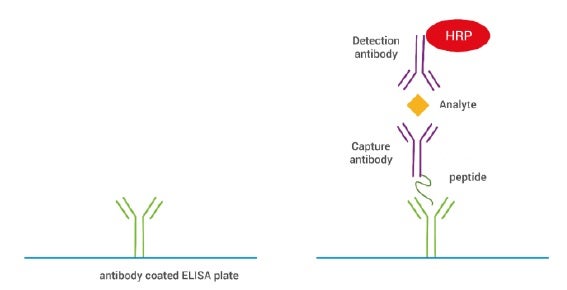
Sandwich immunoassays use two antibodies that bind to distinct epitopes on the same target antigen. A capture antibody first immobilizes the analyte, after which a second detection antibody binds to another accessible region of the molecule, effectively forming an antibody–antigen–antibody “sandwich.” This dual-recognition mechanism provides high specificity by reducing non-specific detection and improving discrimination in complex biological samples. Sandwich assays are among the most commonly used quantitative formats for biomarker analysis, cytokine measurement and therapeutic protein detection. 10
Competitive Immunoassays
Competitive immunoassays are built around competitive binding rather than a sandwich complex. A labeled reference antigen (or antibody) competes with the unlabeled target analyte in the sample for a limited number of antibody binding sites. As the concentration of the target analyte increases, less labeled reference material can bind, causing the measured signal to decrease. This inverse relationship distinguishes competitive assays from sandwich and other non-competitive formats. Competitive immunoassays are particularly useful for small molecules and other single-epitope analytes that cannot be readily detected with a sandwich configuration, including hormones, drugs and other low-molecular-weight analytes.
Immunohistochemistry assay (IHC)
Immunohistochemistry (IHC) is an immunoassay format designed to detect target antigens within preserved tissue sections. Antibodies bind to proteins in situ and enzyme-based or fluorescent labels generate a visual signal that can be examined under a microscope. Unlike bulk-sample immunoassays, which provide only concentration values, IHC preserves tissue architecture and enables spatial visualization of protein distribution, localization and relative abundance. This makes it particularly valuable in pathology, oncology and translational tissue biomarker studies.11
Multiplex Immunoassays
Multiplex immunoassays measure multiple analytes simultaneously in a single sample. Using bead arrays, microarrays or multi-spot detection platforms, these assays assign distinct capture regions or labels to different targets, enabling parallel detection in a single workflow. This approach reduces sample consumption, increases throughput and generates data-rich biological profiles in significantly less time than running individual single-plex assays. Multiplex immunoassays are widely used in systems biology, immune monitoring, cytokine profiling and large-scale biomarker discovery.
Western Blotting
Western blotting combines protein separation with antibody-based detection. In this format, proteins are first separated by molecular weight using gel electrophoresis, transferred to a membrane and then probed with target-specific antibodies for visualization. Because target detection occurs after protein separation by electrophoresis, Western blotting provides an additional level of analyte confirmation beyond standard immunoassays. It is commonly used to verify protein identity, assess relative expression levels and validate findings generated by other immunoassay methods.12
Immunoassay Types at a Glance
How to Choose the Right Immunoassay for Your Research
Selecting an appropriate immunoassay depends on aligning a study's analytical requirements with the strengths of a given assay format. The most suitable choice is typically determined by a combination of biological, technical and operational factors rather than a single performance metric.2
Key considerations include the nature of the target analyte, such as its abundance, molecular size and structural complexity. Required sensitivity and dynamic range are also critical, particularly when working with low-abundance biomarkers or samples with wide concentration variability. In addition, sample type (e.g., serum, plasma, tissue lysates or cell culture supernatants), along with desired throughput, often influences whether a simpler or more complex assay format is most appropriate.2
Beyond performance characteristics, assay validation and reproducibility are essential for ensuring reliable results. Factors such as specificity, precision, linearity and inter-assay variability must be carefully evaluated, particularly in studies intended for comparative or longitudinal analysis.2
Finally, alignment with established research and regulatory standards is important for assay selection, especially in clinical or translational contexts. Well-validated immunoassays that adhere to recognized quality frameworks help ensure data consistency, comparability across studies and confidence in downstream interpretation.2
Key assay-selection considerations:
- Target analyte: abundance, molecular size and structural complexity
- Sensitivity and dynamic range: especially important for low-abundance biomarkers
- Sample type and throughput: sample matrix, sample volume and number of samples per run
- Validation and reproducibility: specificity, precision, linearity and inter-assay variability
- Regulatory alignment: compliance with recognized quality frameworks for clinical or translational applications
Role of Immunoassays in Research Applications
Immunoassays are widely used in biomedical research and development because they can translate specific molecular interactions into quantitative, reproducible data. Their versatility supports applications ranging from early discovery to clinical decision-making.
Drug Discovery & Target Validation
In drug discovery and target validation, immunoassays are used to confirm target engagement, quantify changes in protein expression and measure pharmacodynamic biomarkers. They also support screening workflows by enabling the rapid assessment of biological activity in response to candidate compounds. 13,14
Translational & Clinical Research
In translational and clinical research, immunoassays provide a critical link between molecular mechanisms and patient outcomes. They are commonly used for biomarker quantification, disease monitoring and therapeutic drug measurement in biological samples, helping support study endpoints and comparative analyses across cohorts.15
Precision Medicine & Advanced Diagnostics
In precision medicine and advanced diagnostics, immunoassays are applied to stratify patient populations, monitor disease-associated biomarkers and support treatment selection based on measurable biological signals. These applications rely on the ability of immunoassays to deliver consistent, sensitive measurements across diverse clinical sample types.16
Food Safety & Environmental Monitoring
In addition to biomedical research, immunoassays are widely used in food safety and environmental monitoring to detect contaminants, such as allergens, toxins, pesticides, industrial chemicals and pathogens. Their ability to provide sensitive and relatively rapid detection in complex matrices makes them well-suited for routine screening and surveillance workflows in these settings.17
The workflows used in these applications are increasingly implementing advanced technologies, such as nanoparticle-based labels, to enhance signal detection sensitivity and improve assay performance in complex samples.18,19
Across their many formats and applications, immunoassays remain a cornerstone of modern analytical science by converting highly specific biomolecular interactions into reliable, quantifiable data.
See how Danaher Life Sciences can help
FAQ's
How do immunoassays work?
Immunoassays detect or quantify target molecules by using specific antigen–antibody binding. The binding event is linked to a measurable signal, such as color, fluorescence or light emission, which is proportional to analyte concentration.
What are the main types of immunoassays?
Common types include ELISA, fluorescence-based assays, chemiluminescent immunoassays, radio-immunoassays and multiplex formats, each differing in detection methods and sensitivities.
What is the difference between direct and indirect immunoassays?
Direct immunoassays use a labeled primary antibody for detection, while indirect assays use an unlabeled primary antibody and a labeled secondary antibody, improving signal amplification.
What is the difference between a competitive and a non-competitive immunoassay?
Competitive immunoassays use competition for binding sites, causing the signal to decrease as analyte concentration increases. Non-competitive formats, such as sandwich immunoassays, produce signals that increase with analyte concentration. Competitive assays are particularly useful for small molecules and single-epitope analytes.
Can biomarker immunoassays be used in disease research?
Immunoassays detect and quantify various biomarkers, including proteins, peptides, hormones, cytokines, antibodies and therapeutic proteins. In disease research, these biomarkers are used for discovery, monitoring, immune profiling, therapeutic assessment and translational research.
How do TR-FRET and HTRF-style immunoassays work?
TR-FRET and HTRF-style immunoassays use donor and acceptor fluorophores that generate a fluorescence signal when brought into proximity by target binding. Their ratiometric detection can reduce variability and matrix effects, while their homogeneous, no-wash workflow supports high-throughput screening.
References
- Ahsan H. Monoplex and multiplex immunoassays: approval, advancements, and alternatives. Comp Clin Path 2022;31(2):333-345.
- Vashist SK, Luong JH. Handbook of immunoassay technologies: approaches, performances, and applications: Elsevier, 2025.
- Li Y, Yang HS, Klasse P, Zhao Z. The significance of antigen-antibody-binding avidity in clinical diagnosis. Crit Rev Clin Lab Sci 2025;62(1):9-23.
- Aydin S, Emre E, Ugur K, Aydin MA, Sahin İ, Cinar V, et al. An overview of ELISA: a review and update on best laboratory practices for quantifying peptides and proteins in biological fluids. J Int Med Res 2025;53(2):03000605251315913.
- Radha R, Shahzadi SK, Al-Sayah MH. Fluorescent immunoassays for detection and quantification of cardiac troponin I: A short review. Molecules 2021;26(16):4812.
- Liu C, Chu D, Kalantar‐Zadeh K, George J, Young HA, Liu G. Cytokines: from clinical significance to quantification. Adv Sci 2021;8(15):2004433.
- Khan M, Shah SH, Salman M, Abdullah M, Hayat F, Akbar S. Enzyme-linked immunosorbent assay versus chemiluminescent immunoassay: A general overview. Glob J Med Pharm Biomed Update 2023;18(1).
- Ishii T, Sasaki M, Yamada K, Kato D, Osuka H, Aoki K, et al. Immunochromatography and chemiluminescent enzyme immunoassay for COVID-19 diagnosis. J Infect Chemother 2021;27(6):915-918.
- Kim J-H, Lee S-Y, Lee S-K. Development of novel lab-on-a-chip platform for high-throughput radioimmunoassay. Appl Radiat Isot 2021;168:109526.
- Fei J, Jiang J, Bai Y, Wu W, Zhao X, Yu W, et al. A proof-of-concept sandwich enzyme-linked immunoassay development for small molecules. Anal Chem 2023;95(39):14665-14674.
- Hussaini HM, Seo B, Rich AM. Immunohistochemistry and immunofluorescence. Oral biology: molecular techniques and applications: Springer; 2022:439-450.
- McDade TW, Miller A, Tran TT, Borders AE, Miller G. A highly sensitive multiplex immunoassay for inflammatory cytokines in dried blood spots. Am J Hum Biol 2021;33(6):e23558.
- Wang C, Liu S, Ju H. Electrochemiluminescence nanoemitters for immunoassay of protein biomarkers. Bioelectrochemistry 2023;149:108281.
- Kavetskyy T, Alipour M, Smutok O, Mushynska O, Kiv A, Fink D, et al. Magneto-immunoassay of cancer biomarkers: Recent progress and challenges in biomedical analysis. Microchem J 2021;167:106320.
- Teunissen CE, Kolster R, Triana‐Baltzer G, Janelidze S, Zetterberg H, Kolb HC. Plasma p‐tau immunoassays in clinical research for Alzheimer's disease. Alzheimer's & Dementia 2025;21(1):e14397.
- Huang Z, Zhao X, Hu J, Zhang C, Xie X, Liu R, et al. Single-nanoparticle differential immunoassay for multiplexed gastric cancer biomarker monitoring. Anal Chem 2022;94(37):12899-12906.
- Xiao X, Hu S, Lai X, Peng J, Lai W. Developmental trend of immunoassays for monitoring hazards in food samples: A review. Trends Food Sci Technol 2021;111:68-88.
- Ha Y, Kim I. Recent developments in innovative magnetic nanoparticles-based immunoassays: from improvement of conventional immunoassays to diagnosis of COVID-19. Biochip J 2022;16(4):351-365.
- Pan R, Li G, Liu S, Zhang X, Liu J, Su Z, et al. Emerging nanolabels-based immunoassays: Principle and applications in food safety. TrAC, Trends Anal Chem 2021;145:116462.