Understanding OXPHOS Antibodies: Key Tools in Mitochondrial Research and Diagnostics

Key Takeaways
- OXPHOS antibodies are essential tools for studying mitochondrial oxidative phosphorylation and electron transport chain (ETC) function
- These antibodies target proteins within Complexes I–V to evaluate mitochondrial integrity, ATP production and respiratory chain activity
- OXPHOS antibody cocktails allow simultaneous detection of multiple ETC complexes, improving workflow efficiency and conserving samples
- Researchers use OXPHOS antibodies in techniques such as Western blotting, immunohistochemistry, immunofluorescence, flow cytometry and ELISA
- OXPHOS antibodies support research into mitochondrial dysfunction, cancer metabolism, neurodegenerative disease, aging and inherited mitochondrial disorders
- Proper antibody selection depends on species compatibility, application validation and the required level of specificity and sensitivity
- Changes in OXPHOS protein expression can help identify respiratory chain defects, impaired complex assembly and mitochondrial disease-related abnormalities
What Are OXPHOS Antibodies?
OXPHOS antibodies are specialized antibodies used to detect proteins involved in mitochondrial oxidative phosphorylation (OXPHOS), the process by which cells generate adenosine triphosphate (ATP) via the electron transport chain. These antibodies help researchers and clinicians identify, quantify and analyze mitochondrial proteins involved in cellular energy production.1
Oxidative phosphorylation occurs across the inner mitochondrial membrane and involves five major protein complexes (Complexes I–V). OXPHOS antibodies are commonly designed to target one or more subunits of these complexes, enabling scientists to assess mitochondrial function, protein expression and respiratory chain integrity.1
These antibodies are widely used in applications such as Western blotting, immunofluorescence, immunohistochemistry, ELISA and flow cytometry. In research settings, they support studies of metabolism and aging, as well as mitochondrial dysfunction that underlies neurodegenerative disorders and cancer. In clinical and translational research, OXPHOS antibodies may also help investigate biomarkers for inherited mitochondrial diseases and metabolic disorders.2,3
The Importance of OXPHOS Antibodies in Mitochondrial Research
OXPHOS antibodies play a critical role in mitochondrial research by helping scientists investigate how cells produce energy and how mitochondrial dysfunction contributes to disease. Because oxidative phosphorylation is the primary pathway responsible for ATP generation, abnormalities in OXPHOS proteins can significantly affect cellular metabolism, signaling and survival.4
Researchers commonly use OXPHOS antibodies to study the expression, localization and integrity of proteins within the mitochondrial electron transport chain (ETC). These antibodies support investigations into conditions associated with impaired mitochondrial function, including neurodegenerative diseases, metabolic disorders, cardiovascular disease, cancer and aging-related cellular decline.5-7 They are also valuable for evaluating ATP synthesis efficiency and identifying defects in specific respiratory chain complexes.8
The five major OXPHOS complexes commonly studied include:
Key Complexes:
- Complex I (NADH dehydrogenase): Transfers electrons from NADH to ubiquinone and contributes to proton pumping across the mitochondrial membrane9
- Complex II (Succinate dehydrogenase): Links the tricarboxylic acid (TCA) cycle to the electron transport chain by transferring electrons from succinate to fumarate10
- Complex III (Cytochrome bc1): Facilitates electron transfer from ubiquinol to cytochrome c while supporting proton translocation11
- Complex IV (Cytochrome c oxidase): Transfers electrons from cytochrome c to oxygen, the terminal electron acceptor, forming water12
- Complex V (ATP synthase): Uses the proton gradient generated by the ETC to synthesize ATP13
Together, these complexes maintain cellular energy homeostasis, making OXPHOS antibodies essential tools for mitochondrial biology, bioenergetics and disease research.
Mapping the Electron Transport Chain (ETC): Complex-Specific Targets
OXPHOS antibodies are frequently generated against specific subunits within each electron transport chain (ETC) complex, enabling researchers to assess mitochondrial composition, respiratory chain integrity and complex assembly.
From Complex I to Complex V, key subunit antibodies are summarized below:
Different Forms of OXPHOS Antibodies
OXPHOS antibodies are available in several formats, each designed to support different experimental goals and detection strategies in mitochondrial research. Selecting the appropriate antibody type depends on factors such as specificity, sensitivity, multiplexing needs and assay application.
Monoclonal vs Polyclonal OXPHOS Antibodies
Monoclonal OXPHOS antibodies are produced from a single immune cell clone and recognize one specific epitope on a target protein. Because of their high specificity and batch-to-batch consistency, monoclonal antibodies are widely used in quantitative studies, diagnostic workflows and experiments requiring reproducible results.18
In contrast, polyclonal OXPHOS antibodies are mixtures that recognize multiple epitopes on the same protein. This broader binding profile can improve signal strength and detection sensitivity, especially when target proteins are expressed at low levels or partially denatured. Polyclonal antibodies are often useful for exploratory research and certain immunoprecipitation or immunofluorescence applications.19
Choosing an OXPHOS Antibody Format
See how Danaher Life Sciences can help
Total OXPHOS Antibody Cocktail
A total OXPHOS antibody cocktail combines multiple antibodies targeting representative subunits from Complexes I–V into a single reagent. This approach allows researchers to evaluate multiple mitochondrial respiratory chain complexes simultaneously in a single assay or on a single blot.20
These cocktails are commonly used for:21,22
- Comparing relative expression levels across ETC complexes
- Monitoring mitochondrial content and integrity
- Detecting broad respiratory chain deficiencies
- Streamlining multiplex mitochondrial analyses
Because multiple complexes can be assessed in a single reaction, OXPHOS antibody cocktails help reduce sample usage, assay time and experimental variability.22
The Total OXPHOS Rodent WB Antibody Cocktail combines five monoclonal antibodies in a single vial, targeting subunits from both nuclear and mitochondrial sources, selected for their abundance in Complexes I–V. These include NDUFB8 (Complex I), SDHB (Complex II), UQCRC2, MT-CO1 (Complex III), MT-CO1 and ATP5A (Complex V). Selected for their clear SDS-PAGE resolution and, in some cases, labile nature, these subunits serve as indirect markers of complex assembly or abundance. Supplied as an optimized premixed formulation, the antibodies detect subunits in equal amounts, though individual concentrations vary and should not be seen as indicators of subunit copy number. They are loaded more heavily to produce comparable band development.
OXPHOS Antibody Panel
An OXPHOS antibody panel provides a more comprehensive set of antibodies designed for detailed analysis of mitochondrial respiratory chain function and deficiencies. These panels comprise antibodies against multiple subunits of each ETC complex, along with mitochondrial loading controls or markers of mitochondrial biogenesis.19
Researchers use OXPHOS antibody panels to:19,23
- Investigate inherited mitochondrial disorders
- Characterize metabolic and neurodegenerative diseases
- Study cancer-associated mitochondrial remodeling
- Evaluate drug-induced mitochondrial toxicity
- Analyze mitochondrial dysfunction in translational research
By providing broad coverage of oxidative phosphorylation proteins, OXPHOS antibody panels enable a more detailed and systematic assessment of mitochondrial health and bioenergetic status.
Choosing the Right OXPHOS Antibody for Your Experiment
Selecting the appropriate OXPHOS antibody is essential for generating reliable and reproducible mitochondrial research data. The ideal antibody depends on several factors, including the target species, sample type, detection method and the level of specificity required for the experiment.
Specificity: Matching the Antibody to Your Research Needs
One of the most important considerations when choosing an OXPHOS antibody is target specificity. Researchers should confirm that the antibody has been validated for the species and application being used, such as human, mouse, rat or other model systems.
Sample type also plays a critical role. Certain OXPHOS antibodies perform best with isolated mitochondrial fractions, whereas others are validated for whole-cell lysates, tissue sections or fixed cells. Researchers studying mitochondrial dysfunction may additionally require antibodies capable of detecting native, denatured or post-translationally modified proteins, depending on the assay format.24
Additional factors to evaluate include:19
- Sensitivity and signal intensity
- Cross-reactivity with related proteins
- Compatibility with multiplex detection workflows
- Published validation data and peer-reviewed references
The recombinant multiclonal Total OXPHOS Antibody Cocktail AB317270 was tested with human samples using Western blotting, ICC/IF, flow cytometry and IHC-P, including cell lines, tissue lysates and tissue sections. Validating an antibody in a sample type and method similar to your own, not just species reactivity, builds confidence in successful selection and reduces optimization needs. However, validation in a related sample doesn't guarantee the same performance across all specimens or protocols.
Antibody Formats: Monoclonal, Polyclonal or Cocktail?
Different antibody formats offer distinct advantages depending on the experimental objective and detection method.
Monoclonal antibodies are highly specific and recognize a single epitope on the target protein. They are often preferred for quantitative assays and experiments requiring high reproducibility and low background staining.25
Polyclonal antibodies recognize multiple epitopes on the same protein, thereby improving detection sensitivity and signal amplification. These antibodies may be advantageous when studying low-abundance mitochondrial proteins or partially denatured samples.26
OXPHOS antibody cocktails combine antibodies against multiple ETC complexes into a single reagent, enabling simultaneous analysis of multiple mitochondrial targets in a single experiment. This format is especially useful for comparative respiratory chain profiling. 19
The ultimate choice between monoclonal, polyclonal and cocktail-based approaches should align with the study design, detection platform and desired balance between specificity and sensitivity.
Techniques for Detecting OXPHOS Complexes
Western Blot
Western blotting is one of the most widely used methods for analyzing OXPHOS protein expression. Researchers commonly use OXPHOS antibody cocktails to simultaneously detect representative subunits from Complexes I–V in a single assay, allowing efficient comparison of mitochondrial respiratory chain components.3
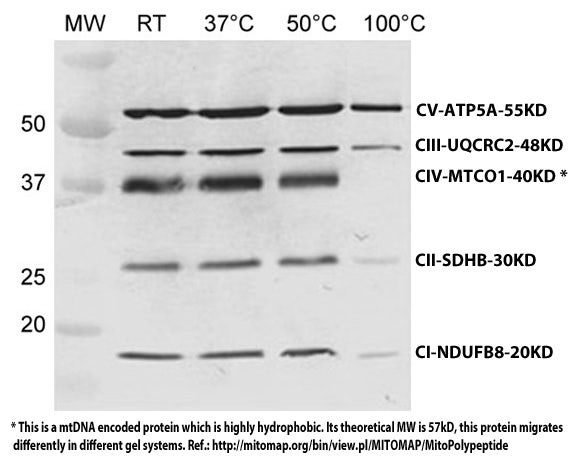
For the Total OXPHOS Rodent WB Antibody Cocktail, read the typical band pattern from highest to lowest apparent molecular mass: ATP5A (~50–55 kDa), UQCRC2 (45–48 kDa), MT-CO1 (broad band at 35–40 kDa, usually migrates anomalously below 57 kDa due to hydrophobicity), SDHB (29–32 kDa) and NDUFB8 (19–22 kDa). MT-CO1's position varies with preparation and conditions. A weak or absent band may indicate reduced target or assembly issues, but technical factors like sample quality, loading, transfer, antibody performance and exposure should be ruled out first. Unexpected bands could be nonspecific due to degradation or altered migration, not necessarily indicating biological issues.
Blue Native PAGE
Denaturing Western blotting measures individual OXPHOS subunits, while Blue Native PAGE uses mild solubilization and non-denaturing electrophoresis to preserve native protein assemblies, revealing changes in complex abundance, migration or assembly. The results depend on detergent choice and extraction conditions; detecting a native complex doesn't confirm enzymatic activity. In two-dimensional Blue Native/SDS-PAGE, complexes are first separated under native conditions and then into subunits by denaturing electrophoresis. Target selection varies; for example, the Total OXPHOS some Blue Native WB Antibody Cocktail uses NDUFA9 and SDHA as markers for Complexes I and II, rather than NDUFB8 and SDHB. Blue Native PAGE can be applied to mitochondrial preparations, isolated mitochondria, platelets or cultured fibroblasts, with supported sample preparation and detection protocols.
Immunohistochemistry (IHC)
Immunohistochemistry uses OXPHOS antibodies to visualize mitochondrial proteins within tissue sections. This technique helps researchers examine mitochondrial distribution, tissue-specific expression patterns and respiratory chain deficiencies in clinical and research samples.5
Immunofluorescence (IF)
Immunofluorescence enables detection of OXPHOS complexes at the single-cell level with fluorescently labeled antibodies. It is particularly useful for studying mitochondrial morphology, localization and cellular heterogeneity associated with mitochondrial dysfunction.19
Flow Cytometry & ELISA
Flow cytometry and ELISA are commonly used for quantitative analysis of OXPHOS protein expression across different sample types. These methods support high-throughput measurement of mitochondrial markers and are valuable for comparative studies, biomarker analysis and drug response assessments.27
OXPHOS Antibody Cocktail vs Individual Antibodies
Researchers can choose between an OXPHOS antibody cocktail and individual antibodies, depending on the goals of the experiment, the level of detail required and the detection workflow.
An OXPHOS antibody cocktail enables simultaneous detection of Complexes I–V in a single experiment, making it ideal for rapid mitochondrial profiling and comparative analysis. From this perspective, they help simplify workflows, reduce processing time and improve consistency across samples. In contrast, individual OXPHOS antibodies provide greater flexibility and are often preferred when researchers need detailed analysis of a specific ETC complex, protein isoform or signaling pathway. Individual antibodies may also offer greater control over optimization for specialized applications.28
Nevertheless, OXPHOS antibody cocktails can significantly reduce experimental costs by minimizing the number of separate antibody incubations and the number of reagents required. They also help conserve valuable biological material by requiring smaller sample volumes compared with running multiple individual blots. As a result, OXPHOS antibody cocktails are especially useful when working with limited mitochondrial samples or clinical specimens. 28
Clinical and Research Applications: From Cancer to Rare Diseases
Metabolic Reprogramming in Cancer Research
OXPHOS antibodies are widely used in cancer research to investigate metabolic reprogramming and mitochondrial dependence in tumor cells. In cancers such as pancreatic ductal adenocarcinoma (PDAC) and ovarian cancer, researchers use OXPHOS antibodies to investigate elevated oxidative phosphorylation activity, mitochondrial adaptation and potential therapeutic targets in high-OXPHOS tumor populations.2
Diagnosing Mitochondrial Myopathy and Disorders:
OXPHOS antibodies also support the investigation and diagnosis of mitochondrial diseases by detecting deficiencies in respiratory chain complexes. They can help identify heteroplasmic mitochondrial DNA (mtDNA) defects and characterize disorders such as MELAS (Mitochondrial Encephalomyopathy, Lactic Acidosis and Stroke-like episodes) and MERRF (Myoclonic Epilepsy with Ragged Red Fibers) by analyzing ETC protein expression patterns.29 Alongside this, in muscle tissue studies, OXPHOS antibodies are used to detect focal respiratory chain deficiencies associated with mitochondrial myopathies, aging skeletal muscle and neurodegenerative conditions such as Parkinson’s disease.7
Biological Context and Functional Pathways of OXPHOS Antibodies
Mitochondrial Dysfunction
OXPHOS antibodies are important tools for studying mitochondrial dysfunction and its effects on cellular health. Researchers use these antibodies to investigate oxidative stress, mitochondrial quality-control defects and defective mitophagy. Changes in OXPHOS protein expression can also provide insight into cellular stress responses and mitochondrial damage linked to aging and disease.30
Mitochondrial Biogenesis
OXPHOS antibodies are commonly used to evaluate mitochondrial biogenesis by monitoring the expression of respiratory chain proteins during mitochondrial growth and adaptation. Measuring OXPHOS complex levels helps researchers assess changes in mitochondrial content, energy metabolism and overall function during physiological stress, exercise, drug treatment or disease progression.31
Protocols for Success: How to Use OXPHOS Antibodies in the Lab
Sample Preparation and Western Blot (WB) Optimization
Proper sample preparation is essential for accurate detection of OXPHOS proteins. During Western blot workflows, many mitochondrial membrane proteins become susceptible to harsh denaturation conditions. 32
A typical workflow has a critical “no-boil” principle. OXPHOS samples are often prepared without boiling because excessive heat can cause aggregation of mitochondrial membrane proteins, reducing detection quality and band resolution.32
Imaging Techniques: IHC, IF and Flow Cytometry:
OXPHOS antibodies are widely used in imaging-based mitochondrial analysis. In immunohistochemistry (IHC), OXPHOS antibodies help visualize respiratory chain protein expression in tissue samples such as skeletal muscle biopsies. Furthermore, quadruple immunofluorescence staining with OXPHOS antibodies allows researchers to detect mitochondrial deficiencies at the single-cell level and identify heterogeneous respiratory chain defects within tissues.19
Choosing the Right Tool: Total OXPHOS Antibody Cocktail vs. Individual Panels
Advantages of the Total OXPHOS Antibody Cocktail
The right OXPHOS antibody tool depends on the specific application and research questions. That said, OXPHOS cocktails offer several advantages over individual panels. A total OXPHOS antibody cocktail reduces sample and reagent consumption by enabling simultaneous analysis of multiple ETC complexes. This capacity greatly diminishes the required sample volume compared to running separate Western blots for individual antibodies. In addition, OXPHOS antibody cocktails enable the detection of representative subunits from all five mitochondrial complexes in a single Western blot lane, improving workflow efficiency and comparative analysis.33
Nevertheless, the choice between an antibody cocktail vs. individual panels is one of many considerations.
Species and Format Considerations
Certain antibodies are optimized specifically for human samples, while others are designed for mouse or rat tissues. Therefore, researchers should select OXPHOS antibodies validated for the species employed in their experimental model. 19
When selecting the format, the downstream application is the critical factor in deciding between monoclonal and polyclonal OXPHOS antibodies. Monoclonal OXPHOS antibodies are often preferred for diagnostic and quantitative applications because they provide high specificity, consistency and reproducibility across experiments.34
Featured Product
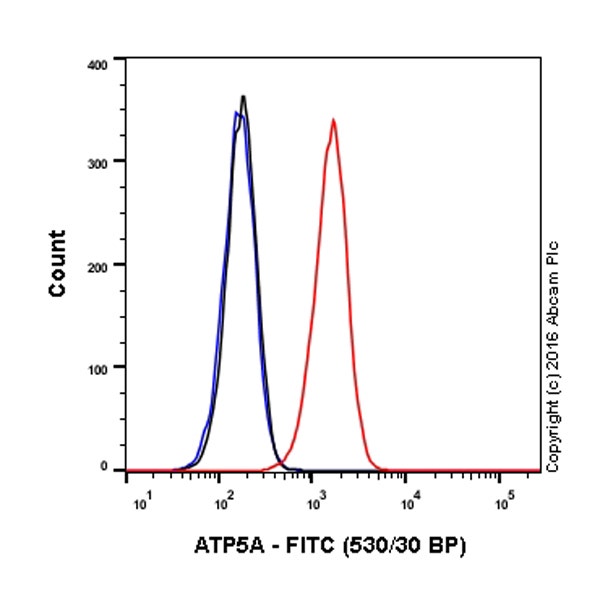
FITC Anti-ATP5A antibody [15H4C4] - Mitochondrial Marker(AB119688)
A FITC-conjugated mouse monoclonal antibody targets ATP5A, the alpha subunit of mitochondrial Complex V. ATP5A indicates mitochondrial Complex V levels and works as an ICC/IF marker without needing a secondary antibody. While ATP5A can serve as a proxy for mitochondrial abundance, its levels vary with metabolic state and with Complex V regulation, so it isn't a universal marker of mitochondrial mass. Direct conjugation prevents cross-reactivity, but autofluorescence, spectral overlap and nonspecific binding should be considered in multicolor flow cytometry panels.
Total OXPHOS Rodent WB Antibody Cocktail(AB110413)
Five mouse monoclonal antibodies in a single vial, validated for Western blot detection against one representative subunit from each OXPHOS complex in rodent mitochondrial preparations; cross-reactivity has also been demonstrated with human, mouse and bovine rat samples. Supplied at 1.5 mg/mL and recommended for a 250-fold dilution to a 6.0 µg/mL working concentration. The cocktail detects representative subunits from Complexes I–V. Resolves all five complexes in a single Western blot lane, enabling a comparative OXPHOS protein full respiratory chain profile from one blot and one sample aliquot. It does not resolve intact complexes or directly measure respiratory-chain activity.
See how Danaher Life Sciences can help
FAQ's
What are OXPHOS antibodies?
OXPHOS antibodies are antibodies used to detect proteins involved in mitochondrial oxidative phosphorylation and the electron transport chain (ETC). They target subunits within Complexes I–V and are widely used in mitochondrial research and disease studies.
Should I boil my samples before running an OXPHOS Western blot?
Generally, no. Excessive heating can aggregate hydrophobic OXPHOS proteins and reduce signal; follow the product-specific sample-preparation protocol.
What is the difference between single OXPHOS antibodies and OXPHOS antibody cocktails?
Single antibodies detect one mitochondrial protein, while OXPHOS antibody cocktails simultaneously detect representative subunits from multiple ETC complexes in one assay.
Why is the MT-CO1 Complex IV band at approximately 35–40 kDa instead of 57 kDa?
MT-CO1 is highly hydrophobic and migrates anomalously during SDS-PAGE, so a broad band at approximately 35–40 kDa is expected.
What does a weak or missing band in an OXPHOS Western blot mean?
It may reflect reduced subunit abundance or impaired complex assembly. Rule out sample preparation, loading, transfer, antibody and exposure issues before assigning biological significance.
How do I choose between a rodent, human or Blue Native OXPHOS antibody cocktail?
Choose a cocktail validated for your species, sample type and application. Use a Blue Native cocktail when assessing native complex abundance or assembly.
References
- Zotta A, O’Neill LA, Yin M. Unlocking potential: the role of the electron transport chain in immunometabolism. Trends Immunol 2024;45(4):259-273.
- Qiu X, Li Y, Zhang Z. Crosstalk between oxidative phosphorylation and immune escape in cancer: a new concept of therapeutic targets selection. Cell Oncol 2023;46(4):847-865.
- Teixeira RB, Pfeiffer M, Zhang P, Shafique E, Rayta B, Karbasiafshar C, et al. Reduction in mitochondrial ROS improves oxidative phosphorylation and provides resilience to coronary endothelium in non-reperfused myocardial infarction. Basic Res Cardiol 2023;118(1):3.
- Koc EC, Koc FC, Kartal F, Tirona M, Koc H. Role of mitochondrial translation in remodeling of energy metabolism in ER/PR (+) breast cancer. Front Oncol 2022;12:897207.
- Tian J, Luo J, Zeng X, Ke C, Wang Y, Liu Z, et al. Targeting oxidative phosphorylation to increase the efficacy of immune-combination therapy in renal cell carcinoma. J Immunother Cancer 2024;12(2):e008226.
- Gordon-Lipkin EM, Banerjee P, Franco JLM, Tarasenko T, Kruk S, Thompson E, et al. Primary oxidative phosphorylation defects lead to perturbations in the human B cell repertoire. Front Immunol 2023;14:1142634.
- Chen C, Mossman E, Malko P, McDonald D, Blain AP, Bone L, et al. Astrocytic changes in mitochondrial oxidative phosphorylation protein levels in Parkinson's disease. Mov Disord 2022;37(2):302-314.
- Wang T, Sun F, Li C, Nan P, Song Y, Wan X, et al. MTA1, a novel ATP synthase complex modulator, enhances colon cancer liver metastasis by driving mitochondrial metabolism reprogramming. Adv Sci 2023;10(25):2300756.
- Jiménez-Gómez B, Ortega-Sáenz P, Gao L, González-Rodríguez P, García-Flores P, Chandel N, et al. Transgenic NADH dehydrogenase restores oxygen regulation of breathing in mitochondrial complex I-deficient mice. Nat Commun 2023;14(1):1172.
- Bénit P, Goncalves J, El Khoury R, Rak M, Favier J, Gimenez-Roqueplo A-P, et al. Succinate dehydrogenase, succinate, and superoxides: a genetic, epigenetic, metabolic, environmental explosive crossroad. Biomedicines 2022;10(8):1788.
- Esser L, Xia D. Mitochondrial cytochrome bc 1 complex as validated drug target: A structural perspective. Trop Med Infect Dis 2024;9(2):39.
- Brischigliaro M, Zeviani M. Cytochrome c oxidase deficiency. Biochimica et Biophysica Acta (BBA)-Bioenergetics 2021;1862(1):148335.
- Lai Y, Zhang Y, Zhou S, Xu J, Du Z, Feng Z, et al. Structure of the human ATP synthase. Mol Cell 2023;83(12):2137-2147. e4.
- Ornstead MJ, Sirohi D, Albertson DJ, Greenberg SE, Mahlow J. Expression Patterns of Succinate Dehydrogenase B: An Immunohistochemical Study of 57 Tumors With Known SDHx Germline Pathogenic Alterations. Int J Surg Pathol 2026:10668969261439732.
- Matassa DS, Criscuolo D, Avolio R, Agliarulo I, Sarnataro D, Pacelli C, et al. Regulation of mitochondrial complex III activity and assembly by TRAP1 in cancer cells. Cancer Cell Int 2022;22(1):402.
- Deng M, Zhou Z, Chen J, Li X, Liu Z, Ye J, et al. Enhanced oxidative phosphorylation driven by TACO1 mitochondrial translocation promotes stemness and cisplatin resistance in bladder cancer. Adv Sci 2025;12(5):2408599.
- Chang Y-W, Tony Yang T, Chen M-C, Liaw Y-g, Yin C-F, Lin-Yan X-Q, et al. Spatial and temporal dynamics of ATP synthase from mitochondria toward the cell surface. Commun Biol 2023;6(1):427.
- Santos D, Santos C, Artuch R, Marco MP, Pascual N. Novel Monoclonal Antibody for Coenzyme Q10: A diagnostic tool for mitochondrial OXPHOS diseases. 2025.
- Sachdeva A, Hart CA, Carey CD, Vincent AE, Greaves LC, Heer R, et al. Automated quantitative high-throughput multiplex immunofluorescence pipeline to evaluate OXPHOS defects in formalin-fixed human prostate tissue. Sci Rep 2022;12(1):6660.
- Ramchandani D, Berisa M, Tavarez DA, Li Z, Miele M, Bai Y, et al. Copper depletion modulates mitochondrial oxidative phosphorylation to impair triple negative breast cancer metastasis. Nat Commun 2021;12(1):7311.
- Yanar S, Kasap M, Kanli A, Akpinar G, Sarihan M. Proteomics analysis of meclofenamic acid‐treated small cell lung carcinoma cells revealed changes in cellular energy metabolism for cancer cell survival. J Biochem Mol Toxicol 2023;37(4):e23289.
- Yoon H, Park SG, Kim H-J, Shin H-R, Kim K-T, Cho Y-D, et al. Nicotinamide enhances osteoblast differentiation through activation of the mitochondrial antioxidant defense system. Exp Mol Med 2023;55(7):1531-1543.
- Evans KW, Yuca E, Scott SS, Zhao M, Paez Arango N, Cruz Pico CX, et al. Oxidative phosphorylation is a metabolic vulnerability in chemotherapy-resistant triple-negative breast cancer. Cancer Res 2021;81(21):5572-5581.
- Sabbir MG, Taylor CG, Zahradka P. CAMKK2 regulates mitochondrial function by controlling succinate dehydrogenase expression, post-translational modification, megacomplex assembly, and activity in a cell-type-specific manner. Cell Commun Signal 2021;19(1):98.
- Alhazmi HA, Albratty M. Analytical techniques for the characterization and quantification of monoclonal antibodies. Pharmaceuticals 2023;16(2):291.
- Chen RE, Zhang X, Case JB, Winkler ES, Liu Y, VanBlargan LA, et al. Resistance of SARS-CoV-2 variants to neutralization by monoclonal and serum-derived polyclonal antibodies. Nat Med 2021;27(4):717-726.
- Liu M, Fu X, Yi Q, Xu E, Dong L. Impaired mitochondrial oxidative phosphorylation induces CD8+ T cell exhaustion. Biochem Biophys Res Comm 2024;734:150738.
- Zhang B, Feng H, Lin H, Li R. Somatostatin-SSTR3-GSK3 modulates human T-cell responses by inhibiting OXPHOS. Front Immunol 2024;15:1322670.
- Machida A, Shirai K, Oyama J, Usui E, Kakuta T. MERRF/MELAS overlap syndrome mimicking paradoxical cerebral embolism due to patent foramen ovale. Neurol Sci 2026;47(4):395.
- Dontaine J, Bouali A, Daussin F, Bultot L, Vertommen D, Martin M, et al. The intra-mitochondrial O-GlcNAcylation system rapidly modulates OXPHOS function and ROS release in the heart. Commun Biol 2022;5(1):349.
- Wang Y, Tang B, Long L, Luo P, Xiang W, Li X, et al. Improvement of obesity-associated disorders by a small-molecule drug targeting mitochondria of adipose tissue macrophages. Nat Commun 2021;12(1):102.
- Guo L, Zhang B, Zhang W, Xie Y, Chen X, Sun X, et al. Inhibition of carbohydrate metabolism potentiated by the therapeutic effects of oxidative phosphorylation inhibitors in colon cancer cells. Cancers (Basel) 2024;16(7):1399.
- Chen C, McDonald D, Blain A, Sachdeva A, Bone L, Smith AL, et al. Imaging mass cytometry reveals generalised deficiency in OXPHOS complexes in Parkinson’s disease. npj Parkinson's Disease 2021;7(1):39.
- Merlin J, Ivanov S, Dumont A, Sergushichev A, Gall J, Stunault M, et al. Non-canonical glutamine transamination sustains efferocytosis by coupling redox buffering to oxidative phosphorylation. Nat Metab 2021;3(10):1313-1326.