Total OXPHOS Rodent WB Antibody Cocktail(AB110413)
$undefined
Total OXPHOS Rodent WB Antibody Cocktail ab110413 is an optimized cocktail of high quality antibodies for analyzing relative levels of OXPHOS complexes in rat or mouse mitochondria by western blot.
- Measure the levels of OXPHOS complexes I through V, at the same time, in the same lane of a western blot
- Use 5x less sample and take 5x less time than running separate western blots
- Cited in over 450 publications
Total OXPHOS Rodent WB Antibody Cocktail Details
This OXPHOS cocktail ab110413 contains 5 mouse mAbs, one each against CI subunit NDUFB8 (ab110242), CII-30kDa (ab14714), CIII-Core protein 2 (ab14745), CIV subunit I (ab14705) and CV alpha subunit (ab14748) as an optimized premixed cocktail. The kit is suitable for Western Blotting analysis of the relative levels of the 5 OXPHOS complexes in mitochondrial preparations from mouse, rat, human, or bovine sources. The positive control supplied with the cocktail is ab110341.
Altered levels of OXPHOS complex assembly can arise from mutations in individual subunits, mutations in assembly factors for the complex(es), mtDNA depletion or as a result of physiological and or pathological changes e.g. hormone treatment, exercise, diet or oxidative stress.
The mAbs in the cocktail were chosen because they are each against a subunit that is labile when its complex is not assembled. Also, the different subunits are easily resolved in SDS-PAGE (see protocols).
Tips for success
Mouse tissue samples can easily be contaminated with antibodies from the animal's blood. To avoid background bands, use ab110413 with an anti-mouse secondary against native antibodies. We recommend Anti-mouse IgG for IP (HRP) ab131368 which detects native mouse IgG antibodies (subtypes: IgG1, IgG2a, IgG2b, IgG3).
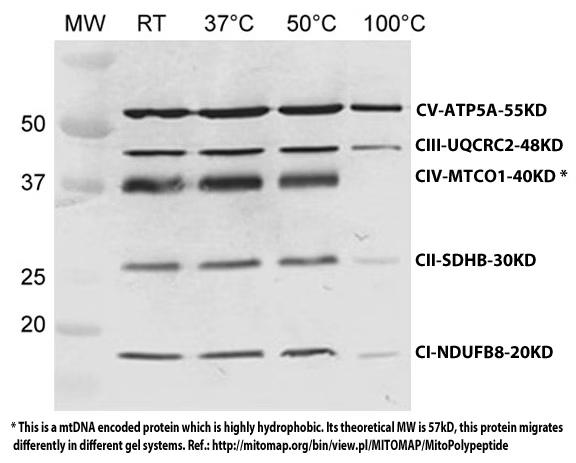
COXI is a highly hydrophobic protein and appears as a broad band at ~35 kDa (not at its true molecular weight at 57 kDa). It is very sensitive to heating. Therefore, the samples, including the positive control, should not be heated over 50°C before loading on the gel.
The antibody cocktail (1.5 mg/mL) should be diluted 250x to a nal working concentration of 6.0 µg/mL for Western blotting.
We recommend using PBS with 1% milk as the antibody diluent, and a high pH CAPS / PVDF transfer protocol. Please contact us for more details.
The Western blot cocktail is supplied at a concentration of 1.5 mg/mL. Store the antibody cocktail at 4°C and the control sample at -80°C.
Supplementary information
This supplementary information is collated from multiple sources and compiled automatically.
MitoProfile® Total OXPHOS Rodent refers to a collection of proteins associated with oxidative phosphorylation (OXPHOS) in rodents. This target includes several key protein complexes involved in the electron transport chain within mitochondria. These complexes specified as OXPHOS Complexes I-V act in conjunction to facilitate ATP production. OXPHOS proteins such as NADH dehydrogenase (complex I) cytochrome c oxidase (complex IV) and ATP synthase (complex V) are detected using antibodies specified in a mitochondrial cocktail or OXPHOS cocktail tailored for Western blots. Mitochondria express these proteins across various tissues including skeletal muscle heart and brain reflecting their essential role in energy metabolism.
Biological function summary
OXPHOS proteins are integral to the production of ATP the primary energy molecule in cells. They form a multi-protein complex that transduces energy by transferring electrons and pumping protons across the inner mitochondrial membrane. The OXPHOS system comprises complexes I to V each playing a specific role within this energy-converting process. This system is important for cellular respiration acting as the powerhouse that drives numerous cellular processes.
Pathways
OXPHOS proteins participate significantly in the mitochondrial electron transport chain and oxidative phosphorylation pathways. The ATP produced through this mechanism contributes to various metabolic pathways and cellular activities. Cytochrome c associated with complex IV plays a pivotal role in apoptotic pathways linking energy metabolism with cell death processes. Other key proteins such as ubiquinone function as electron carriers in the electron transport chain to ensure efficient ATP synthesis.
Impaired OXPHOS function associates with metabolic disorders such as mitochondrial diseases and neurodegenerative conditions like Parkinson's disease. Defects in any of the OXPHOS complexes can lead to insufficient ATP production causing energy deficits in cells and tissues. For example complex I defects can contribute to degenerative disorders linked with lease syndrome through dysregulated energy metabolism. Variations in expression of components within the OXPHOS system such as mutations or deletions can also influence the risk and progression of these diseases.
Target data
Accessory subunit of the mitochondrial membrane respiratory chain NADH dehydrogenase (Complex I), that is believed not to be involved in catalysis. Complex I functions in the transfer of electrons from NADH to the respiratory chain. The immediate electron acceptor for the enzyme is believed to be ubiquinone.
Sample Images for Expected Results & Reference
Impact of Sample Heating on OXPHOS Signal Detection Rat liver mitochondria labeled with ab110413 (MS604).

The sample in lane 1 was kept at room temperature, whereas the remaining three samples were heated to 37°C, 50°C, and 100°C, respectively. This blot shows that boiling of samples leads to a decrease in signal due to aggregation of proteins therefore heating samples at or close to boiling is not recommended.
Species Cross-Reactivity & CI Subunit (NDUFB8) Validation

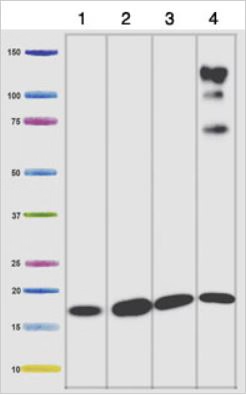
Isolated mitochondria from heart of human (5 μg - Lane 1), cow (1 ug - Lane 2), rat (10 μg - Lane 3), mouse (10 μg - Lane 4) labeling CI subunit NDUFB8 with ab110242 at 0.5 ug/ml.
Extra bands in the mouse sample (lane 4) are due to the reaction of the IgG-specific goat anti-mouse secondary antibody with residual mouse blood in the heart tissue, as it is very difficult to entirely remove the blood from these small organs.
Species Reactivity & Complex II (CII) Subunit Validation

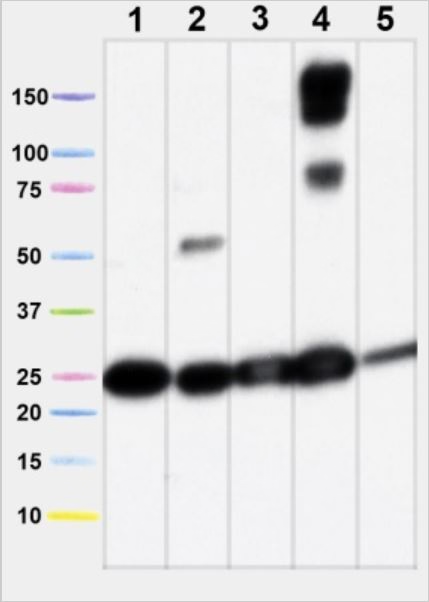
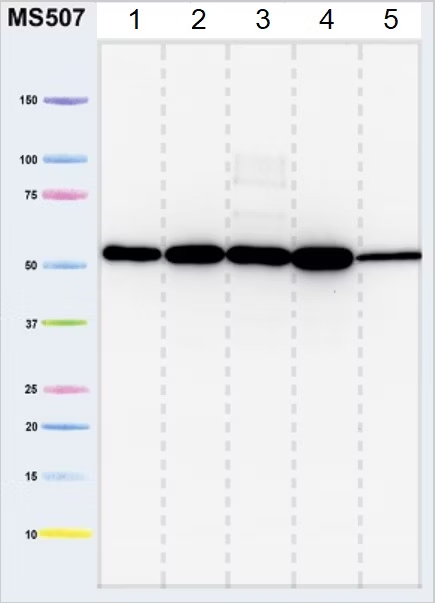
Isolated mitochondria from heart of human (5 μg - Lane 1), cow (1 ug - Lane 2), rat (10 μg - Lane 3), mouse (10 μg - Lane 4), HepG2 (human liver hepatocellular carcinoma cell line) whole cell lysate (20 μg -Lane 5) labeling CII-30kDa with ab14714 at 5 μg/mL. Secondary antibody is a goat anti-mouse antibody.
Extra bands in the mouse sample (lane 4) are due to the reaction of the IgG-specific goat anti-mouse secondary antibody with residual mouse blood in the heart tissue, as it is very difficult to entirely remove the blood from these small organs.
Complex III (CIII) Validation: Skeletal Muscle and Ramos Cell Lysates

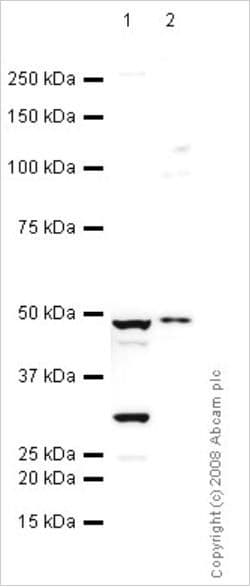
Human skeletal muscle tissue lysate, (10 μg - Lane 1) and Ramos (human Burkitt's lymphoma cell line) whole cell lysate (10 μg - Lane 2) labeling CIII-Core protein 2 with ab14745 at 5 μg/mL. Secondary antibody is a goat polyclonal to Mouse IgG - H&L - Pre-Adsorbed (HRP), 1/3000 dilution.
Complex IV (CIV) Subunit I Validation Across Species

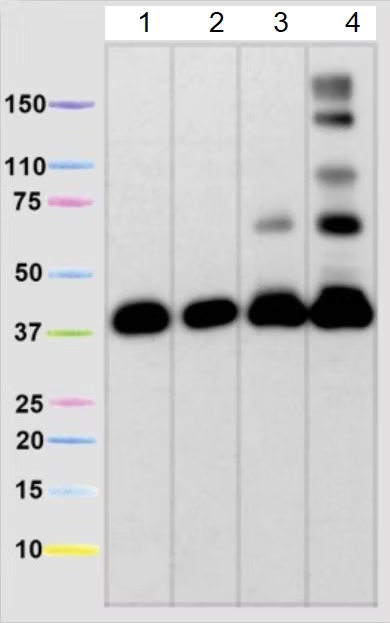
Isolated mitochondria from heart of human (5 μg - Lane 1), cow (1 ug - Lane 2), rat (10 μg - Lane 3), mouse (5 μg - Lane 4) labeling CIV subunit I with ab14705 at 0.5 μg/mL. Secondary antibody is a goat anti-mouse antibody.
Extra bands in the mouse sample (lane 4) are due to the reaction of the IgG-specific goat anti-mouse secondary antibody with residual mouse blood in the heart tissue, as it is very difficult to entirely remove the blood from these small organs.
Complex V (CV) Alpha Subunit Validation in Tissue and Cell Lysates

Isolated mitochondria from heart of human (10 μg - Lane 1), cow (4 μg - Lane 2), rat (10 μg - Lane 3), mouse (10 μg - Lane 4), HepG2 (human liver hepatocellular carcinoma cell line) whole cell lysate (20 μg -Lane 5) labeling CV alpha subunit with ab14748 at 1 μg/mL
CV Alpha Validation: Human Liver Tissue vs. HepG2 Cell Lysates

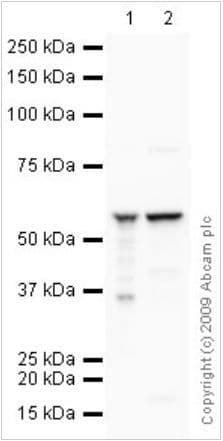
Human liver tissue lysate, (10 μg - Lane 1) and HepG2 (human liver hepatocellular carcinoma cell line) whole cell lysate (10 μg - Lane 2) labeling CV alpha subunit with ab14748 at 1 μg/mL. Secondary antibody is a goat polyclonal to Mouse IgG - H&L - Pre-Adsorbed (HRP), 1/3000 dilution.
Key Facts
| Applications | WB | |
| Target | NDUFB8 | |
| Reacts with | Mouse, Rat, Cow, Human, Cynomolgus monkey | |
| Form | Liquid | |
| Storage buffer | Preservative: 0.02% Sodium azide Constituents: 0.15% HEPES |
| Shipped At Conditions | Dry Ice |
| Appropriate Long term Storage Conditions | Multi |
| Appropriate short-term storage conditions | Multi |