Image-Based Cell Counters vs Flow Cytometry
Accurate cell analysis is fundamental to modern drug discovery, translational research and clinical diagnostics because cell count, viability and phenotype directly influence the reliability of experiments investigating mechanisms of disease and therapeutics. From monitoring cell health during bioprocessing to evaluating immune responses in oncology and infectious disease research, researchers depend on cell analysis technologies that generate reproducible, biologically meaningful data. Among the most widely used approaches are flow cytometry and image-based cell counters, each offering distinct strengths for cell characterization and quantification.1,2
The comparison between image-based cell counters and flow cytometry is not about which technology is universally superior, but rather about which method is best suited to a specific application, workflow or level of analytical complexity. Flow cytometry provides high-throughput, multiparametric analysis of individual cells using fluorescent labeling and laser-based detection. In contrast, image-based cell counters combine microscopy and automated image analysis to evaluate cell number, morphology and viability. Understanding the differences between these technologies helps researchers select the most appropriate tool for their experimental and clinical objectives.1,2
Why Cell Analysis Technology Selection Matters in Modern Research
The selection of cell analysis technology has become instrumental as modern research workflows demand greater reproducibility, quantitative accuracy and scalability. In drug discovery and translational research, even small inconsistencies in cell counting, viability assessment or phenotypic characterization can affect downstream interpretation and compromise confidence in the results. Accurate cell analysis is particularly critical in high-throughput drug screening, where data quality directly influences hit identification, toxicity assessment and candidate prioritization.3
The choice of technology also carries serious implications for regulatory compliance and standardization in clinical research. Biopharmaceutical and clinical laboratories must generate data that are traceable, reproducible and suitable for validated workflows, in line with increasingly stringent regulatory expectations. At the same time, researchers face growing demands for higher data dimensionality, including multiparametric characterization of heterogeneous cell populations, alongside the need to process large sample volumes efficiently. As a result, throughput capacity, analytical depth and workflow integration have become central factors when selecting between different cell analysis platforms. 4,5
Understanding Image-Based Cell Counters
Image-based cell counters are automated analytical systems that combine digital microscopy with software-driven image analysis to quantify and evaluate cells in suspension. These instruments are widely used in research, bioprocessing and pharmaceutical laboratories because they provide rapid and standardized assessment of cell concentration and viability with minimal manual intervention. Compared with traditional manual hemocytometer counting, image-based cell counters improve consistency, reduce subjectivity and accelerate routine cell analysis workflows.
Core Operating Principle
Image-based cell counters typically use brightfield, fluorescence or a combination of both imaging.6,7
Brightfield imaging directly captures the visual appearance of cells, while fluorescence-based viability dyes distinguish live and dead cells based on membrane integrity or metabolic activity.6,7
Upon image capture, advanced automated image segmentation algorithms identify individ
ual cells within the images, separating them from debris, background artifacts and clustered populations. Many systems also incorporate morphology recognition capabilities to evaluate parameters such as cell shape, circularity and structural consistency.8
What Image-Based Cell Counters Measure
These systems are primarily designed to measure total cell count and to determine the proportion of viable versus non-viable cells. Many platforms can also detect cell aggregation, estimate cell size distribution and identify morphological abnormalities within samples. Advanced instruments may also support limited phenotypic marker analysis via fluorescent labeling, although their multiplexing capabilities remain substantially lower than those of flow cytometry. 9,10
Strengths in Drug Discovery Workflows
Image-based cell counters are particularly valuable in drug discovery workflows that require rapid, routine viability assessment. Sample preparation is generally straightforward and fast, reducing workflow complexity and minimizing operator-dependent variability. Their automation improves reproducibility across experiments, making them well-suited for routine culture monitoring, cytotoxicity studies and early-stage compound screening. In addition, these systems are often more cost-efficient than highly specialized cytometric platforms, particularly in laboratories focused on high sample throughput with relatively simple analytical requirements.10
Technical Limitations of Image-Based Cell Counters
Despite their advantages, image-based cell counters have several technical limitations. Their ability to perform multiparametric analysis is relatively limited compared with that of flow cytometry, limiting detailed characterization of complex cellular phenotypes. They also typically allow fewer total events per sample, which can reduce statistical robustness in heterogeneous populations. Furthermore, they are generally less effective at detecting rare cell populations or subtle immunophenotypic differences that require highly sensitive fluorescence-based discrimination.10
Understanding Flow Cytometry in Cell Counting
Flow cytometry is a laser-based analytical technique widely used for cell counting, viability assessment and multiparametric characterization of individual cells within complex populations. Unlike imaging-based approaches that analyze captured microscopic images, flow cytometry evaluates cells in real time as they pass through an optical detection system in suspension. The technology is widely applied in immunology, oncology, hematology, translational research and biopharmaceutical development due to its ability to generate highly detailed, statistically robust cellular data.11
Core Operating Principle
Flow cytometry operates through hydrodynamic focusing, a process that aligns cells into a narrow single-cell stream before they pass through one or more laser beams. As each cell intersects the laser, it generates scattered light and fluorescence signals that are detected and converted into quantitative measurements. Fluorescence emission detection allows labeled antibodies or viability dyes to identify specific cellular markers and functional states. In parallel, forward scatter (FSC) provides information related to cell size, while side scatter (SSC) reflects internal complexity or granularity, helping distinguish different cell types and cellular conditions.11
How Flow Cytometry Performs Cell Counting
Cell counting in flow cytometry is based on detecting individual cells as they move through the instrument's flow cell. Modern systems commonly use volumetric counting methods that measure a defined sample volume directly, while some workflows rely on absolute counting beads with known concentrations to calculate total cell numbers. 12
To improve counting accuracy in complex samples, gating strategies are applied during data analysis to exclude debris, dead cells and non-cellular artifacts. Fluorescent viability discrimination further enhances reliability by distinguishing live and dead cells using membrane integrity or metabolic staining.12
Strengths in Advanced Research Applications
Flow cytometry offers several advantages in advanced research and clinical applications. Its ability to acquire very high event numbers improves statistical robustness, particularly when analyzing heterogeneous or low-frequency populations. The technology provides superior debris discrimination through combined scatter and fluorescence analysis, while doublet exclusion methods based on pulse geometry help prevent counting errors caused by aggregated cells.11
Together, these capabilities make flow cytometry especially effective for analyzing heterogeneous biological samples and quantifying rare cell populations that may be difficult to detect with image-based analytical systems.11
Technical Considerations
Despite its analytical power, flow cytometry presents technical and operational challenges. Instrument acquisition and maintenance costs are typically higher than those associated with image-based counting platforms. Data analysis can also become complex due to compensation requirements, multidimensional gating strategies and fluorescence panel optimization. As a result, reliable operation often requires experienced personnel with specialized training. In addition, achieving consistent standardization across laboratories and instruments remains a recognized challenge, particularly in multicenter clinical and translational research settings.11
See how Danaher Life Sciences can help
The Difference Between Image-Based Cell Counters and Flow Cytometry in Cell Counting13
When to Choose Image-Based Cell Counters
Image-based cell counters are often preferred in workflows that prioritize speed, simplicity and standardized cell counting. These systems are particularly well-suited for rapid and high-frequency cell analysis tasks performed during routine laboratory operations, including cell culture monitoring, viability assessment and early-stage drug screening. Their streamlined workflows and minimal sample preparation requirements make them practical for laboratories that need efficient turnaround without complex analytical methods.14
Image-based cell counters are also advantageous for small sample volumes or applications where visual validation of results is important. Because the technology captures actual cell images, users can directly review the counts of cells, debris and aggregates to confirm data quality and identify potential artifacts. Many platforms can effectively recognize clustered or aggregated cells through automated morphology analysis, helping reduce counting inconsistencies associated with manual methods. In addition, their ease of use, lower operator dependency and relatively straightforward instrument setup make them accessible to laboratories with varying levels of technical expertise.14
Featured Product
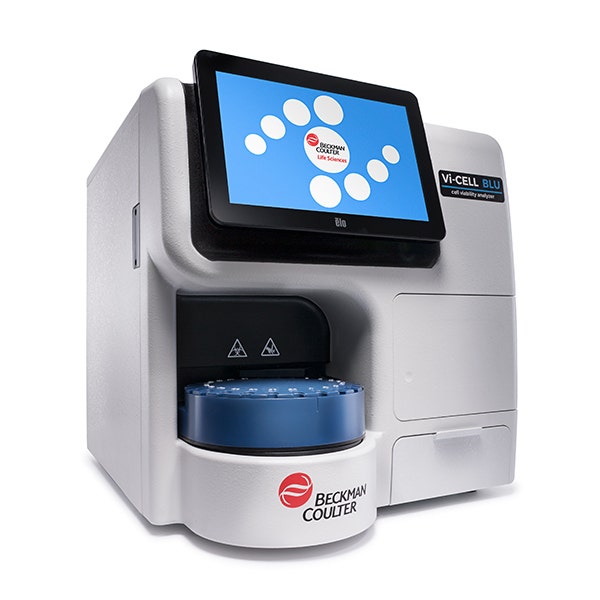
Vi-CELL BLU Cell Viability Analyzer
Chosen because it is an automated cell counter that measures viability, density and size via trypan-blue exclusion imaging, tying directly to this page's subject of image based cell counters vs flow cytometry.
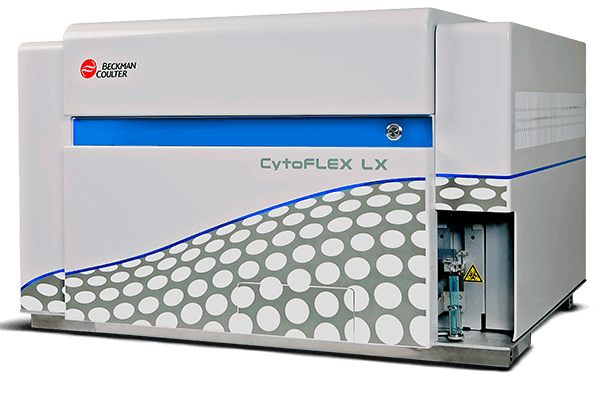
CytoFLEX LX Flow Cytometer
Chosen as a complementary second option because it is a multicolor flow cytometer for detailed immunophenotyping and multi-parameter cell analysis, also directly relevant to image based cell counters vs flow cytometry.
When to Choose Flow Cytometry
Flow cytometry is typically selected when research applications require high analytical depth, large-scale sample processing or detailed characterization of complex cell populations. The technology is particularly valuable in high-throughput environments because it can rapidly analyze thousands of individual cellular events per second while maintaining strong statistical robustness. This capability makes flow cytometry highly effective for large screening studies, translational research programs and clinical laboratory workflows that demand extensive quantitative data generation.15
Flow cytometry is also the preferred approach for rare cell detection and multiparametric analysis. By combining multiple fluorescent markers within a single assay, researchers can simultaneously evaluate numerous cellular characteristics, including phenotype, activation status, viability and functional biomarkers. This makes the technology especially useful for complex phenotyping applications involving heterogeneous immune, stem cell or tumor populations. In addition, fluorescence-activated cell sorting (FACS) extends the capabilities of flow cytometry by enabling the physical isolation of specific cell populations for downstream molecular, functional or therapeutic studies.16
Imaging Flow Cytometry
Imaging flow cytometry represents a hybrid approach that combines features of both microscopy and flow-based analysis. It merges the high-throughput single-cell processing of flow cytometry with the visual, image-rich information typically associated with image-based cell counters. As a result, each cell is measured not only by fluorescence and scatter signals but also captured as a high-resolution image as it flows through the instrument.17
This dual capability makes imaging flow cytometry particularly powerful for applications that require both quantitative and spatial information. It is widely used in morphological phenotyping, subcellular localization studies and the analysis of rare cellular events where visual confirmation is important. In immunology and oncology research, it can provide deeper insight into cell activation states, protein translocation and heterogeneous cell populations.17
However, this technology is more specialized than either conventional flow cytometry or image-based counting systems. It typically involves greater operational complexity, higher data analysis demands and increased costs. For this reason, it is generally used in advanced research settings rather than routine cell counting or standard viability workflows.17
See how Danaher Life Sciences can help
FAQ's
What is the main difference between Image-Based Cell Counters and Flow Cytometry?
Image-based cell counters use microscopy and automated image analysis for cell counting and viability assessment, while flow cytometry uses lasers and fluorescence detection for high-dimensional single-cell analysis.
Are flow cytometers accurate for cell counting?
Yes. Flow cytometers provide highly accurate counting through event-based detection, volumetric analysis and advanced debris exclusion strategies.
Do Image-Based Cell Counters measure cell viability?
Yes. Many systems use fluorescence-based viability dyes to distinguish live and dead cells.
Can Image-Based Cell Counters detect rare cell populations?
Their sensitivity for rare populations is limited compared with flow cytometry.
How do Image-Based Cell Counters work?
They capture cell images and use automated segmentation algorithms to identify, count and classify cells based on morphology and staining.
References
- Yu Y, Zheng Y, Guan C, Yi M, Chen Y, Zeng Y, et al. Detection of cells by flow cytometry: Counting, imaging, and cell classification. J Innov Opt Health Sci 2023;16(03):2330005.
- Serrano E, Peters J, Wagner J, Graham RE, Chen Z, Feng BY, et al. Progress and new challenges in image-based profiling. Mol Syst Biol 2026;22(5):624-658. (In eng). DOI: 10.1038/s44320-026-00197-7.
- Hou Y, Yao H, Lin J-M. Recent advancements in single-cell metabolic analysis for pharmacological research. J Pharm Anal 2023;13(10):1102-1116.
- Coltman NJ, Roberts RA, Sidaway JE. Data science in drug discovery safety: Challenges and opportunities. Exp Biol Med 2023;248(21):1993-2000.
- Czechowska K, Bonilla DL, Cotty A, Dankar A, Mead PE, Nash V. Beyond the limits: how is spectral flow cytometry reshaping the clinical landscape and what is coming next? Cells 2025;14(13):997.
- Uka A, Ndreu Halili A, Polisi X, Topal AO, Imeraj G, Vrana NE. Basis of image analysis for evaluating cell biomaterial interaction using brightfield microscopy. Cells Tissues Organs 2021;210(2):77-104.
- Pratapa A, Doron M, Caicedo JC. Image-based cell phenotyping with deep learning. Curr Opin Chem Biol 2021;65:9-17.
- Padovani F, Mairhörmann B, Falter-Braun P, Lengefeld J, Schmoller KM. Segmentation, tracking and cell cycle analysis of live-cell imaging data with Cell-ACDC. BMC Biol 2022;20(1):174.
- Way GP, Kost-Alimova M, Shibue T, Harrington WF, Gill S, Piccioni F, et al. Predicting cell health phenotypes using image-based morphology profiling. Mol Biol Cell 2021;32(9):995-1005.
- Bourn MD, Daly LF, Huggett JF, Braybrook J, Rivera JF. Evaluation of image analysis tools for the measurement of cellular morphology. Front Cell Dev Biol 2025;13:1572212.
- Robinson JP, Gmyrek GB, Rajwa B. Flow Cytometry: Advances, Challenges and Trends. Bioessays 2026;48(1):e70091.
- Telford WG. Flow cytometry and cell sorting. Front Med 2023;10:1287884.
- Matuszewski DJ, Sintorn I-M, Puigvert JC, Wählby C. Comparison of flow cytometry and image-based screening for cell cycle analysis. International Conference on Image Analysis and Recognition: Springer; 2016:623-630.
- LaBelle CA, Massaro A, Cortés-Llanos B, Sims CE, Allbritton NL. Image-based live cell sorting. Trends Biotechnol 2021;39(6):613-623.
- Ofir N, Rozenberg E, Sharabi O, Zektser M, Rouvio O, Gazit R. Advanced Multicolor Flow Cytometry Method for Multiple Myeloma. Clin Lymphoma Myeloma Leuk 2025.
- Cai B, Ding J, Yalikun Y, Ren D. Progress of Cell Sorting in Flow Cytometry. iLABMED 2025;3(1):96-105.
- Dimitriadis S, Dova L, Kotsianidis I, Hatzimichael E, Kapsali E, Markopoulos GS. Imaging flow cytometry: development, present applications, and future challenges. Methods Protoc 2024;7(2):28.