Metabolite Identification: From Accurate Mass to Signature Fragment

A peak that looks like a metabolite isn't yet a metabolite identification. Between an accurate-mass hit and a structure you can defend in a safety review is a chain of evidence, and every link in that chain is built somewhere in the workflow.
Confident metabolite identification starts with a selective, reproducible analytical method and robust supporting data. Confidence is built both in the steps before any spectrum is interpreted and in the weight of the evidence supporting the assignment. This is especially important when evaluating low-abundance metabolites, positional isomers or other closely related species, where reliable assignments help teams make better decisions about candidate selection, safety and development strategy.
Before interpretation
- Study objective: Define the target analytes and the question the analysis must answer
- Sample preparation: Consistently recover analytes and reduce matrix interference
- LC separation: Resolve parent compounds, metabolites and related species before identification
Evidence supporting identification
Not all identification evidence carries the same weight. Each added layer narrows the possible structures and increases the confidence with which the result can support downstream decisions.




For most challenging metabolites, the hardest step is the move from a credible composition to a fragment-supported structure. That's where fragmentation evidence does the heavy lifting.
Where fragmentation makes the difference
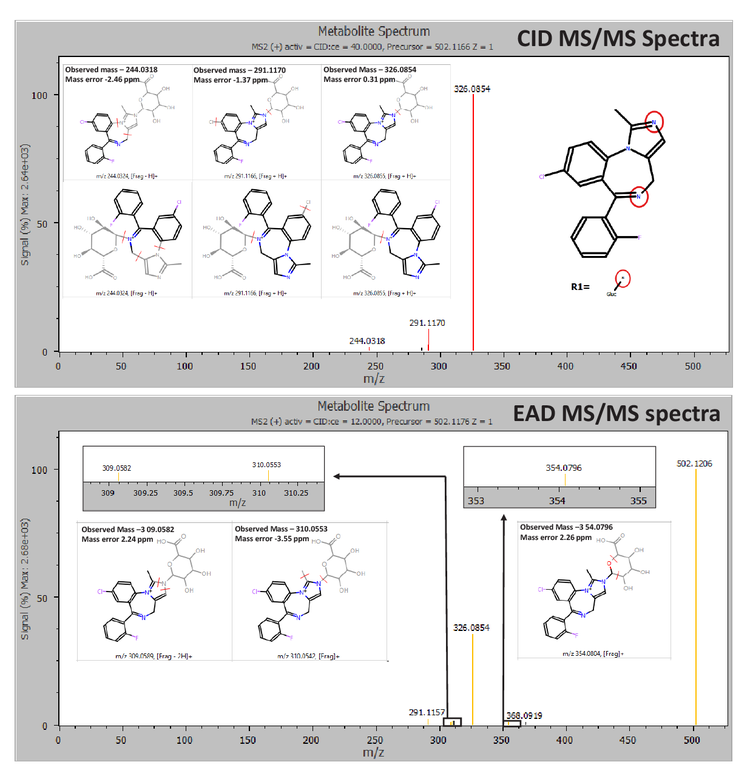
This case study (Confident characterization and identification from EAD) shows that accurate mass identifies likely candidates, while fragmentation can further distinguish the most likely structure. Electron activated dissociation (EAD) can preserve labile modifications and help localize them within the structure.
In midazolam hepatocyte incubations, collision-induced dissociation (CID) indicated two possible sites of glucuronidation, while signature EAD fragments localized the metabolite to the imidazole ring, narrowing the candidate to a single metabolite. This matters most for low-abundance and isomeric metabolites.
Where each capability strengthens the identification chain
Identification confidence depends on sample quality and separation, the structural evidence produced by the instrument, and the consistency of data interpretation and review. The weakest of these can limit the strength of the final assignment.



Separation supports liraglutide catabolite identification
Separation and fragmentation work together the same way for peptide therapeutics, where catabolites must be resolved before they can be identified.
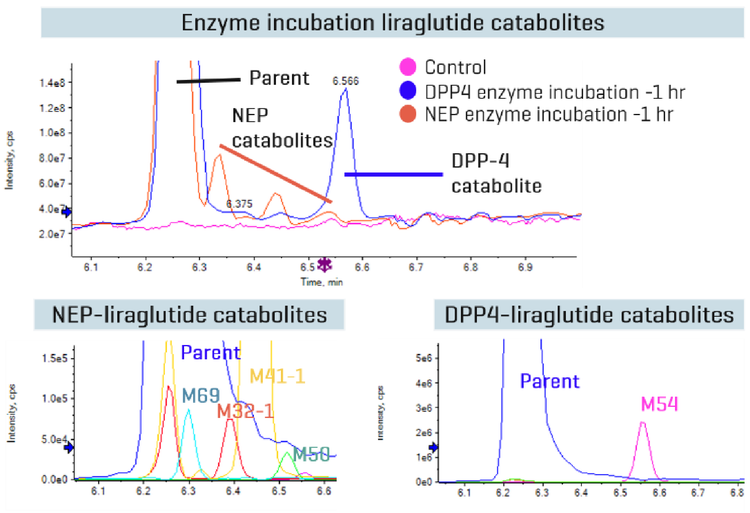
In this case study (Enhancing sequence coverage and identification with CID and EAD fragmentation), chromatograms compare liraglutide before and after a 1-hour incubation with neprilysin (NEP) or dipeptidyl peptidase-4 (DPP-4). In the graph above, the lower panels show the separation of the parent compound and enzyme-generated catabolites. These profiles provide a starting point for structural identification using accurate-mass and fragmentation evidence.
Building confidence before you need it
Confident identification isn't decided at the final review. It's set by the choices made upstream, including how cleanly samples are prepared, how well species are separated, how much structural evidence is collected and how consistently it is interpreted. When each link holds, teams can move from a detected feature to a decision with fewer repeat analyses and less uncertainty.
Explore the full MetID and Monitoring workflow. Download the ebook to see how each stage, from study objective to decision-ready reporting, contributes to identification confidence.