Metabolite Identification & Monitoring
Resolve complex metabolites. Measure critical species. Move development forward.
From sample preparation and separation through high-resolution MS and scalable data analysis, the life sciences companies of Danaher help drug-development teams identify metabolites, distinguish relevant species from background, measure priority analytes and turn complex results into traceable, decision-ready evidence.
Turning Metabolite Data into Development Decisions
From a technical task to a development-decision capability
Metabolite identification matters because uncertainty about what formed, how much is present, and whether it affects exposure or safety can delay critical development decisions. As analytical complexity and data volume increase, three pressures are raising the standard for how teams generate, review, and apply metabolite evidence.
Barriers to Confident MetID Workflows
The problem is not one analytical step. It is the gaps between them.
Customers must distinguish true biotransformation products from impurities and background signals, characterize complex modalities such as oligonucleotides, peptides, ADCs and AOCs, and maintain consistent results as sample volumes, studies and sites increase. The challenge is not one analytical step. It connects recovery, separation, acquisition, identification, quantitation, and review while preserving the scientific context needed for faster, more defensible development decisions.
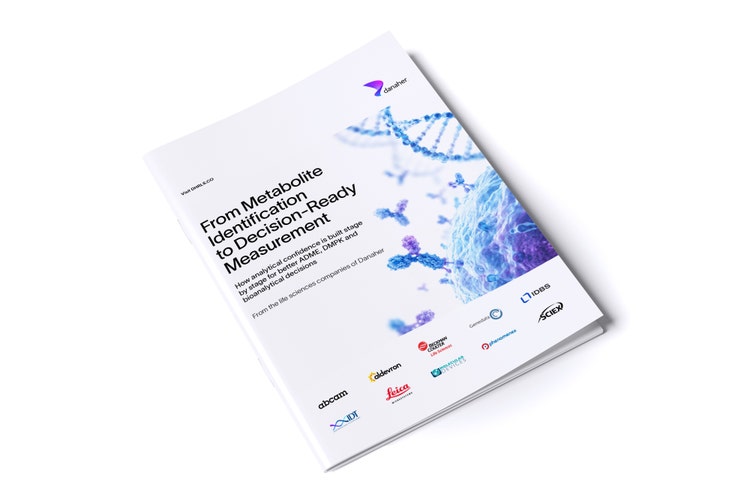
From Metabolite Identification to Decision-Ready Measurement
Metabolite data is only as valuable as the workflow behind it can defend. Confidence builds through a chain of analytical decisions and is set by the weakest link, not the average. This ebook shows how identification, measurement, and reporting each add a link and how the life sciences companies of Danaher own different ones.

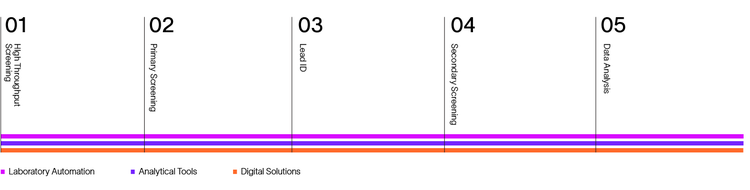
A meaningful MetID or monitoring decision depends on several connected stages
Metabolite Identification & Validation

We see a way to increase confidence in biomarker discovery and validation with up to 10x greater sensitivity and quantitative data that scales
SCIEX | ZenoTOF 8600 system
Scale and productivity pressure
High-resolution LC-MS generates richer datasets than teams can process. Manual preparation, review, and study-to-study comparison can become the bottleneck. Labs need to scale insight and throughput without scaling manual effort or variability.

Separation & Sample Recovery

We see a way to improve the recovery and consistency of your biotherapeutic sample by more than 80%, significantly accelerating the drug development process
Phenomenex | Biozen™ LC Columns
Therapeutic and analytical complexity
Small molecules remain essential, but oligonucleotides, peptides, ADCs and AOCs generate far more fragments, catabolites and modifications. Complex matrices can obscure the species that matter. Scientists must assign unknowns with structural confidence and separate meaningful metabolites from background.
Risk Identification & Decision Support

We See a Way to turn weeks of analytical work into high-quality results in just 1–2 days
Genedata| Genedata Biopharma Platform
Development and regulatory decisions require connected evidence
Metabolites can influence the interpretation of exposure, safety assessment and candidate progression decisions. When major or disproportionate metabolites are not adequately represented in toxicity studies, teams may need additional evidence to evaluate potential risk. Assessing metabolic fate and comparative exposure early and keeping the underlying data connected and traceable can help teams address evidence gaps before they delay development.
What is the difference between identification and monitoring?
Identification asks what drug-related species formed and what their likely structures are. Monitoring and quantitative bioanalysis ask how much parent drug and selected metabolites or related species are present across samples or over time.
What should an LC-MS workflow offer for oligonucleotides, peptides, ADCs and AOCs?
The workflow should address each modality’s extraction, separation, ionization and analysis needs. Key capabilities include high-recovery preparation, low-adsorption components, high-resolution separation, sensitive MS and software that differentiates intact molecules from related variants. For ADCs and AOCs, it should connect intact-conjugate results with released components and biotransformation products.
How do you keep metabolite data defensible for Metabolites in Safety Testing (MIST) assessments and regulatory submissions?
Use controlled procedures and traceable review criteria. Support assignments with accurate mass, isotope patterns, retention behavior, MS/MS fragments, reference standards and relative exposure data. Retain raw data, processing settings, analyst decisions, version history and confidence levels. Align the approach with applicable guidance for disproportionate human metabolites.
How can you improve recovery of oligonucleotides and peptides from sample preparation through LC-MS?
Identify losses from binding, adsorption, extraction, matrix effects and metal interactions. Improve recovery with analyte-appropriate extraction, low-binding components, fewer transfers and optimized conditions. Consider mixed-mode or ion-exchange SPE for oligonucleotides and precipitation, SPE or affinity enrichment for peptides. Use internal standards and stage-specific recovery tests.
How does chromatographic separation help resolve isomeric metabolites?
Isomeric metabolites can share exact mass and produce similar fragments. Chromatography separates them through differences in polarity, shape and stationary-phase interactions, creating distinct retention times. This reduces co-elution and improves identification and quantitation, particularly when retention is confirmed with authentic standards.
How does electron-activated dissociation (EAD) improve metabolite structure assignment?
EAD generates complementary, structurally informative fragments that can preserve labile modifications and localize metabolic changes. Combined with accurate mass and chromatographic separation, it helps distinguish related structures and strengthens assignment confidence. Definitive identification may still require confirmation with an authentic standard.
Find Out More
TTAE
TTAE
546005641
TTAE
add
Talk to an Expert
https://lifesciences.danaher.com
https://lifesciences.danaher.com/us/en/connect/thank-you.html