Clinical-Ready Biomarkers Start with Connected Workflows
Integrating sample preparation, multi-omics analysis, imaging, automation and data management to help researchers accelerate biomarker discovery, enhance reproducibility and support clinical decisions confidently.
Why Biomarkers Matter Now
From Discovery to Clinical-Ready Biomarkers
For years, biomarker development followed a linear model: one biomarker, one assay, one decision. Today, diseases are more complex, requiring integration of genomics, transcriptomics, proteomics, metabolomics, imaging and clinical data to understand disease, identify therapeutic signals and stratify patients. Multi-omics has evolved from a specialized research approach into a critical component of translational and clinical research workflows. The current challenge lies in producing insights that are both reproducible and actionable.

Biomarker-Driven Research: Closing the Translation Gap
Despite major advances in technology, many biomarker programs continue to face challenges with:
- Fragmented workflows and disconnected datasets
- Inconsistent assay performance across sites
- Limited scalability of sample and data workflows
- Difficulty connecting biological findings to clinical outcomes
- Regulatory and traceability requirements for clinical use
Researchers aim for deeper biological insights, robust assays, scalable workflows and a clear path from biomarker discovery to clinical application.
Connected Biomarker Workflows: From Discovery to Translation
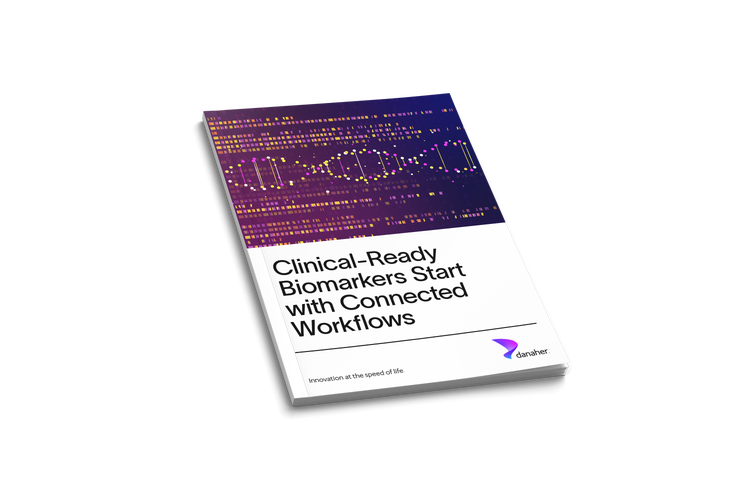
Biomarker development drives precision medicine, yet fragmented data, complex workflows and disconnected insights often slow progress. This ebook explores how the life sciences companies of Danaher enable AI-powered biomarker workflows, integrating sample prep, automation, analysis and data management to drive faster, more confident decisions.
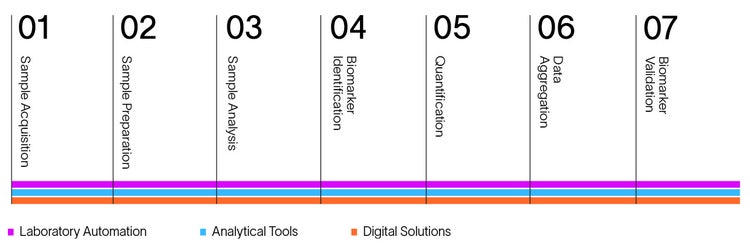
Connecting Every Step from Sample to Clinical Insight
Deeper Biological Insight

We see a way to increase confidence in biomarker discovery and validation with up to 10x greater sensitivity and quantitative data that scales
SCIEX | ZenoTOF 8600 system
Reveal Deeper Biological Insights Across Modalities
Integrated multi-omics, spatial biology and phenotypic analysis can uncover molecular mechanisms, biological pathways and patient heterogeneity that traditional workflows might miss. Researchers require technologies able to link genomic, proteomic, metabolomic, imaging and functional data to form a more comprehensive biological understanding.

Reproducibility at Scale

We see a way to improve the recovery and consistency of your biotherapeutic sample by more than 80%, significantly accelerating the drug development process
Phenomenex | Biozen™ LC Columns
Improve Reproducibility Across Every Study
Biomarker programs frequently fail not due to biological factors, but because workflows are not consistently reproducible across different operators, studies or sites. Implementing automation and standardized sample preparation methods can minimize variability, boost throughput and enhance confidence in results. As biomarker initiatives advance toward translational and clinical uses, ensuring reproducibility becomes even more critical.
Connect Data Across Modalities

We see a way to design smarter clinical trials to improve the success rate by 20%
Genedata | Genedata Profiler
Transform Data Silos into Decision-Ready Insights
The most valuable biomarker insights often come from combining molecular, phenotypic, imaging and clinical data. However, many organizations face challenges due to fragmented datasets, incompatible formats and the time-consuming process of data integration. Researchers require a reliable data foundation capable of integrating various datasets while ensuring traceability, governance and regulatory compliance.
Resources
Webinar
Scaling Oncology NGS for Biomarker-Ready Translational Research
Translational oncology teams need reliable NGS workflows that scale with increasing study volumes and inform future decisions. In this webinar, experts from IDT and Beckman Coulter will explore:
- How manual library preparation increases time and variability and makes standardization difficult
- How Archer FUSIONPlex-HT and VARIANTPlex-HT assays automated on the Biomek i3 can address these challenges
- A walkaway workflow that reduces hands-on time while maintaining library quality
Webinar
AI-Powered Biomarker Discovery: From Screening to Translational Insights
Biomarker discovery is crucial for precision medicine, but complex assays, workflow scaling and translating results into insights can slow progress. This webinar shows how integrated, AI-powered solutions from Leica Microsystems and Molecular Devices can help researchers:
- Reduce delays and improve reproducibility across biomarker workflows
- Accelerate phenotypic screening with advanced imaging and analytics
- Generate insights with stronger translational relevance
Webinar
Innovative AI Software Solutions Driving Biomarker Research Efficiency
Biomarker discovery and validation are crucial for personalized medicine and improved treatments, but high-throughput assays and image analyses can hinder efficient insight generation. Join this webinar to learn how Genedata Profiler and Leica’s Aivia AI software assist researchers.
- Simplify complex high-throughput and image-based workflows
- Shorten time to insights
- Advance biomarker research with integrated data and AI-powered analysis
Webinar
Cell and Gene Therapy Biomarkers
Advanced biomarker technologies can strengthen therapy development, monitoring and evaluation by providing measurable indicators of biological activity and treatment response. This webinar highlights:
- Liquid biopsy tools for assessing biological activity and treatment response
- RCA-based mutation detection for sensitive and precise analysis
- Biomarker strategies that accelerate research and improve biological insights
What's the difference between biomarker discovery and biomarker validation, and why do both matter?
Biomarker discovery involves identifying biological signals linked to diseases, treatments or outcomes, often through multi-omics, imaging or advanced research. Validation confirms a biomarker's reliability, reproducibility and clinical value across larger datasets and populations. Both are crucial: discovery provides insights, validation builds evidence for decision-making, research, patient stratification and clinical use.
What role does AI play in biomarker discovery?
AI helps researchers analyze large, complex biomarker data by identifying patterns and potential candidates, accelerating interpretation, supporting predictive models and guiding decision-making. Success relies on high-quality, well-structured data.
How can automation improve biomarker studies?
Automation improves biomarker studies by reducing manual errors, increasing reproducibility and enabling high-throughput testing. Standardized workflows lead to more consistent results across operators and labs, supporting large-scale programs. Automation also accelerates timelines, reduces workload and helps organizations advance biomarkers from discovery to clinical use with greater confidence.
What is involved in an end-to-end biomarker and multi-omics workflow, from sample prep to data connectivity?
An end-to-end biomarker workflow involves sample collection, data generation, analysis and clinical translation. It includes standardized sample prep, multi-omics, imaging, automated workflows and integrated data systems. Linking data from different sources unifies environments, reduces fragmentation, improves consistency and speeds up insights.
Why are multi-omics workflows important?
Multi-omics workflows combine genomics, transcriptomics, proteomics, metabolomics and imaging to better understand disease biology. This integration helps researchers find mechanisms missed by single methods, identify reliable biomarkers and improve drug discovery. As organizations seek to enhance patient stratification, generate treatment insights and accelerate precision medicine, multi-omics is increasingly essential.
Find Out More
TTAE
TTAE
546005641
TTAE
add
Talk to an Expert
https://lifesciences.danaher.com
https://lifesciences.danaher.com/us/en/connect/thank-you.html