Multi-color Flow Cytometry: Principles, Protocols and Panel Design

Introduction to Multi-color Flow Cytometry
As biological research continues to shift toward systems-level understanding, the demand for high-dimensional cellular analysis is rapidly increasing. Multi-color flow cytometry meets this need by offering scalable, precise and efficient characterization of complex cellular systems.1
Multi-color flow cytometry is an advanced analytical technique for simultaneously measuring multiple parameters in individual cells using fluorophore-conjugated antibodies. By detecting different fluorescent signals in parallel, it provides a comprehensive view of cellular phenotype, function and heterogeneity within complex biological samples. This high-resolution capability is central to immune profiling, identification of rare cell populations and the evaluation of therapeutic responses. Therefore, multi-color flow cytometry is especially valuable in areas such as oncology, infectious diseases and biomarker discovery.1
Compared to single-color or low-parameter cytometry, multi-color flow cytometry can extract more information from fewer cells, reducing experimental variability and cost.2
Key Takeaways
- Multi-color flow cytometry simultaneously measures multiple fluorophore-labeled markers and light-scatter parameters on individual cells, rather than analyzing one marker per aliquot.
- Panel design, including matching fluorophore brightness to antigen abundance, considering marker co-expression and limiting spillover and spreading error, can influence data quality as strongly as instrument configuration and performance.
- FMO controls help define gating boundaries, whereas single-stained compensation controls prepared with cells or appropriate capture beads are used to calculate spillover correction between fluorescence detectors.
- Sample collection, storage, handling, fixation and permeabilization can affect cell viability, epitope accessibility and fluorophore signal, so these conditions should be optimized before acquisition.
- The technique supports immunophenotyping, biomarker research and cell-therapy quality control; depending on the validated assay, it can evaluate attributes such as identity, purity, viability and selected potency-related markers within the same sample.
Multi-color Flow Cytometry Principle
Multi-color flow cytometry is based on the passage of single cells in a fluid stream through a focused laser beam, where each cell is interrogated individually. As cells pass through the laser, they scatter light and, if labeled with fluorescent markers, emit signals that are detected and quantified. These optical signals are converted into digital data, allowing researchers to analyze physical and biochemical properties at the single-cell level.3
How Multi-color Detection Works
Cells stained with fluorophore-conjugated antibodies are exposed to one or more lasers. Each fluorophore is excited at a specific wavelength. Once excited, fluorophores emit light at characteristic wavelengths. Detectors capture this emitted fluorescence across multiple channels, enabling simultaneous measurement of different markers. Optical filters are implemented to isolate the emission spectra and minimize overlap between fluorescent dyes. In addition to fluorescence, forward scatter (FSC) provides information on cell size, while side scatter (SSC) reflects cell granularity or composition. These parameters help distinguish cell populations and guide downstream analysis.4,5
Multiparametric Analysis
Multicolor flow cytometry enables the simultaneous detection of multiple surface and intracellular markers within a single sample. Researchers can subsequently perform detailed phenotyping of complex cell populations and identify rare subsets that would be difficult to resolve with fewer parameters. Resolution also depends on selecting fluorophores with minimal spectral overlap. Proper separation ensures accurate signal detection and reduces the need for extensive correction during analysis.6
Data interpretation considerations
Because emission spectra can inevitably overlap, researchers employ compensation to correct for signal spillover between channels. Accurate compensation is critical for reliable interpretation of multi-color data. Nevertheless, some degree of signal spread may persist even after compensation, thereby reducing the resolution between positive and negative populations.7
In addition to spillover, data variability can also arise from true biological differences or from technical factors such as staining efficiency, instrument settings and sample handling. Distinguishing between these sources is essential for drawing meaningful conclusions from multi-color flow cytometry experiments.8
These concerns underscore the need for effective panel design strategies.
See how Danaher Life Sciences can help
Multi-color Flow Cytometry Panel Design
Principles of Effective Panel Design
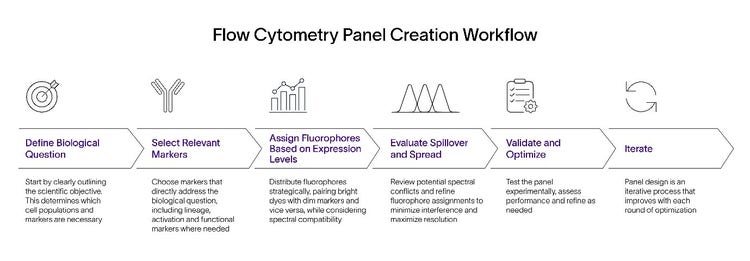
A key principle in panel design is matching fluorophore intensity to antigen expression. Bright fluorophores should be paired with low-abundance markers to improve detection sensitivity, while highly expressed antigens can be assigned to dimmer dyes without compromising signal quality.9
Minimizing overlap between fluorophore emission spectra is critical to reducing spillover and simplifying compensation. Careful selection of fluorophores helps preserve resolution between populations and improves overall data quality.9
For more complex panels, researchers may use an instrument-specific spillover spreading matrix (SSM) to identify fluorophore combinations that could reduce population resolution. Combined with information about marker co-expression and antigen abundance, this helps guide fluorophore assignments and minimize interference.
The instrument is another critical factor for panel design. Each flow cytometer has a defined set of lasers and detectors. Fluorophores must be chosen based on their excitation and emission wavelengths to ensure efficient signal detection and optimal performance.9
Some fluorophores can be excited by more than one laser, producing a signal in detectors associated with different laser paths. Because this cross-laser excitation depends on the instrument’s optical configuration, researchers should evaluate fluorophore compatibility across the complete laser and detector setup and use appropriate single-stained controls for compensation.
Flow Cytometry Panel Creation Workflow10
Multi-color Flow Cytometry Protocol
Pre-Analytical Considerations
Sample handling and viability
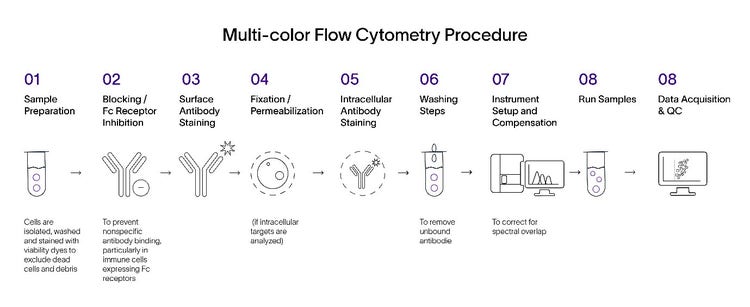
Proper sample handling is essential for preserving cell integrity and minimizing artifacts before starting a multi-color flow cytometry procedure. Fresh samples are generally preferred, but if storage is required, conditions should be optimized to maintain viability. Dead cells can introduce nonspecific staining and should be excluded using viability dyes.11
Appropriate fixation/lysis buffers
Choosing the right fixation and lysis buffers is essential in multi-color flow cytometry, as these reagents directly impact cell integrity, antigen accessibility and fluorescence signal stability.
For whole blood samples, red blood cell lysis buffers are used to remove erythrocytes without damaging leukocytes. Common formulations are ammonium chloride–based, which selectively lyse RBCs while preserving nucleated cells. Timing is important, as over-lysis can reduce cell viability and alter marker expression.12
Fixation, which involves using formaldehyde or paraformaldehyde-based buffers, stabilizes cellular structure and preserves antigenicity by crosslinking proteins. However, it can also alter epitopes, particularly for surface markers, so antibody compatibility should always be verified. Fixation also helps preserve fluorescence signals for delayed acquisition.13
For intracellular staining (e.g., cytokines, transcription factors), cells must be permeabilized after fixation. Detergent-based buffers (e.g., saponin, Triton X-100) are used for cytoplasmic targets, while alcohol-based buffers (e.g., methanol) enable staining for nuclear targets like transcription factors.14
In all of these steps, buffer compatibility with fluorophores and epitopes should always be verified. For fixation-sensitive epitopes, researchers should consider staining before fixation or using specialized buffers that preserve epitope structure.15
Multi-color Flow Cytometry Procedure10
Critical Controls and Standardization
Fluorescence Minus One (FMO) controls include all antibodies in a panel except the one of interest. They are often used to accurately define gating boundaries in multi-color experiments where spillover and background fluorescence can obscure the true signal. FMO controls are particularly important for dim markers or when resolving rare populations, as small gating shifts can significantly affect interpretation.16
Isotype controls use an irrelevant antibody matched to the test antibody’s host species, isotype and fluorophore to estimate nonspecific antibody-associated staining. Unlike FMO controls, they are not used to set gating boundaries and are generally reserved for experiments in which nonspecific binding is a specific concern.
Compensation beads are particles that bind to the Fc region of fluorophore-conjugated antibodies. When stained with a single antibody-fluorophore conjugate, the beads produce a strong, uniform fluorescent signal. By running one bead sample per fluorophore in the panel, the instrument can measure the signal from each fluorophore in other detection channels, which is then used to build the compensation matrix. Although cells can be used for compensation, beads offer several advantages, including more uniform signal intensity, higher brightness and no biological variability, making them ideal for accurate spillover calculations.17
Beyond basic setup, daily quality control (QC) is equally instrumental in maintaining reliability, especially for multi-color experiments where small shifts can distort high-dimensional data. Calibration beads with predefined fluorescence intensities must be run at the start of each day to assess three core systems:10
- Ensuring that the laser consistently intersects the sample stream at the correct position is crucial, as misalignment can reduce signal intensity or increase variability.
- Confirming that detectors are capturing fluorescence at expected levels.
- Monitoring how consistently cells or beads pass through the laser.
Over time, components such as lasers and detectors naturally drift. By tracking QC metrics over time, labs can identify gradual performance changes before they affect experimental data. This allows for proactive maintenance, recalibration or adjustment of detector voltages. Maintaining detailed QC logs creates a performance history for the instrument. This is especially important in regulated or multi-user environments, where reproducibility across operators, days and experimental batches is critical.10
Tips for Achieving Reproducibility
Titration of each antibody
Each antibody should be titrated to determine the concentration for optimal staining. Using excessive antibody concentrations can increase nonspecific binding and background noise, while too little can reduce sensitivity. Titration identifies the concentration that provides the best signal-to-noise ratio, improving resolution between positive and negative populations.18
Proper fluorophore selection
Bright fluorophores should be reserved for low-abundance antigens, while dimmer fluorophores can be used for highly expressed markers. It is also important to consider fluorophore stability under fixation/permeabilization conditions, as well as their susceptibility to spillover and spreading errors. Matching fluorophores to the instrument's laser configuration further ensures consistent detection.6
Standardized gating strategy
A consistent gating strategy is essential for comparing results across samples, experiments and operators. Practices include applying the same sequence of gates, using FMOs to define thresholds and avoiding subjective adjustments. Documenting gating hierarchies and using automated or AI-powered software can further reduce variability and improve reproducibility.19
Applications of Multi-color Flow Cytometry
The ability to sort cells based on multiple markers makes multi-color flow cytometry the preferred method for several applications, summarized below.
Common Challenges in Multi-color Flow Cytometry
Despite its widespread use in immunology, biomarker research, and biologics discovery, multi-color flow cytometry faces significant challenges in signal detection, spectral overlap and experimental conditions.
High background staining or dim signals
High background staining can obscure true positive populations, while dim signals make it difficult to resolve low-abundance markers. Common causes include excessive antibody concentration, nonspecific binding via Fc receptors or inadequate washing. On the other hand, dim signals may result from low antigen expression, weak fluorophores or suboptimal instrument settings. Careful antibody titration, proper blocking and strategic fluorophore selection are key to improving signal-to-noise ratio.8
Poor compensation and spectral interference
In multi-color panels, overlapping emission spectra can lead to inaccurate signal separation if compensation is not properly applied. Poor compensation results in false positives or distorted population distributions. Additionally, even with correct compensation, spectral spread can reduce resolution between populations. This challenge is often linked to suboptimal panel design, such as the use of fluorophores with significant overlap. Using high-quality single-stain controls, minimizing spectral overlap and validating compensation settings are essential to mitigate these issues.8
Cell loss or low viability
Cell loss during processing or low viability can significantly impact data quality and interpretation. Harsh handling, prolonged processing times or inappropriate buffer conditions can damage cells and reduce yield. Dead cells can also increase nonspecific staining and autofluorescence, complicating analysis. Gentle sample handling practices, such as controlled pipetting, moderate centrifugation speeds and careful resuspension, help maintain sample integrity, while optimized protocols that include viability dyes ensure reliable results.24
Featured Product
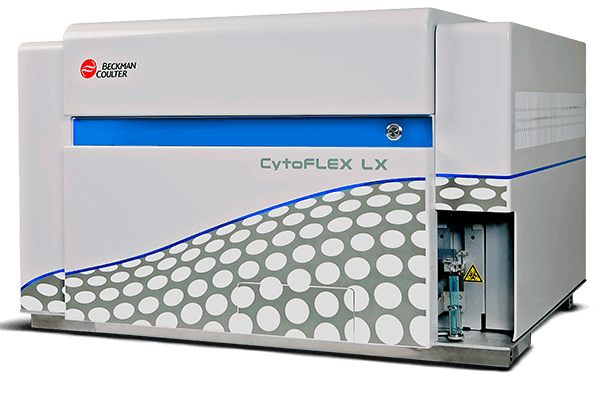
CytoFLEX LX Flow Cytometer
A benchtop system with up to six lasers and 21 fluorescence detection channels, built for high-parameter immunophenotyping and rare-population work. Wide laser coverage gives panel designers more room to separate fluorophores across detectors.
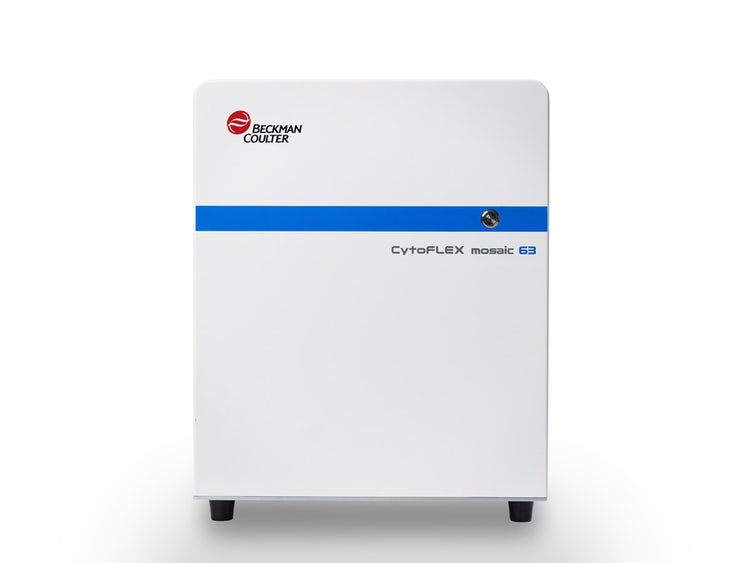
CytoFLEX Mosaic Spectral Detection Module
A spectral detection module that adds full-spectrum acquisition to a CytoFLEX system, capturing the complete emission profile of each fluorophore rather than a single filtered band. Useful where conventional compensation leaves populations poorly resolved.
See how Danaher Life Sciences can help
FAQ's
What is multi-parameter flow cytometry?
Multi-parameter flow cytometry or multicolor flow cytometry, is a technique that simultaneously measures multiple physical and biochemical characteristics of single cells using fluorescently labeled antibodies.
How much does a multicolor flow cytometry cost?
Panel cost depends mainly on the number of fluorophores, the antibody clones and conjugates selected and whether pre-validated versus custom-built reagents are used; larger panels with rare or specialty conjugates cost more per test than smaller, standard panels.
How to choose the right fluorochromes for panel design?
One should select fluorochromes based on antigen expression, brightness, spectral properties and compatibility with the instrument’s lasers and filters.
What factors should be considered when designing multi-color panel?
Key factors include antigen density, fluorochrome brightness, spectral overlap, instrument configuration and proper controls such as compensation and FMO.
What controls are essential for multicolor flow cytometry cell sorting?
Cell sorting adds sort-purity and post-sort viability checks on top of the standard FMO, isotype and compensation controls used for analysis-only panels, since sorted populations are typically used in downstream functional assays.
Are there examples of validated multicolor flow cytometry panels?
Yes, pre-validated panels exist for common applications such as T-cell subset immunophenotyping and cell therapy quality control, typically supplied with a defined marker list, recommended fluorophore assignments and reference compensation settings.
References
- Liu Y, Zhao H, Fu B, Jiang S, Wang J, Wan Y. Mapping cell phenomics with multiparametric flow cytometry assays. Phenomics 2022;2(4):272-281.
- Robinson JP. Flow cytometry: past and future. BioTechniques 2022;72(4):159-169.
- Siddiqui S, Livák F. Principles of advanced flow cytometry: A practical guide. T-Cell Development: Methods and Protocols: Springer; 2022:89-114.
- Sun L, Wu H, Pan B, Wang B, Guo W. Evaluation and validation of a novel 10‐color flow cytometer. J Clin Lab Anal 2021;35(11):e23834.
- van der Pan K, Khatri I, de Jager AL, Louis A, Kassem S, Naber BA, et al. Performance of spectral flow cytometry and mass cytometry for the study of innate myeloid cell populations. Front Immunol 2023;14:1191992.
- Laspa Z, Rohlfing A-K, Gawaz MP. Analyzing Platelet Subpopulations by Multi-color Flow Cytometry. JoVE 2025(220):e67878.
- Fan L, Gao C, Wang J, Huo X, Chen J. Effectiveness evaluation of fluorescent compensation in multicolor flow cytometry: A quantitative study. NPE 2025;8(4).
- Robinson JP, Gmyrek GB, Rajwa B. Flow Cytometry: Advances, Challenges and Trends. Bioessays 2026;48(1):e70091.
- Maciorowski Z. Multicolor Flow Cytometry and Panel Design. Biomedical Research, Medicine, and Disease: CRC Press; 2023:31-44.
- Holmberg-Thyden S, Grønbæk K, Gang AO, El Fassi D, Hadrup SR. A user's guide to multicolor flow cytometry panels for comprehensive immune profiling. Anal Biochem 2021;627:114210.
- Sędek Ł, Flores-Montero J, van der Sluijs A, Kulis J, Te Marvelde J, Philippé J, et al. Impact of pre-analytical and analytical variables associated with sample preparation on flow cytometric stainings obtained with EuroFlow panels. Cancers (Basel) 2022;14(3):473.
- Keyel ME, Furr KL, Kang MH, Reynolds CP. A multi-color flow cytometric assay for quantifying dinutuximab binding to neuroblastoma cells in tumor, bone marrow, and blood. J Clin Med 2023;12(19):6223.
- Yerpasheva D, Kemaykin V, Zhunis G, Aisyn Z, Vorobjev I. How fixation affects the results of lymph node immunophenotyping by flow cytometry. J Clin Med Kaz 2023;20(5):47-54.
- Saxena A, Biancotto A, Dagur P, Mccoy Jr JP. Polychromatic Flow Cytometry. Manual of Molecular and Clinical Laboratory Immunology 2024;1:144-165.
- Drescher H, Weiskirchen S, Weiskirchen R. Flow cytometry: A blessing and a curse. Biomedicines 2021;9(11):1613.
- Patel C, Shi L, Whitesides JF, Foster BM, Fajardo RJ, Quillen EE, et al. A new method of bone stromal cell characterization by flow cytometry. Curr Protoc 2022;2(3):e400.
- Bhowmick D, Lowe SK, Ratliff ML. Side-by-Side comparison of compensation beads used in polychromatic flow cytometry. ImmunoHorizons 2023;7(12):819-833.
- Burn OK, Mair F, Ferrer‐Font L. Combinatorial antibody titrations for high‐parameter flow cytometry. Cytometry Part A 2024;105(5):388-393.
- Lee E, Torres R, Schulz W, Durant T. Automated gating and interpretation of clinical flow cytometry data: A computational approach using artificial intelligence and deep learning. Am J Clin Pathol 2022;158:S7.
- Schultze-Florey CR, Chukhno E, Goudeva L, Blasczyk R, Ganser A, Prinz I, et al. Distribution of major lymphocyte subsets and memory T-cell subpopulations in healthy adults employing GLP-conforming multicolor flow cytometry. Leukemia 2021;35(10):3021-3025.
- Majumdar D, Pietras EM, Pawar SA. Analysis of Radiation‐Induced Changes in Cell Cycle and DNA Damage of Murine Hematopoietic Stem Cells by Multi‐Color Flow Cytometry. Curr Protoc 2021;1(8):e216.
- Berger C, Dietrich W, Richter M, Kellner F, Kühne C, Strasser K. Noninvasive Cell Population Profiling of Normal and Dysplastic Cervical Biofluids by Multicolor Flow Cytometry as a Promising Tool for Companion Diagnostics. Cancers (Basel) 2025;17(20):3328.
- Mackey S, Dai A, Davis M, Fesnak A, Siegel D, Plesa G. FLOW CYTOMETRY CASE STUDIES ILLUSTRATING COMPREHENSIVE APPROACH REQUIRED FOR DEVELOPING, OPTIMIZING, AND IMPLEMENTING MULTICOLOR PANELS FOR THE MANUFACTURING AND RELEASE OF INVESTIGATIONAL CELL THERAPY PRODUCTS AT UPENN. Cytotherapy 2024;26(6):S137-S138.
- Brestoff JR, Frater JL. Contemporary challenges in clinical flow cytometry: small samples, big data, little time. J Appl Lab Med 2022;7(4):931-944.