How to Reduce Variability in LC-MS Bioanalysis

A metabolite level measured by LC-MS appears to rise between two studies. Is it a real change in compound levels or a shift in retention, matrix effects or integration? If the answer isn't clear, the result can't confidently guide the next development decision.
From measured results to confident reporting
Detection is only the starting point. To guide development decisions, results must be measurable, comparable and reportable. They must remain reliable across runs, studies and teams. They must withstand scientific scrutiny.
Meeting this standard depends on a small set of analytical controls that must be maintained throughout the workflow. These controls help distinguish genuine changes in compound levels from analytical variability.
For work supporting regulatory submissions, these expectations become formal requirements: data integrity consistent with ALCOA+ principles; compliance with 21 CFR Part 11 for electronic records and signatures and, where applicable, GLP requirements and EU Annex 11 for computerized systems; and bioanalytical method validation and study sample analysis aligned with ICH M10 for assays within its scope.
Whether your work is exploratory or regulated, reviewers ask similar questions: Was the method consistent? Is the response reliable? Can the result be traced back to the raw data? The five controls below help answer them.
Five ways to show that data is decision-ready
- Reproducible methods: Consistent method versions and parameters support reproducible results across analysts, instruments and sites
- Stable retention: Retention times remain within a predefined acceptable range across the batch, with system suitability injections before and after the run
- Controlled matrix effects: Matrix effects and recovery are assessed in the relevant matrix, with stable isotope-labeled (SIL) internal standards, where available, used to compensate for and monitor response variability
- Consistent data processing: One locked integration and processing method is applied across the study, with manual intervention flagged and justified
- Traceable reporting: An audit trail runs from the raw file to the reported value, including the analyst, instrument and method version, so a reviewer can reconstruct how the result was generated
Where the controls are applied in the workflow
These five controls are delivered at three points in the workflow: before, during and after acquisition. The order matters because variability introduced before the mass spectrometer cannot be recovered by the instrument, while inconsistent review afterward can undo good work at earlier stages. Reportable confidence depends on all three holding together.
How each workflow stage supports the controls
Before acquisition: Reproducible front-end performance
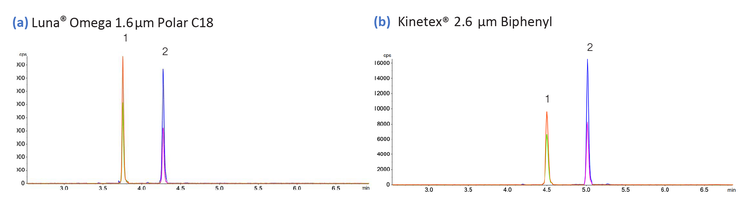
Phenomenex sample preparation and column chemistries support recovery, retention stability and selectivity, reducing matrix-related variability and making quantitative results easier to interpret across runs and studies. The case study below illustrates how column choice can influence the retention and response of a specific analyte pair.
How phase choice can change the result
Front-end choices are often treated as method setup details, but they shape every result that follows. In this case study (LC-MS/MS Separation using Luna® Omega Polar C18 and Kinetex® Biphenyl), both phases resolve diclofenac and 4′-hydroxydiclofenac under identical mobile-phase conditions. For this analyte pair, Kinetex® Biphenyl provides greater retention, narrower peaks and higher MS sensitivity. π–π and polar interactions help explain the retention and selectivity, while the narrower peaks and the core-shell morphology that supports chromatographic efficiency contribute to the sensitivity gain. Because phase selection influences retention and response before detection, downstream analysis cannot fully recover these chromatographic gains.
During acquisition: Acquisition evidence that withstands review
SCIEX X500 QTOF and ZenoTOF 8600 systems generate MS evidence for both quantitative and structural questions. On the ZenoTOF 8600 system, the Zeno trap increases the MS/MS duty cycle, improving sensitivity for low-abundance metabolites. More signal at low levels supports a more reliable response, but comparability across runs and studies still depends on the controls applied before and after acquisition.
After acquisition: Reporting built on standardized workflows
Genedata Expressionist provides standardized workflows for data processing, review and reporting, helping teams document results consistently and share traceable evidence across programs to support confident decisions.

Accelerate HT-MS Data Analysis with Automation
We see a way to reduce the time required for HT-MS data analysis by up to 80%.
Genedata | Genedata Expressionist
Confidence is built across the workflow
Decision-ready data does not come from a single instrument, a single column or a single software step. It comes from controls applied consistently before, during and after acquisition, so a change in a reported value is more likely to reflect the sample than the method. When these controls work together, results become measurable, comparable and reportable across runs, studies and teams.
Ready to strengthen confidence in your LC-MS results? Read our eBook, From Metabolite Identification to Decision-Ready Measurement, to see how a connected workflow supports reliable measurement, consistent review and traceable reporting.