Design Once Deploy Many Through Platform‑Based Gene Editing

As gene editing has evolved from a research tool to a credible therapeutic strategy, advances in edit design and targeting have been the primary focus. Yet, success should not depend on standalone innovation, but on a well-established, platform-ready process that integrates regulatory readiness across workflows, connecting edit design to biological results and clinical performance.
The central challenge facing the field is not a lack of tools, but the fragmentation of efforts. As the gap between what can be edited and what can be delivered widens, a platform approach is necessary to make genomic medicine more accessible.
What the field needs isn’t piecemeal solutions. We have the opportunity to develop an end-to-end platform and leverage it across hundreds to thousands of disorders.
A platform approach provides an alternative path forward. Centered around designing a process once and then implementing it repeatedly, adjusting only what is necessary for mutation-specific treatments.
The Limits of One‑Off Development
Traditional therapeutic development is optimized for mainstream drugs. Each gene editing program advances independently, with its own manufacturing process, analytical strategy and regulatory narrative. This approach works when patient populations are large and timelines are flexible.
CRISPR‑based therapies, particularly those targeting rare and ultra‑rare diseases, operate under very different constraints:
- Patient populations are small
- Mutations are often unique
- Timelines can be clinically urgent
Under these conditions, rebuilding CMC, analytics and regulatory frameworks for every new indication quickly becomes unsustainable.
What If Only the Nucleotide Sequence Changed?
The single-template platform concept is based on the observation that, in many CRISPR workflows, most of the system remains unchanged.
Across indications, the following elements are often conserved:
- Cell type and harvest methodology
- Editing machinery
- Delivery modality
- Manufacturing workflow
- Analytical release framework
Oftentimes, the sequence of a guide RNA or repair template is the only change.
Instead of redesigning the entire process for every disease, platform approaches allow change to a single, well‑characterized component. Everything else is validated once and reused.
The only thing you change from disease one to disease two is the middle of a single strand of DNA.
Building Reusable Systems Through Manufacturing Consistency
Historically, development pipelines are drawn as straight lines:

Each program moves forward independently. As researchers, biopharma and regulators increasingly emphasize reuse and comparability, platform‑based development is becoming a shared direction for the field.
Platform thinking replaces this linear model with a reusable system, where:
- Validated processes are carried forward
- Manufacturing knowledge compounds
- Regulatory precedent accumulates
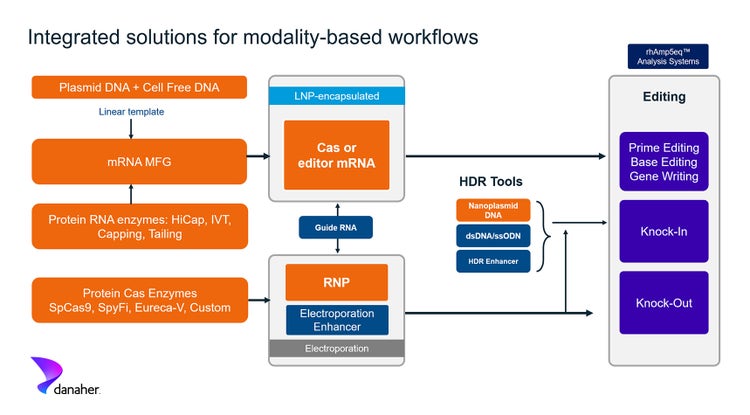
This platform-level depends on the alignment of complementary capabilities across the development and manufacturing continuum. Within the life science companies of Danaher, efforts to connect nucleic acid production, delivery and manufacturing technologies with analytics and characterization tools into unified workflows help establish the consistency and continuity required for reusable systems.
Each new indication strengthens the platform rather than fragmenting it. In this model, the unit of innovation is no longer a single drug. It is the system that produces drugs.
The success of a single‑template platform depends on consistency in manufacturing and controls.
Holding core processes constant enables teams to:
- Establish well‑defined critical quality attributes (CQAs)
- Demonstrate comparability across programs
- Reduce variability introduced by process changes
This consistency allows meaningful reuse of CMC processes and analytics, which is critical for accelerated development timelines.
Within a platform vision, high‑quality DNA, RNA and protein inputs, combined with scalable manufacturing and delivery systems, are designed to support repeatable execution rather than fragmented workflows.

Why CMC Matters
Platforms succeed when manufacturing and controls are designed for reuse, not reinvention.
Working with Regulatory Frameworks Through Platform Design
Platform‑based development does not seek to bypass regulation; it seeks to work with it.
When regulators can see that:
- The manufacturing process is unchanged
- The analytical framework is consistent
- Only a defined genetic element has been modified
Review shifts from evaluating an entirely new product to assessing a controlled variation within an established framework.
This approach allows regulatory learnings to scale alongside scientific ones, specifically for pediatric and rare‑disease indications. This approach reduces friction while maintaining oversight.
From Craft to Infrastructure for Scaling Personalized Medicine
Personalized and mutation‑specific therapies are often viewed as incompatible with scale. The single‑template platform challenges that assumption.
By standardizing everything around the edit, platforms enable personalization without reinvention:
- New sequences can be designed rapidly
- Manufacturing workflows remain stable
- Release and potency assays are reused
The system absorbs variability, allowing teams to move from sequence to gene therapy without restarting development. Having proven what is scientifically possible, the field now faces a different challenge: making those successes repeatable.
Building for What Comes Next
Early CRISPR programs succeeded because of extraordinary scientific craftsmanship. That foundation was necessary to prove what was possible.
The next phase of genetic medicine requires infrastructure. Single‑template platforms transform CRISPR from an artisanal process into an engineered system, one that can support many diseases, many patients and many iterations over time.
The long‑term impact of CRISPR will not be measured by how precisely we can edit a single genome, but by how reliably we can deliver that capability to patients who need it.
The single‑template platform concept is not just a technical strategy; it is a mindset shift. One that prioritizes reuse, consistency and scalability without sacrificing scientific rigor.
By designing systems that expect variation and are built to accommodate it, the field can move closer to making CRISPR medicine practical, repeatable and accessible.
Learn how scalable manufacturing, analytics and delivery strategies enable repeatable gene editing programs.