How Reagent Design and Selection Impact Scalable CRISPR Gene Editing

CRISPR technology remains the backbone of modern gene editing because of its adaptability, programmability and precision. As the field advances, however, the expectations for reagent design and selection continue to rise. Drug developers must now balance specificity, efficiency, manufacturability and regulatory considerations from the very first design cycle when building scalable gene editing workflows.
Why Consistency Drives Scalability
High-fidelity nucleases, engineered Cas variants and purpose-built guide RNAs play a central role in determining the reliability, reproducibility and translational viability of CRISPR gene editing programs. Choosing reagents that minimize off-target effects while maintaining consistent performance across experiments is essential.
In platform-based gene editing approaches, defined PAM sequence recognition drives predictable editing behavior. This predictability reduces characterization and validation requirements, helping teams accelerate downstream development.
Just as important, thorough quality control and validation ensure that editing results reflect true biological performance rather than reagent-driven variability. As gene editing moves into increasingly regulated environments, reagent integrity, traceability and performance data have become foundational requirements for scaling beyond early research.
Key Considerations:
Reliably Designed to Your Specifications
IDT enables researchers to take control of translational gene editing programs with a suite of RUO CRISPR-Cas9 guide RNAs engineered for manufacturing consistency. These solutions enable reagent design, selection and evaluation at every stage.
From redesigned and custom guides to tools for evaluating published or internally generated protospacer sequences, IDT provides flexible design options to help you de-risk edit selection, streamline characterization and improve traceability.
- Predesigned Alt-R CRISPR-Cas9 guide RNAs
Ready-to-use gRNAs targeting common model organisms, manufactured to stringent quality standards to ensure consistent cutting performance - Custom Alt-R™ CRISPR-Cas9 guide RNA
Designed for any target or species, produced with controlled processes that translate predictive in silico performance into reliable on-target activity - CRISPR-Cas9 guide RNA design checker
A computational assessment to assess the on- and off-targeting potential of protospacer designs of your own or from publications before ordering guide RNAs
In addition, IDT offers end-to-end CRISPR cGMP gRNA manufacturing services designed to support therapeutic programs from preclinical development through clinical trials. These services combine phase-appropriate cGMP production, robust quality control and regulatory-aligned documentation.
HDR Design That Supports Translational Gene Editing
For applications requiring homology-directed repair, the Alt-R™ CRISPR HDR Design Tool offers exceptional flexibility. Supporting multiple species and input formats, researchers can design and order HDR donor templates, along with associated Cas9 guide RNAs, for genome editing.



Simplifying Nuclease Selection at Scale
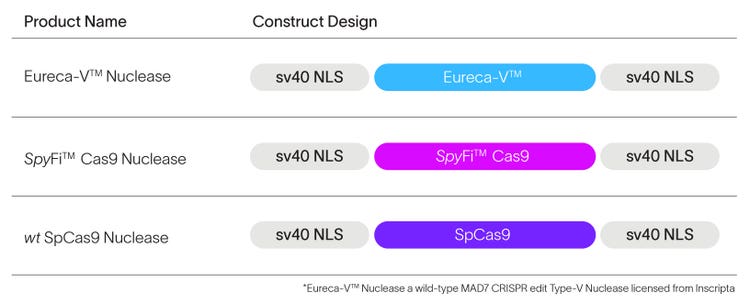
Guide RNAs are only one component of a scalable gene editing strategy. Selecting the right nuclease is another critical component of scalable gene editing. Aldevron has streamlined nuclease selection by manufacturing and stocking gene-editing nucleases under appropriate quality systems, including research-grade, ISO 13485 or full cGMP. Plasmid DNA and mRNA formats are also available in scalable configurations.
These scalable formats help development teams maintain continuity, reduce comparability burden and streamline CMC readiness as programs advance.
Reagent Design as a Foundation for Scaling Gene Editing
As gene editing programs advance toward practical application, reagent design and selection increasingly influence what can be achieved downstream. Choosing well-characterized, high-quality reagents from the beginning supports consistent results, reduces development risks and establishes the foundation for scalable, regulated workflows. In today’s gene editing landscape, scalability is not an afterthought; it starts with design.
Discover how the life sciences of Danaher solutions can support you in scalability, reduce development risk and enable regulatory-ready CRISPR workflows from initial research to clinical development.