A Practical Approach to Automating Oncology NGS Research
Many oncology research teams are under pressure to deliver actionable NGS results to advance the understanding of complex tumor biology. Yet they are constrained by inadequate bench space, limited throughput and the complications of manual preparation, which introduce variability and additional steps for troubleshooting and rework.
While automation is often seen as a solution reserved for high-throughput facilities, these challenges are equally applicable to smaller laboratories seeking to improve consistency in low-throughput NGS assays. In this Q&A, Eedann McCord, PhD, Sr. Field Application Scientist at Beckman Coulter Life Sciences, explains why benchtop liquid handlers are an ideal entry point for research groups considering automation and how it can strengthen confidence in results while freeing researchers from exhaustive and repetitive tasks at the bench.
1. What laboratory challenges signal that it may be time to move from manual methods to automation?
Manual workflows can be effective for small-to medium-scale studies, but they often carry hidden costs that accumulate over time. Repetitive benchwork is one of the major sources of error. Repeated pipetting, labeling, and setup steps create opportunities for human error and rework. By consuming valuable time and creating physical and mental strain, manual repetition ultimately limits staff availability for cognitively demanding tasks, such as data analysis or method development.
Small errors can be compounded by operator-to-operator variability when multiple team members repeat tasks with differing levels of expertise. The resulting variations in outputs can heavily disrupt interpretability, reproducibility and the ability to leverage data for decision-making.
The ideal time to move toward automation is when these bottlenecks become recurring themes and stall research projects. By standardizing execution, reducing variation and embedding sample tracking into the workflow, automation can help research teams reclaim time, minimize errors and build confidence in their results.
2. What makes a benchtop liquid handler an approachable first step into laboratory automation?
For many labs, the leap into automation can feel daunting, especially when sample volumes are modest and bench space is limited. The Biomek i3 Benchtop Liquid Handler was designed to remove these barriers by offering a compact, entry-level solution that delivers automation benefits without requiring a high-throughput platform.
Its small footprint makes it particularly suitable for integration into existing laboratory setups. Within a small space, the platform consolidates functions otherwise spread across the bench, including pipetting, plate movement, heating, cooling and shaking, all of which can be easily automated.
Beyond the hardware, Biomek software makes implementation even easier. It provides a drag‑and‑drop interface, guided setup and built‑in error prediction, enabling researchers to automate methods without coding experience. Training resources, downloadable methods and application support further reduce adoption hurdles, helping teams get acquainted quickly.
Most importantly, the Biomek i3 allows laboratories to build automation capability incrementally. Rather than redesigning the entire workflow at once, teams can first standardize critical processes and then continue to expand and align as sample volumes increase and the need for additional panels grows.

We See a Way to
accelerate biomarker discovery by reducing hands-on sample preparation time by up to 2.5 hours
Beckman Coulter Life Sciences | Biomek i3, Biomek i5, Biomek i7 Automated Workstations
3. How does automating an NGS library preparation workflow change the day-to-day experience for laboratory teams?
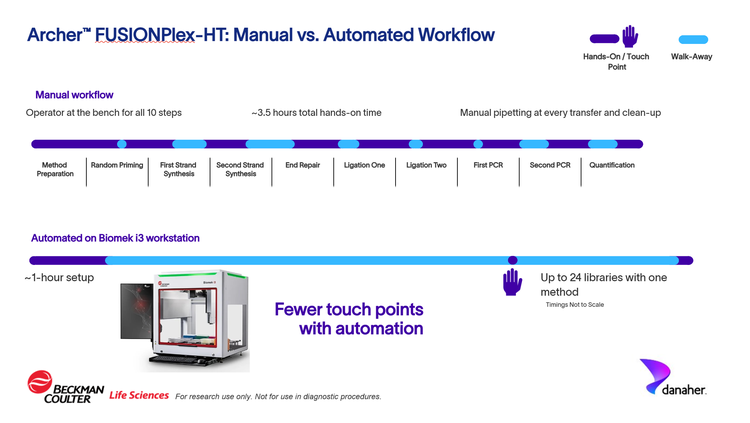
One of the biggest changes automation brings to sequencing workflows is the way researchers spend their time. With manual workflows, operators must be present at the bench for every step, performing repetitive pipetting and setup tasks. These touchpoints are separated by only short pauses, leaving limited time to focus on tasks away from the bench.
Automation shifts that balance. While total runtime may remain similar, required touchpoints and, therefore, hands-on time, decrease significantly. For example, when running the Integrated DNA Technologies FusionPlex HT assay with 24 samples, the Biomek i3 reduces user interaction to a single mid-run touchpoint. For a smaller batch with 8 runs, that touchpoint disappears. This means that teams can allocate valuable time to other priority work, such as data analysis.
Beyond freeing up time, automation also mitigates the risks of human errors associated with manual setup. Guided reagent and deck setup helps streamline library preparation while still giving users the flexibility to select start and stop points according to their schedules. As a result, automation makes complex NGS workflows more predictable, efficient and manageable.
4. How can labs extend the value of the Biomek i3 beyond a single FusionPlex workflow?
The Biomek i3 is not limited to a single assay, but rather adaptable to other sequencing assays. Because the deck configured for FusionPlex HT would use the same layout as other workflows, such as the Integrated DNA Technologies VariantPlex, teams do not need to reinvent their setup when expanding into new panels.
This adaptability is further supported by downloadable tutorials and demonstrations that provide step-by-step guidance for specific workflows. This is complemented by extensive support and training by field application scientists, helping researchers modify their experimental design incrementally without sacrificing method robustness.
Overall, the Biomek i3 provides a foundation for automation that can be scaled to meet laboratories' needs as research priorities evolve.
5. How does the automated method help support reproducibility and confidence in results?
Variation is a pain point in manual workflows, a problem that automation addresses by standardizing critical experimental operations. We demonstrate this in comparative studies, where Biomek i3-automated FusionPlex HT libraries exhibited equal or greater complexity and gene-specific primer performance than manually prepared libraries.
More importantly, the automated workflow supported reliable fusion detection across both panels. For the Pan Heme V2 panel, automated preparation achieved a higher average detection rate for the nine expected fusions than manual preparation. For the Pan Solid Tumor V2 panel, both automated and manual preparation detected all six expected fusions. These results demonstrate that automation not only preserves coverage and sensitivity but also builds confidence in data quality by supporting consistent fusion detection.
Watch the webinar to see the Biomek i3-automated FusionPlex HT workflow in action and explore the performance data, workflow configuration and implementation considerations in greater detail.