Metabolite Quantitation Without Reference Standards: Choosing the Right Measurement Approach

Identifying a metabolite answers only the first question. Development teams also need to know how much is present, whether it's changing and whether the data are reliable enough to act on. That can be hard when reference standards are scarce and data come from several studies, instruments and sites.
From identified signals to consistent targeted measurement
Once metabolites are identified, the goal is to track priority components consistently enough to distinguish meaningful change from analytical variability.
Start with a results-supported decision, then align the acquisition strategy, calibration approach and acceptance criteria with it. Metabolite reference standards can be difficult to obtain due to limited accessibility, so the quantitation strategy must fit both the decision and the materials available.
Three measurement tiers and the decisions each supports
When no reference standard exists, most programs work in the semi-quantitative tier, using one of two strategies:
- Parent-equivalent estimates use the parent compound’s calibration curve and are reported as parent equivalents, assuming a comparable analytical response between the parent and the species being measured.
- Response-normalized trending tracks relative peak area against a labeled parent or surrogate internal standard. It's valid for tracking change over time, not absolute concentration.
For either approach, confirm any quantitative estimates using appropriately characterized reference material and a method suited to the intended purpose before relying on them for exposure assessment, safety evaluation or regulatory decisions.
Where acquisition and data processing fit in
The degree of measurement confidence a program can achieve depends largely on acquisition performance and analytical consistency. Acquisition must deliver the required sensitivity and selectivity, while data processing must apply consistent criteria across samples and over time.
In practice, that means pairing acquisition that can see low-level species with processing that applies the same rules every time. Consistent measurement also depends on reproducible sample preparation and chromatographic separation, because variability introduced before acquisition cannot be corrected through downstream processing alone.
From discovery signal to targeted follow-up
SCIEX X500R QTOF supports broad screening with accurate-mass data and measurement data that targeted metabolite screening depends on. For targeted follow-up, the ZenoTOF 8600 system enhances sensitivity for lower-abundance analytes that require closer evaluation.
Standardized data processing for consistent results
Genedata Expressionist applies automated workflows to process data, compare results across samples, instruments and studies and generate standardized reports, enabling consistent evaluation of priority analytes, metabolites and impurities while reducing reliance on ad hoc manual review.

Accelerate Biomarker Discovery & Validation
We see a way to increase confidence in biomarker discovery and validation with up to 10x greater sensitivity and quantitative data that scales
SCIEX | ZenoTOF 8600 system
Standardized processing of oligonucleotide biotransformation data
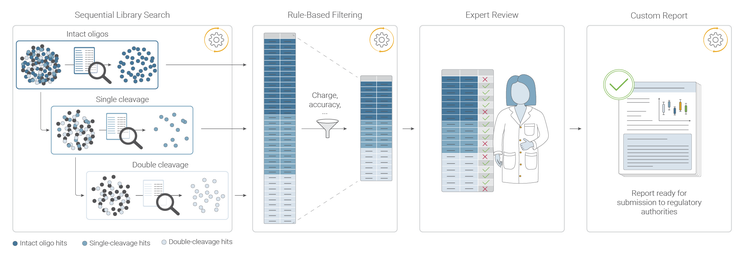
In this case study (Automating MS Analysis of Therapeutic Oligonucleotide Biotransformations), Novartis uses sequential searches and predefined filters to assess oligonucleotide therapeutics and their metabolites consistently. Genedata Expressionist removes signals already matched to known species and filters the rest by charge and mass accuracy, so expert review focuses on what remains unexplained.
Applying the same processing rules every time can help keep results comparable as priority species move into targeted monitoring. Quantitative measurement still requires calibration matched to the tier of decision being made.
Explore the full MetID and Monitoring workflow. Download the ebook to see how identification, targeted monitoring, calibration and standardized reporting work together to support decisions from early screening through quantitative confirmation.