Multiparametric Image Analysis of Organoids Using Machine Learning Algorithms for Toxicity Assessment
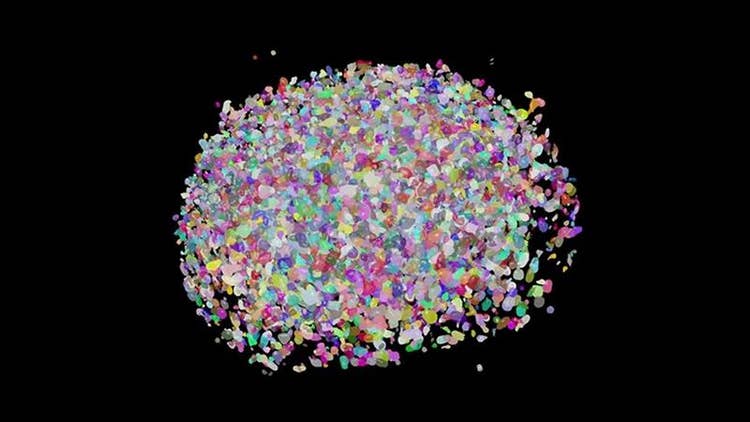
Dr. Oksana Sirenko, PhD, Senior Manager, Assay Development – Molecular Devices, addresses the utility of machine learning-based image analysis in assessing drug hepatotoxicity, a critical bottleneck in drug discovery. She discusses how combining unsupervised and supervised learning can streamline high-content imaging and phenotypic screening, which can significantly improve the accuracy of toxicity assessment.
1) What is the role of advanced cell models in improving clinical trial success rates?
Developing a single drug can take up to 15 years and cost billions of dollars, yet nearly 90% of drug candidates fail during early clinical trials. Liver toxicity is a particular concern not only for drugs in development but also for those already available on the market. In the US alone, there are about 60,000 cases of liver toxicity each year. This has a profound impact on drug development because 30% of clinical trial failures are due to safety issues, many of which are linked to liver toxicity.
One of the main reasons for early clinical trial failures is the reliance on traditional 2D cell cultures and animal models, which do not accurately replicate the complexity of human biology. That is why there is a critical need for advanced cell-based systems that better represent human physiology and better predict drug efficacy and toxicity.
Current models for toxicity testing have serious limitations. Immortalized cell lines lack tissue complexity, and animal models often fail due to species differences in metabolism and toxicity responses. This gap presents an exciting opportunity to leverage sophisticated cell models that better reflect human biology, along with analytical tools to more accurately predict toxicity.

IN Carta by Molecular Devices accelerates high-content imaging by 4X and enables Al-generated analysis.
Molecular Devices | IN Carta Image Analysis Software
2) What are the hallmarks of drug toxicity, and what is the key challenge in their analysis?
When using advanced models, various markers can be selected to gain critical insight for phenotypic toxicity assessment. Mitochondrial dysfunction indicates cellular toxicity, disrupting energy production and triggering apoptosis. The actin cytoskeleton regulates cell shape, motility and intracellular transfer. Disturbances here often signal toxicity-induced apoptosis and necrosis. Nuclear staining assesses cell viability and apoptosis, while Golgi disruption indicates stress. Similarly, changes in mRNA levels reflect transcriptional and translational damage.
Traditional image analysis uses high-content imaging methods. Microtissues are treated with a panel of known hepatotoxic drugs, and spheroids are fixed and stained using a set of cell painting dyes to visualize various cellular components, including key biomarkers. Images are then captured with multiple markers, and analysis proceeds through several steps, which include object identification, markup detection and cell classification. Performing image segmentation enables us to extract measurements characterizing spheroids and the cells within them.
Because this process generates high-dimensional data, especially in multiparametric image analysis, advanced statistical methods like principal component analysis, clustering and heat maps are often required.
3) How can machine learning streamline complex high-content imaging and multiparametric image analysis?
Multiparametric image data analysis is computationally expensive and difficult to interpret biologically. Machine learning simplifies the process by automating the classification and clustering of phenotypic profiles, which reduces manual effort while improving scalability. In addition, machine learning can enable deeper morphological profiling and more detailed biological insights.
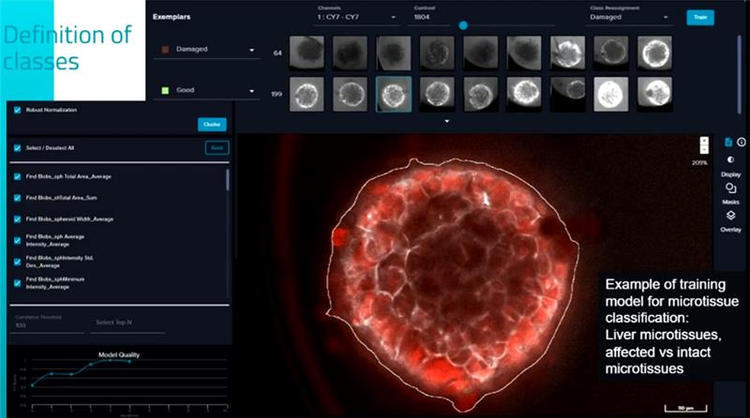
We use machine learning tools built into the IN Carta Image Analysis Software that combine unsupervised and supervised learning. First, we use IN Carta's deep learning module, SINAP, for image segmentation to detect spheroids and extract measurements, including area, diameter, perimeter, texture and intensity. To make sense of the vast data generated, we use IN Carta’s Phenoglyph module, which clusters objects based on similarities, providing an unbiased view of organoid appearance under various conditions. Then, supervised learning consolidates these clusters into two classes, such as intact and damaged organoids. We train the software using example organoids to distinguish these classes, enabling us to determine the EC50, the drug concentration at which 50% of organoids become damaged.
4) What are the main advantages of machine learning-driven image analysis?
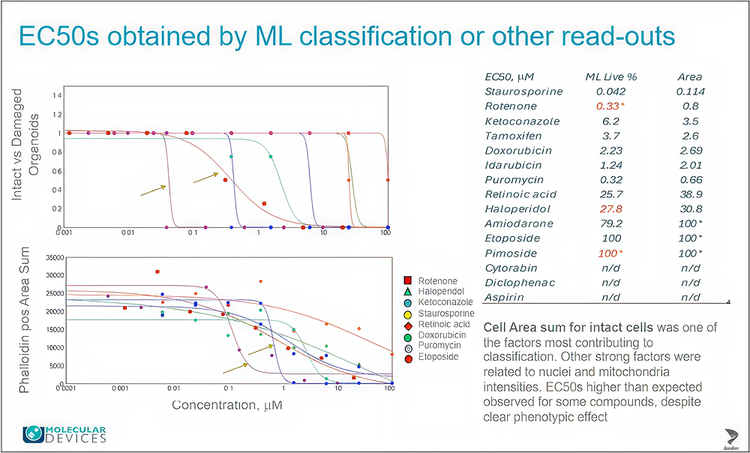
A key advantage of machine learning is its capacity for multiparametric classification, which demonstrates higher accuracy and sensitivity than manual classification with a singular readout. For example, we measured the ratio of intact organoids to damaged organoids using both methods. We found that classification with a single manual readout returned a higher ratio compared to IN Carta’s multiparametric algorithms. Upon further investigation, we found that organoids may exhibit strong actin staining despite being damaged. So, if you rely only on a single readout, you may falsely identify damaged organoids as intact, deducing an EC50 value for your drug candidate much higher than the actual value.
Overall, machine learning is crucial for robust, automated classification of organoid phenotypes, ensuring accurate detection of toxicity-related effects. By delivering multiparametric, sensitive and unbiased quantification of toxicity responses, machine learning offers deeper insight into the drug mechanism of action. It also streamlines image analysis workflows, saving time and significantly increasing throughput. Ultimately, machine learning makes high-content screening more efficient and supports data-driven decision-making in drug discovery pipelines.
Check out the full webinar for an in-depth discussion covering AI-driven imaging and screening solutions, demonstrating how rich datasets can be turned into actionable insights.