Streamlining Fusion Detection in Translational Oncology with NGS
Detecting gene fusions is one of the most challenging aspects of translational research and can be difficult to detect in sequencing workflows. Missing these details can leave critical gaps in understanding disease biology, especially when investigating complex tumors. Traditional library preparation methods often increase the difficulty.
In this Q&A, Randy Pares, Automation Staff Specialist, Integrated DNA Technologies (IDT), unpacks how FUSIONPlex-HT addresses pain points in NGS and scales NGS workflows for biomarker-driven oncology research.
1. Why is detecting novel, rare or complex fusion events important in translational research?
Fusion events can be particularly challenging to detect when they involve rare partners, complex rearrangements or low-abundance RNA transcripts. Predefined assays often miss these types of alterations, yet they carry significant biological meaning. For translational research, the ability to detect these signals provides a more complete view of disease biology, helping researchers understand tumor heterogeneity and the molecular drivers behind disease progression.
Missing fusion-event signals means losing the opportunity to uncover new biomarkers or to track subtle molecular changes. For instance, low-abundance biomarkers are especially relevant for monitoring residual disease or for detecting the emergence of treatment-resistant clones. Their early detection guides downstream assay development, strengthening disease profiling strategies across solid tumors and hematologic malignancies.
Equally important is the correct interpretation of rare events, which relies on the ability to distinguish between biologically meaningful signals and technical artifacts. Generating more reliable NGS data supports biomarker discovery, longitudinal monitoring and the development of targeted follow-up assays, all of which are central to advancing translational oncology research.

We See a Way to
to detect 22.5% more gene fusions in solid tumor research samples
Integrated DNA Technologies | Archer™ FUSIONPlex™ Pan Solid Tumor v2
2. What laboratory challenges is the automated FUSIONPlex-HT workflow designed to address?
Many labs working on detecting fusion events encounter a set of familiar pain points. Inconsistent results, allele-frequency variability and uneven coverage can undermine confidence in NGS data. Hands-on library preparation adds another layer of complexity, limiting throughput and introducing user-to-user variability, making results harder to compare across runs. To add to that, when reporting is fragmented across different analysis tools, interpretation risks overlooking rare or novel fusions, making it harder for researchers to draw actionable conclusions.
The automated FUSIONPlex-HT workflow is designed to alleviate these challenges. Reducing manual interaction helps standardize library preparation and minimize variability, enabling the preparation of 8 to 24 sequence-ready libraries in approximately 12 hours. On top of that, it aligns preparation with a more unified reporting framework to create fusion data ready for translational research.
3. What did the comparison between automated and manually prepared libraries show?
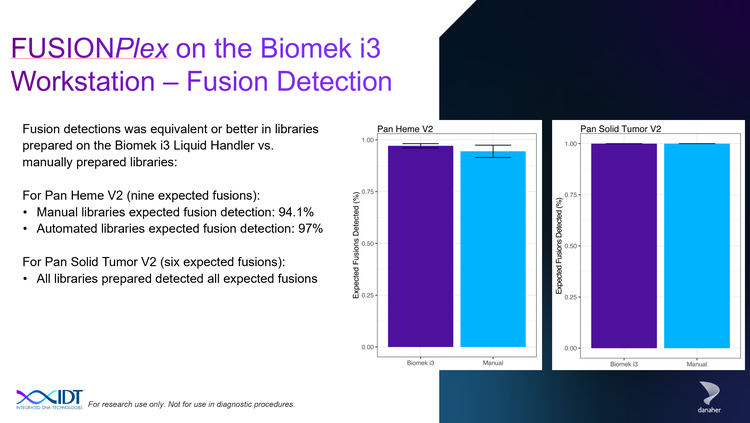
To evaluate performance, libraries were prepared both manually and on the Biomek i3 Benchtop Liquid Handler using FUSIONPlex-HT Pan Heme V2 and Pan Solid Tumor V2 panels. Across both panels and different metrics, automated preparation consistently matched or exceeded manual results.
In terms of library complexity, the Biomek i3 produced libraries comparable to manually prepared libraries. Average unique RNA start sites per primer pair were also comparable between automated and manual workflows, demonstrating that automation does not compromise coverage metrics.
Fusion detection further underscored the reliability of automation. For the Pan Heme panel, manual preparation detected about 94% of the nine expected fusions, with some samples missing one or two events. In comparison, automated preparation increased average detection to 97%, with fewer missed fusions overall. For the Pan Solid Tumor panel, all six expected fusions were detected in both manual and automated libraries. This shows comparable detection across the evaluated Pan Solid Tumor samples and even improves it in some cases.
Overall, these results indicate that automated library preparation not only reduces hands-on time and variability but also delivers consistent, high-quality data for reproducible fusion detection.
4. How do the chemistry, automation and analysis components work together as an integrated workflow?
FUSIONPlex-HT was designed as a connected system where chemistry, automation and analysis work together to create a seamless path from sample preparation to interpretable biomarker data.
The chemistry is rooted in Anchored Multiplex PCR (AMP), a rapid and scalable enrichment method for targeted RNA sequencing. By using unidirectional gene‑specific primers, AMP captures both known and novel fusions, including those with rare partners or complex rearrangements that might be missed by amplicon or hybrid capture sequencing. By embedding molecular barcodes and sample indices into adapters, the workflow ensures duplicates can be collapsed and mutation calls are reliable.
Analysis is powered by Archer Analysis, which integrates advanced algorithms for noise thresholds, error correction and outlier detection to improve confidence in low-level biomarker data. The software can identify various alterations, including fusions, splicing events, SNVs, CNVs and other variant types, in an interface that requires no coding or optimization. This ensures researchers can focus on interpreting and visualizing results rather than troubleshooting workflows.
Automation ties the workflow together and ensures that the gains made in chemistry and analysis are supported by reproducible sample preparation. Automation of FUSIONPlex on the Biomek i3 standardizes liquid handling and minimizes repetitive manual steps. This reduces user‑to‑user variability, shortens hands‑on time and enables longer periods of walk‑away operation, making high‑throughput sequencing more practical and reproducible.
Together, these components form an integrated workflow that empowers translational research by making fusion detection more comprehensive, consistent and scalable. At the same time, the workflow is flexible enough to allow labs to customize panels while maintaining comparable performance in the evaluated panels.
5. How can an NGS workflow balance throughput and flexibility?
Reagents are the first aspect of flexibility. With the FUSIONPlex-HT, flexibility and scalability are built right into the panel, as it is available in both lyophilized and automation-friendly liquid formats. This gives researchers the option to choose between manual protocols and high-throughput automation. For labs implementing automation via the Biomek i3, liquid kits are designed to fit seamlessly into robotic handling. Another advantage is batch-size adaptability, as kits are offered in 24- and 96-reaction formats, allowing researchers to align scale with sample throughput.
The workflow also comes with a breadth of customization options. This flexibility ensures that researchers can adapt their panels to cover disease-driving fusions and add emerging fusion partners as they are discovered.
In addition to the reagents and the panel, the workflow itself can be adjusted to align library preparation with lab schedules. The protocol includes safe start and stop points, optional pauses for pre-sequencing QC and reagent setup instructions, all aimed at maximizing efficient walkaway time and reducing unnecessary manual interventions.
Together, these features make FUSIONPlex-HT a versatile technology, compatible with both small batch exploratory studies and large-scale translational research programs.
Watch the webinar to explore the complete performance data and learn how an integrated oncology NGS approach can support more consistent, scalable biomarker research.