How Integrated CRISPR Manufacturing Accelerates the Path from Discovery to the Clinic
As genetic medicines advance from concept to clinic, the need for streamlined and reliable manufacturing continues to grow. Developing these therapies demands speed, precision and coordination across design, manufacturing, testing and regulatory milestones. In this Q&A, Max Sellman, formerly Senior Product Manager at Aldevron, shares practical insights on how innovative CRISPR manufacturing can support faster development, reduce risk and simplify the development of life-changing therapies for patients.
Q1: Why should genetic medicine innovators seek end-to-end manufacturing services rather than managing multiple vendors?
When developing genetic medicines, timelines are already tight, especially for patients with rare and life-threatening conditions. Working with multiple vendors for sequence design, reagent production, quality testing and regulatory support can introduce delays, miscommunication and supply chain risks.
Working with an end-to-end manufacturing partner helps remove these obstacles by aligning the entire workflow, from early design to final drug product. This reduces complexity, improves coordination and helps keep programs on track. We can see the impact of this approach in the development of the first-ever personalized CRISPR-based therapy for an infant diagnosed with neonatal-onset urea cycle disorder (UCD).
“Through close collaboration with external partners like Integrated DNA Technologies, the overall timeline was shortened from 1.5 years to 6 months.¹ “
Ultimately, centralized manufacturing and aligned expertise allow genetic medicine developers to focus less on operational complexity and deliver treatments to patients sooner.
Q2: What advantages does working with a cGMP manufacturer offer as programs advance?
Working with a cGMP manufacturing partner helps ensure that drug products are produced consistently, safely and in line with regulatory expectations.
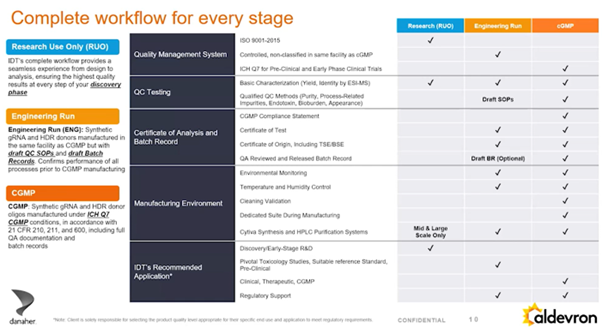
Early research is often about moving quickly and testing ideas. But as programs start heading toward clinical use, regulatory requirements become more stringent. This is where partnering with a cGMP manufacturing partner, such as Aldevron, becomes essential. We support this transition by providing controlled manufacturing environments, validated processes and rigorous quality checks at every step. Beyond compliance, we also help teams prepare for what comes next. This includes early feasibility studies to confirm that production methods are scalable and cost-effective, reducing the risk of delays later in development.
Overall, working with an experienced cGMP provider gives gene therapy developers confidence to move toward regulatory submissions and clinical trials, allowing them to focus on advancing therapies to patients.
Q3: How are CRISPR delivery methods established and optimized across research and genetic medicine workflows?
Choosing the right delivery method is just as important as selecting the gene editing tool itself. Depending on the delivery approach, this can introduce different technical and regulatory considerations.
To support delivery strategies, many developers are moving toward ready-to-use, well-characterized delivery vehicles that can be used consistently from early research through clinical development. For example, off-the-shelf Cas9 proteins produced under GMP conditions allow teams to avoid the time and cost of developing custom enzymes.
At Aldevron, the goal is continuity. By enabling researchers to use the same high-quality Cas9 delivery systems throughout the development lifecycle, variability is reduced and translation risk is minimized. In parallel, we offer regulatory support, such as FDA Drug Master Files (DMFs) and guidance for global submissions of CRISPR-Cas9 systems, to help smooth the path from the lab to the clinic efficiently.
The result we provide is a more predictable development process, lower project risk and faster progression toward clinical milestones.
Q4: How does integrating CRISPR reagents and donor DNA design improve editing efficiency for therapeutic applications?
Many therapeutic gene editing programs need to go beyond disrupting a gene. They require precise DNA insertion or correction. Although homology-directed repair (HDR) makes that possible, it can be inefficient and stressful for cells. By integrating next-generation donor templates with specialized repair enhancers, we can significantly increase the rate of successful gene editing while protecting cell health.
Traditionally, donor DNA is delivered to the genome using plasmids with bacterial sequences that can trigger immune responses. Using a streamlined donor format, such as Aldevron’s NanoplasmidTM helps address this issue by removing non-essential sequences. This results in a reduced cargo size, allowing for larger therapeutic transgenes. This design ultimately reduces transfection toxicity and improves recovery and proliferation rate for sensitive cells.
Even with a perfect template, cells may naturally repair DNA breaks using the quicker but messier NHEJ method. To encourage the cell to use the desired pathway, Aldevron pairs the CRISPR-Cas9 complex with the Alt-RTM HDR enhancer protein. This protein-based approach helps promote HDR pathways with lower toxicity than small molecule enhancers, mitigating concerns about cell viability.
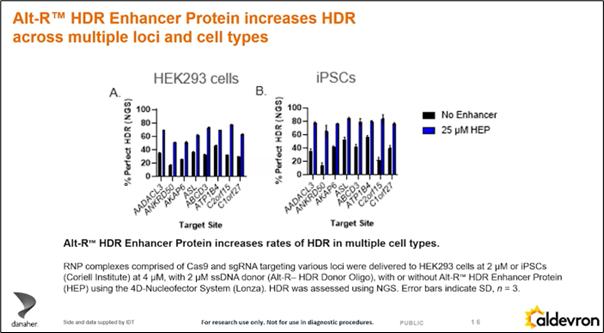
Optimizing both the donor template and the repair environment helps researchers improve editing efficiency. This integrated approach makes complex therapies, such as engineering patient cells with new functions, more scalable and clinically viable.
For a deeper dive into the technical and manufacturing considerations discussed here, view the full webinar on integrated CRISPR development.
1. Musunuru K, Grandinette SA, Wang X, Hudson TR, Briseno K, Berry AM, et al. Patient-specific in vivo gene editing to treat a rare genetic disease. NEJM 2025;392(22):2235-2243.