AI-Driven Multiplex Image Analysis to Uncover the Spatial Biology of Biomarkers in Complex 3D Cell and Tissue Models
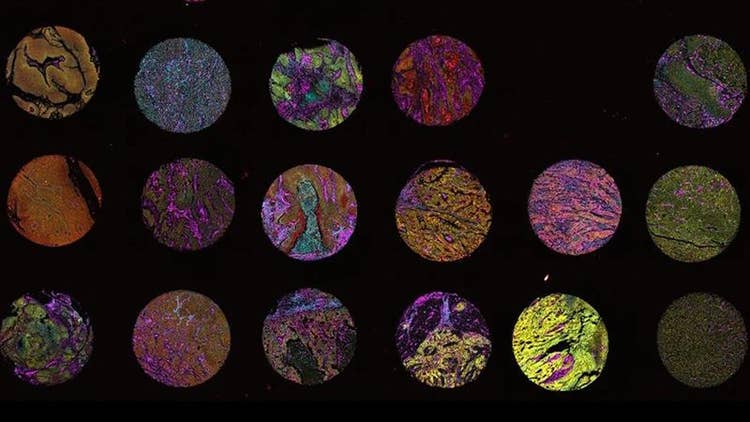
Dr. Won Yung Choi explores how AI-powered multiplex imaging and analysis are transforming our ability to interrogate spatial biology at scale. By enabling rapid, accurate segmentation and phenotyping of millions of cells, AI is helping researchers uncover complex relationships among biomarkers, signaling pathways, spatial organization and disease mechanisms, insights that were previously inaccessible.
1) Why is spatial biology important in cancer research?
Traditionally, tumor biology was studied using thin tissue sections and a limited number of biomarkers via visual inspection by a trained pathologist. While this approach provided valuable insights, it often overlooked the spatial organization of key tumor components and the dynamic interactions among them. Research has shown that the tumor microenvironment (TME) plays a crucial role in tumor prognosis and behavior in the human body.
At the same time, multiplex imaging methods have allowed researchers to detect and visualize several biomarkers simultaneously from a single tissue sample. With spatial biology technologies, scientists not only gain insights about the quantity of these markers but also monitor their distributions within the native tumor microenvironment.
2) How does AI enable deeper and more accurate spatial biology insight?
Analyzing complex 3D systems presents a significant challenge due to the massive data volumes generated from millions of cells across multiple imaging channels and biomarkers. The volume and dimensionality of datasets are far beyond what traditional analysis approaches can handle efficiently.
This is where AI becomes essential. Beyond accurate segmentation, AI models can rapidly interpret complex image data by classifying cells based on phenotypes and marker expression and by presenting similarities and differences in a coherent way. Furthermore, we can infer correlations between phenotypes and marker intensity and uncover insights into the complex interplay among cell types, marker intensity, and the spatial relationships among various structures of interest.
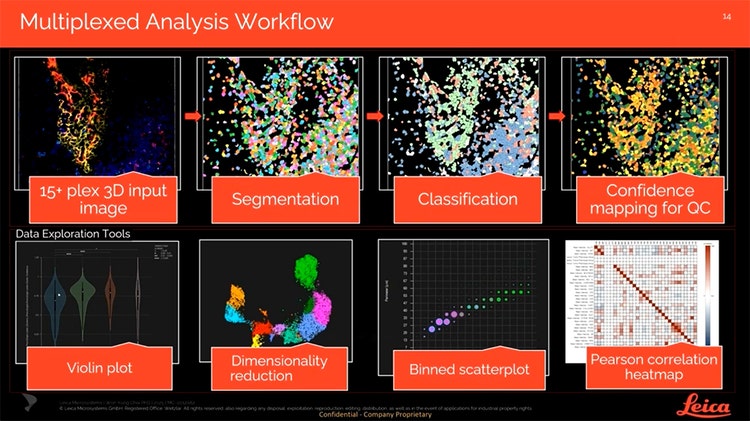
In an AI-powered multiplexed workflow, such as with the SpectraPlex imaging combined with Aivia analysis, high-plex 3D images are acquired and analyzed efficiently. Within Aivia, supervised learning and confidence mapping for classification support accurate phenotyping and spatial analysis of the tumor microenvironment.
3) What imaging and AI tools power multiplex analysis and what insights do they offer?
For robust image analysis, you should be able to visualize multiple targets at high resolution, but nuclear markers may interfere with your available spectra for high-plex imaging. SpectraPlex provides an innovative solution through advanced spectral unmixing algorithms, enabling high-plex imaging of up to 15 markers in a single acquisition. By expanding the usable spectral range, researchers can image more biomarkers simultaneously and gain deeper biological insights. Complementing this imaging capability, Aivia provides an advanced analysis solution for high-plexed 3D images without nuclear markers.
After segmentation, users can choose between supervised classification, in which they provide the software with labelled examples to train for phenotypic classification, and automated data-driven classification, in which the software discovers patterns unsupervised using the Leiden clustering method. Once you achieve the first level of phenotyping, specific cell populations can be further subdivided based on marker intensity and morphological features, enabling increasingly granular biological insights.
Aivia has additional tools for data interpretation:
- Interactive dendrograms to visualize similarities and differences among phenotypes and visualize the cells in their biological context
- Heatmap-based spatial distance maps that color-code cells based on proximity to specific phenotypes or structures
- Dimensionality reduction to simplify high-dimensional data into interpretable clusters
Collectively, these tools help users explore the complex relationships among phenotypes, biomarker expression and spatial organization within the sample without requiring coding expertise or training in deep learning algorithms.
4) How can image analysis software achieve unparalleled segmentation accuracy?
In designing Aivia’s segmentation capabilities, inspiration was drawn from Cellpose, a generalist cellular segmentation algorithm. One key component of this algorithm is that it was trained on highly diverse image types, including images from multiple microscopy modalities and even nonbiological objects such as seashells, garlic bulbs and road signs. This diversity enables strong generalization across cell types and imaging conditions.
To tailor this approach to our research, we trained our own deep learning model using extensive cellular imaging data and further optimized the pipeline to accelerate performance for both 2D and 3D high-plex datasets. This additional training significantly improved cellular segmentation accuracy by enabling the detection of cell membranes, cytoplasm, nuclei and vesicles across cells of diverse morphology.
Watch the full webinar for an in-depth look at AI-driven imaging and screening solutions that show how extensive datasets can be transformed into valuable insights.