We See a Way to
Reduce off-target editing by up to 100-fold using Alt-R™ S.p. HiFi Cas9 Nuclease
IDT | Alt-R™ CRISPR-Cas9 System + Alt-R™ S.p. HiFi Cas9 Nuclease

Point, click, edit-using a complete CRISPR Cas9 workflow
The Alt-R™ CRISPR-Cas9 System brings together high-performance guide RNAs, trusted Cas9 enzymes, and optimized delivery, repair, and analysis tools into one complete, validated workflow.
By delivering CRISPR components as a ribonucleoprotein (RNP) complex, researchers can achieve strong on-target activity, reduced off-target effects, and faster, more reproducible results across both knockout and knock-in applications. From experimental design through data confirmation, the Alt-R™ CRISPR-Cas9 System helps teams move confidently from idea to edit.






Why a complete CRISPR-Cas9 system matters
Optimizing individual CRISPR components in isolation can improve performance, but variability often emerges at the workflow level. Combining a high-fidelity nuclease with an integrated CRISPR system helps teams make confident editing decisions earlier, reducing rework and accelerating progress toward meaningful biological or translational outcomes.
Reduce off-target edits without sacrificing on-target performance
Off-target edits can slow research timelines, complicate phenotype interpretation, and lead to rework when experiments need to be repeated or re-optimized. In workflows such as pooled screens, precision knock-ins, or early translational studies, minimizing unintended edits while maintaining robust on-target activity is essential.
Pairing Alt-R™ S.p. HiFi Cas9 Nuclease with an integrated CRISPR-Cas9 workflow helps teams pursue confident edits while preserving editing efficiency across diverse applications.
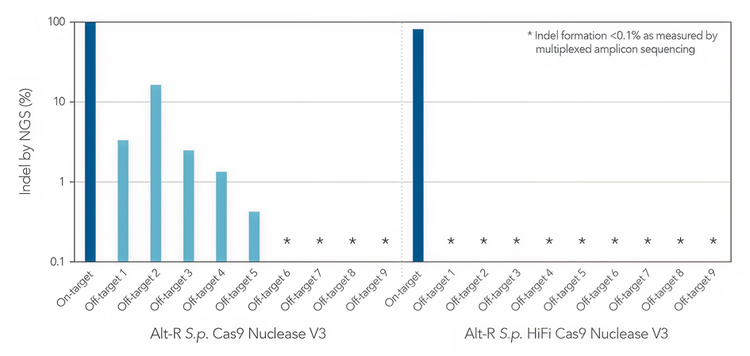
Figure 1. Alt-R S.p. HiFi Cas9 Nuclease V3 facilitates near-WT on‑target editing potency and reduces off-target site editing. RNP complexes were formed with either Alt-R S.p. Cas9 Nuclease V3 or Alt-R S.p. HiFi Cas9 Nuclease V3, combined with an Alt-R crRNA:tracrRNA complex targeting the EMX1 gene. RNP complexes (4 µM) were delivered into HEK-293 cells via nucleofection. Indel formation at the on-target locus, as well as nine known off-target sites, was measured by NGS (indicated on the y axis in log scale). n = 1.
Comprehensive off‑target editing analysis to support confident decisions
Reducing off‑target activity is only part of the solution. Understanding and validating off‑target editing risk is essential, particularly as genome‑editing programs advance toward translational and clinical applications. IDT offers end‑to‑end CRISPR off‑target editing (OTE) analysis services designed to identify and confirm unintended edits associated with CRISPR‑Cas nucleases.
IDT’s OTE workflow combines UNCOVERseq, a sensitive, genome-wide, in-cellulo off-target nomination method based on GUIDE-seq™, with the rhAmpSeq™ CRISPR Analysis System for downstream confirmation of nominated sites. Together, this integrated approach enables a robust and reproducible assessment of off‑target activity, supporting informed decision‑making across discovery and translational workflows.
A recent study describing UNCOVERseq demonstrated improved off‑target nomination performance compared with other commonly used OTE methodologies, enabling detection of low‑frequency off‑target editing events while maintaining specificity across CRISPR‑Cas modalities.
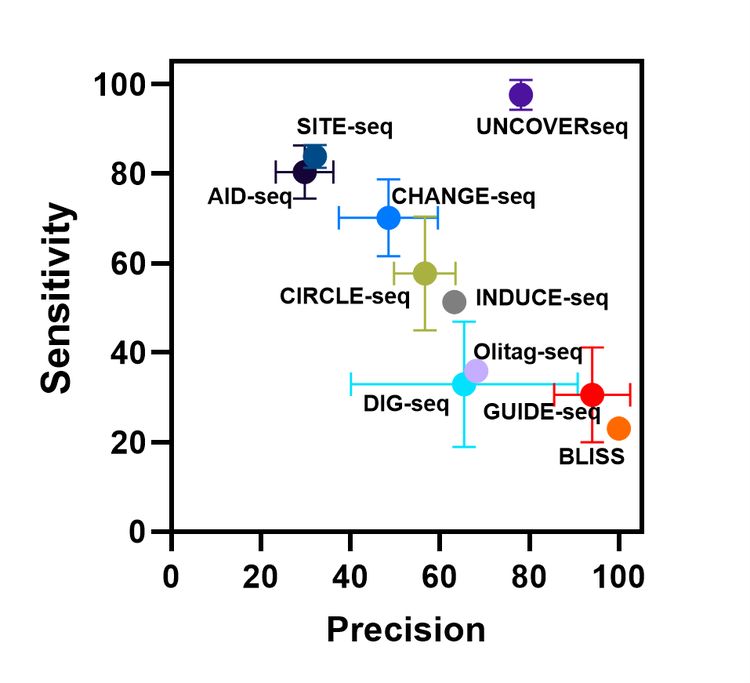
Figure 2. Comparative analysis of UNCOVERseq to other nomination technologies.
Method‑specific sensitivity (nominated true positives / confirmed true positives) and specificity (confirmed true positives / total nominated sites, including true and false positives) were calculated for each off‑target analysis method based on confirmed off‑target sites across two guide RNAs. Data illustrate the relative balance of sensitivity and specificity achieved by UNCOVERseq compared with other commonly used CRISPR off‑target nomination technologies.
Together, high-fidelity CRISPR editing reagents and sensitive off-target analysis tools enable researchers to both minimize unintended edits and confidently evaluate residual genome-editing risk.
Speak to one of our leading life sciences experts
TTAE
TTAE
546006278
TTAE
add
Talk to an Expert
https://lifesciences.danaher.com/
https://lifesciences.danaher.com/us/en/solutions/gene-therapy/crispr-gene-mediated.html