We See a Way to
Automate NGS workflows during process development and reduce the analysis time by 10X.
Genedata | Genedata Selector

Overcoming NGS Data Analysis Bottlenecks in Gene Editing Workflows
Gene editing programs rely on next‑generation sequencing (NGS) to verify intended edits, assess off‑target and integration events, and characterize gene editing constructs and delivery vectors such as AAV and LNPs. As CRISPR‑based programs progress and scale, sequencing datasets increase in size, diversity and complexity, often spanning multiple technologies, assays, and teams.
In many organizations, NGS data analysis is still performed using a combination of custom scripts, point solutions, and disconnected pipelines. This makes analyses difficult to standardize, results harder to reproduce, and review processes time‑consuming. As a result, sequencing data that are critical for understanding gene‑editing outcomes become challenging to compare, trust and reuse as programs move forward.
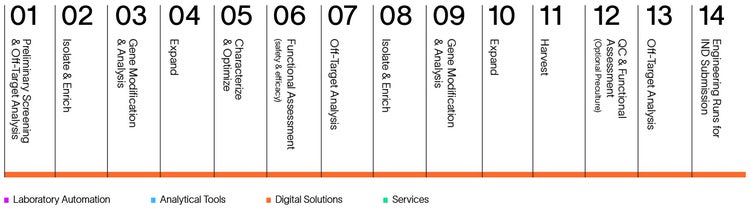
Consistent, decision-ready NGS data analysis for gene editing
Genedata Selector provides a unified software environment to automate and accelerate NGS‑based data analysis and management across gene‑editing workflows, enabling consistent interpretation of sequencing data from early experiments through later stages. As a single system for NGS analysis, Genedata Selector allows teams to integrate, analyze, and share sequencing data in a controlled and traceable way, even as gene editing programs grow in scale, complexity, and technological diversity.
From Raw Sequencing Data to Confident Gene Editing Decisions
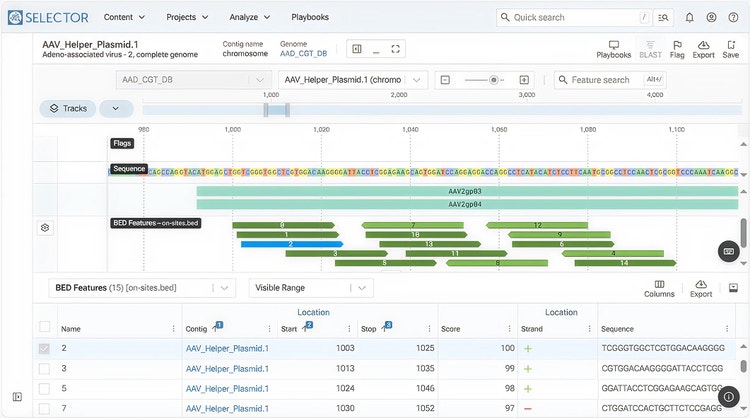
Genedata Selector supports NGS‑based analyses that are central to gene‑editing programs, including confirmation of intended edits, detection of off‑target and integration events and sequence‑level characterization of gene editing constructs and vectors. By processing raw sequencing data within a single, controlled analysis environment, Selector enables results to be reviewed and interpreted consistently across experiments, studies and programs.
Across these activities, Genedata Selector maintains full data lineage from raw sequencing data through analysis and reporting. This provides transparency into how results were generated and supports confident decision‑making based on NGS data as geneediting programs advance.
Handling Heterogeneous NGS Data in Gene Editing Programs
Gene editing programs increasingly rely on a combination of short‑ and long‑read sequencing technologies to assess editing outcomes, integration events, and construct integrity. Genedata Selector supports the analysis of NGS data generated across different sequencing platforms within a single analytical environment, allowing results to be evaluated using a consistent framework despite differences in read length, assay design, or technology. This enables gene editing teams to interpret sequencing results coherently as analytical strategies evolve and new sequencing approaches or modalities are introduced.
Speak to one of our leading life sciences experts
TTAE
TTAE
546006278
TTAE
add
Talk to an Expert
https://lifesciences.danaher.com/
https://lifesciences.danaher.com/us/en/solutions/mabs/cell-line-development.html