ATTO Rho110 Carboxy Fluorescent Label 1 mg
$undefined
Product No. AD-RHO110-21
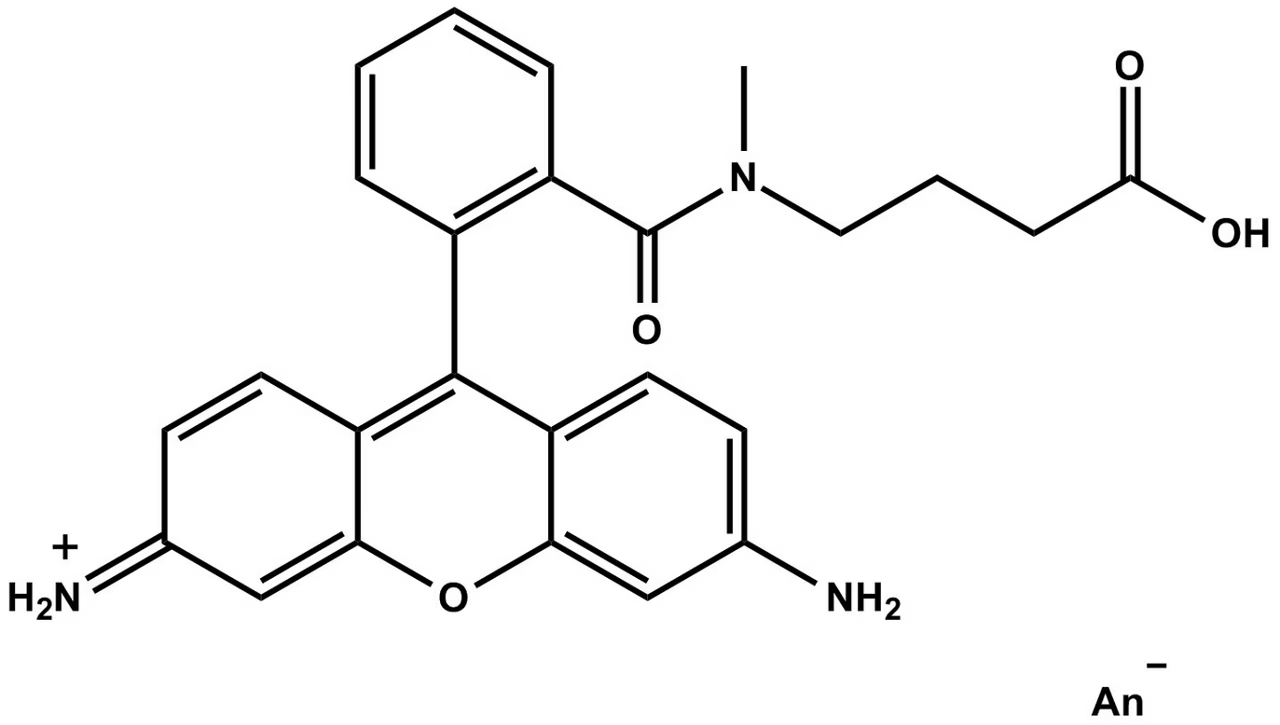
ATTO Rho110 is a new fluorescent label of the ATTO Rho dye-series.
ATTO-TEC is a wholly owned subsidiary of Leica Microsystems
Optical properties
- λ abs = 507 nm
- ε max = 1.0×10⁵ M -1 cm -1
- λ fl = 531 nm
- n fl = 85 %
- τ fl = 4.1 ns
- CF 260 = ε 260 /ε max = 0.21
- CF 280 = ε 280 / ε max = 0.14
ATTO Rho110 is a new fluorescent label of the ATTO Rho dye-series. The dye is a less hydrophilic variant of the dye ATTO 488 and is characterized by strong absorption, very high fluorescence quantum yield and high thermal and photochemical stability. Thus ATTO Rho11 is highly suitable for single-molecule detection applications and high-resolution microscopy such as SIM, STED, PALM, dSTORM, etc. Like all ATTO Rho dyes, ATTO Rho11 highly qualifies to be applied in oligonucleotide labeling. Additionally the dye can be used in flow cytometry (FACS), fluorescence in-situ hybridization (FISH and many more.
| Modification | Carboxy |
| Unit of Measure | 1 mg |
| Product Group | ATTO Rho110 |
| Product Type | Fluorescent Label |
| Emission Line (nm) | 488, 514 |
| Fluorescence Maximum (nm) | 531 |
| MH+ (g/mol) | 430 |
| Molecular Weight (g/mol) | 530 |
| Light Source | Argon-Ion laser |
| Correction Factor Used in Calculation of Degree of Labeling (DOL) in Case of Dye-DNA Conjugates (CF260 = e260 /emax ) | 0.21 |
| Correction Factor Used in Calculation of Degree of Labeling (DOL) in Case of Dye-Protein Conjugates (CF280 = e280 /emax) | 0.14 |
| Increase of Molecular Mass on Conjugation with ATTO-label (NHS-ester : amine) | 412.5 |
| Increase of Molecular Mass on Conjugation with ATTO-label (maleimide : thiol) | 552.6 |
| Change of Electrical Charge on Conjugation with ATTO-Label | +1 |
| Longest Wavelength Absorption Maximum (nm) | 507 |
| Molar Decadic Extinction Coefficient at the Longest Wavelength Absorption Maximum (M-1 cm-1) | 100000 |
| Fluorescence Quantum Yield (%) | 80 |
| Real Fluorescence Decay Time (ns) | 4.1 |