ATTO 610 Carboxy Fluorescent Label 5 mg
$undefined
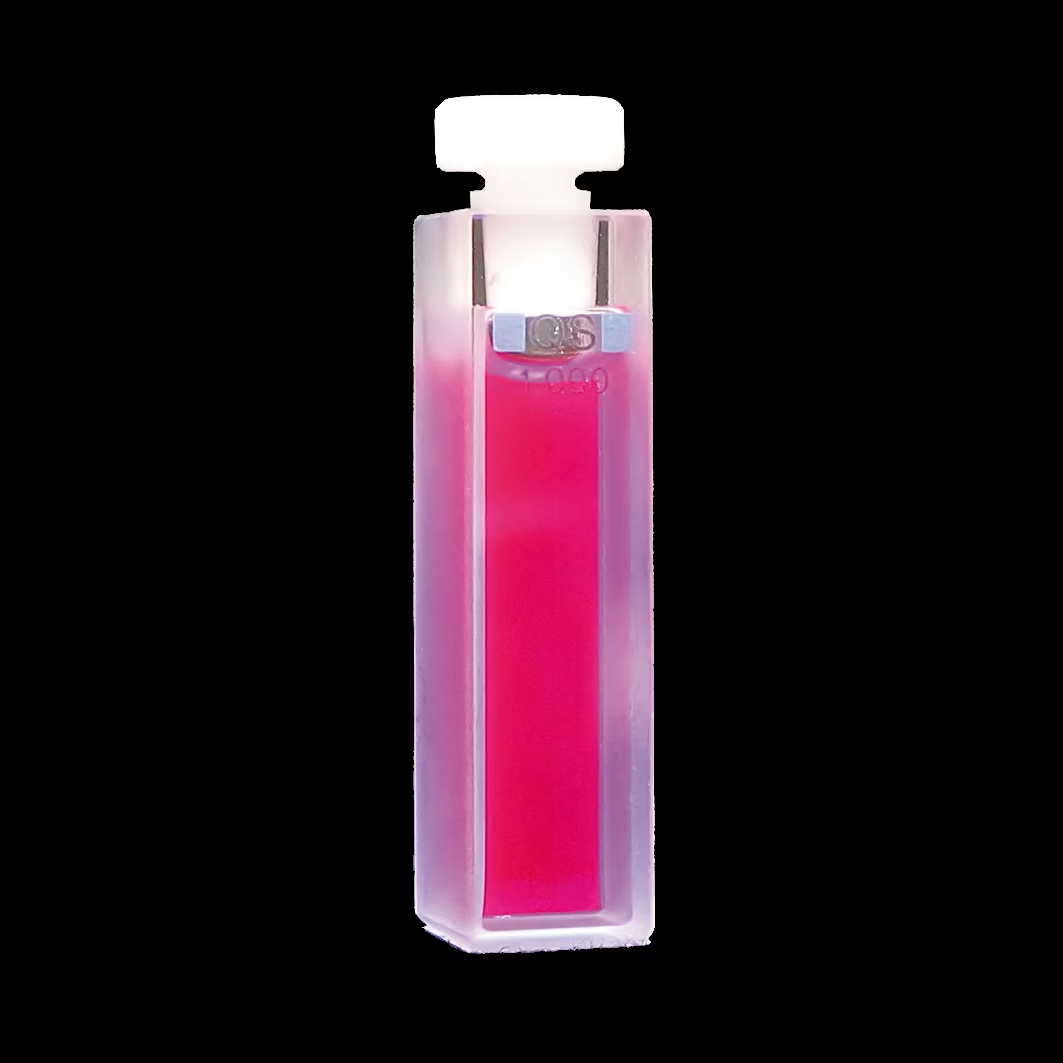
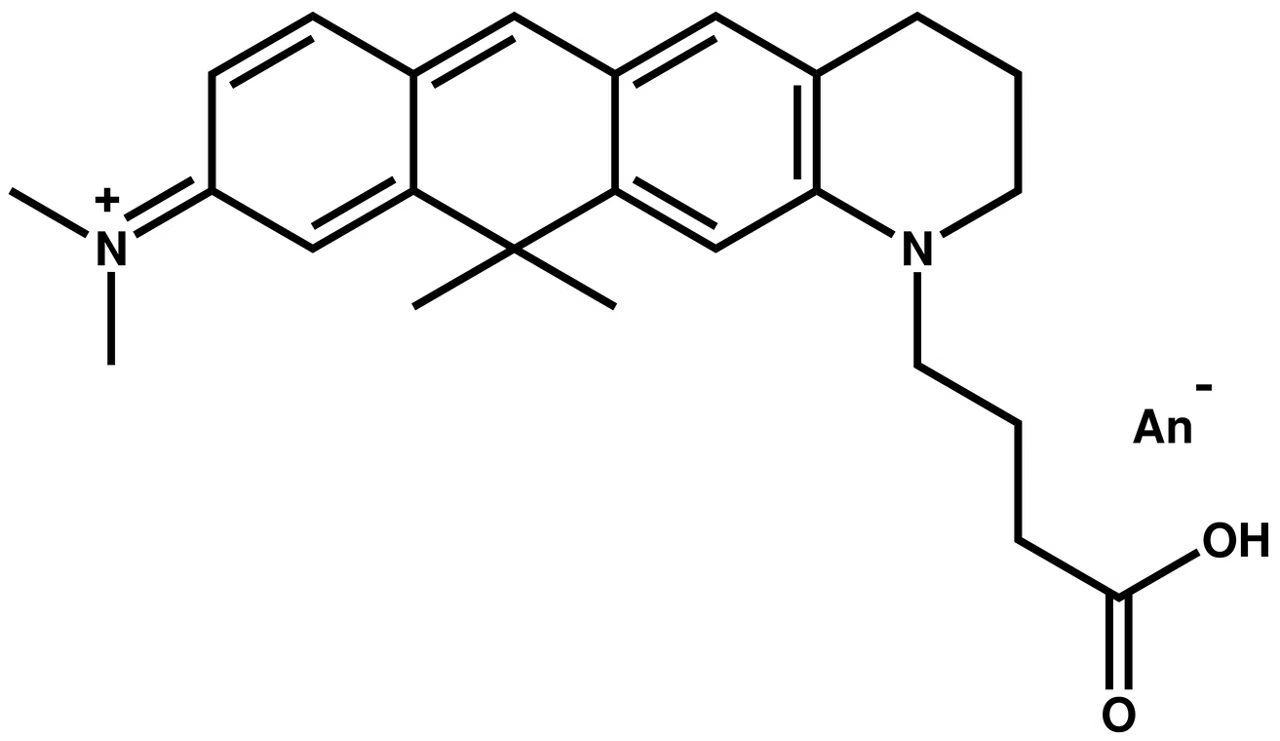
Product No. AD-610-25
ATTO 610 belongs to a new generation of fluorescent labels for the red spectral region.
ATTO-TEC is a wholly owned subsidiary of Leica Microsystems
Optical properties
- λ abs = 616 nm
- ε max = 1.5×10⁵ M -1 cm -1
- λ fl = 633 nm
- n fl = 70 %
- τ fl = 3.2 ns
- CF 260 = ε 260 /ε max = 0.03
- CF 280 = ε 280 / ε max = 0.06
ATTO 610 belongs to a new generation of fluorescent labels for the red spectral region. Characteristic features of the label are strong absorption, high fluorescence quantum yield, and high thermal and photo-stability.
The dye is moderately hydrophilic. The dye is stable under physiological pH-values and in buffers up to pH 8. However, it slowly degrades at higher pH. The fluorescence is excited most efficiently in the range 595 - 625 nm.
| Modification | Carboxy |
| Unit of Measure | 5 mg |
| Product Group | ATTO 610 |
| Product Type | Fluorescent Label |
| Emission Line (nm) | 577 |
| Fluorescence Maximum (nm) | 633 |
| MH+ (g/mol) | 391 |
| Molecular Weight (g/mol) | 491 |
| Light Source | Mercury arc lamp |
| Correction Factor Used in Calculation of Degree of Labeling (DOL) in Case of Dye-DNA Conjugates (CF260 = e260 /emax ) | 0.03 |
| Correction Factor Used in Calculation of Degree of Labeling (DOL) in Case of Dye-Protein Conjugates (CF280 = e280 /emax) | 0.06 |
| Increase of Molecular Mass on Conjugation with ATTO-label (NHS-ester : amine) | 373.5 |
| Increase of Molecular Mass on Conjugation with ATTO-label (maleimide : thiol) | 513.7 |
| Change of Electrical Charge on Conjugation with ATTO-Label | +1 |
| Longest Wavelength Absorption Maximum (nm) | 616 |
| Molar Decadic Extinction Coefficient at the Longest Wavelength Absorption Maximum (M-1 cm-1) | 150000 |
| Fluorescence Quantum Yield (%) | 70 |
| Real Fluorescence Decay Time (ns) | 3.2 |