SpectraMax® M Series Multi-Mode Microplate Readers
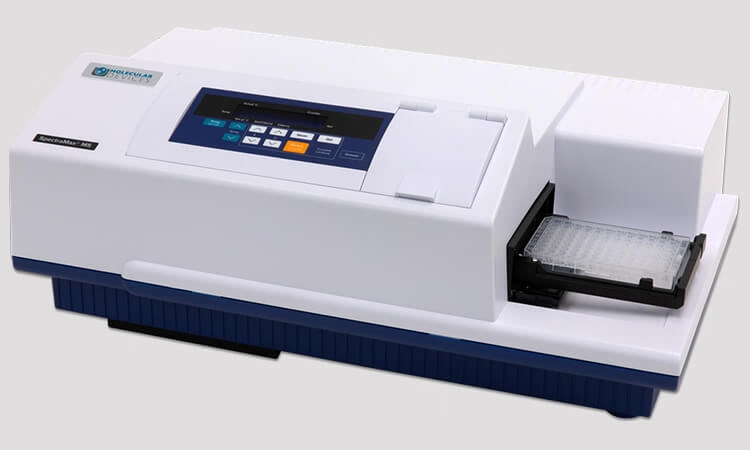
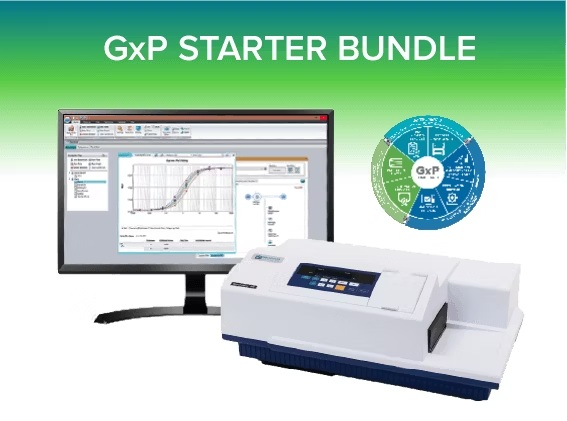
Configurable readers with triple-mode cuvette ports, validation tools, and compliance software
Dual Monochromators Increase Performance and Assay Flexibility in the SpectraMax Plate Reader (M Series)
The SpectraMax® M Series Multi-Mode Microplate Readers measure UV and visible absorbance, fluorescence, luminescence, fluorescence polarization, TRF and HTRF. Standard features include a cuvette port, spectral scanning in 1 nm increments, and up to six wavelengths per read. These robust readers have been placed in labs from Antarctica to the International Space Station. With optimized reagents, validation tools, and industry-leading SoftMax® Pro Software, they provide consistent performance.
-
Assay flexibility
The optical system uses two scanning monochromators so you can determine optimal excitation and emission settings, resulting in assay performance similar to that of dedicated single-mode readers when using a SpectraMax plate reader such as the SpectraMax M5.
-
Better absorbance accuracy
Measure sample depth with no temperature dependency using the PathCheck Sensor technology available across the SpectraMax M Series. It automatically normalizes absorbance readings to 1 cm, eliminating the need for standard curves.
-
Increased throughput
Integrate easily with our StakMax® Microplate Stacker for walk-away automation when operating a SpectraMax M or m5 plate reader. The stacker can hold up to 50 plates and can be configured to include a barcode reader.
Key Features of the SpectraMax M Series Plate Reader
-
Patented optimization
The patented AutoPMT optimization of the SpectraMax M5 reader adjusts the fluorescence detector to each sample well's concentration and normalizes the raw data, extending the dynamic range of assays.
-
IQ/OQ/PM Services
Qualify Molecular Devices microplate readers, including the SpectraMax M Series, in GLP or GMP environments with our IQ/OQ/PM Services to preserve the documentation of services in a compliant format that can be accessed remotely.
-
Validation tools
Extensive suite of validation tools reduces the cost and time of validation by 50% as compared to using multiple platforms to collect and analyze data on a SpectraMax M5.
-
Compliance software
SoftMax Pro GxP Software extends data acquisition and analysis solution into regulated laboratories working under GMP, GLP, and 21 CFR Part 11 for secure electronic records when using SpectraMax plate readers.
| Item Height Range (Metric cm) | 22 cm |
| Item Width Range (Metric cm) | 58 cm |
| Microplate Reader Type | Multi-Mode Reader |
| Detection/Read Mode(s) | Absorbance, Fluorescence Intensity (Top/Bottom Read), Luminescence (Top/Bottom Read), Time-Resolved Fluorescence (Top/Bottom Read), Fluorescence Polarization (Top Read), Homogenous Time-Resolved Fluorescence (Top/Bottom Read) |
| Detection/Read Type(s) | Endpoint, Kinetic, Spectrum Scan, Well Scan |
| Absorbance Read Time Range (sec) | 17 sec |
| Fluorescence Intensity Read Time Range (sec) | 15 sec |
| Luminescence Read Time Range (sec) | 17 sec |
| Fluorescence Polarization Read Time Range (sec) | 44 sec |
| Time-Resolved Fluorescence Read Time Range (sec) | 15 |
| Minimum Absorbance Wavelength Range (Metric nm) | 200 nm |
| Maximum Absorbance Wavelength Range (Metric nm) | 1000 nm |
| Minimum Fluorescence Intensity Wavelength Range (Metric nm) | 250 nm |
| Maximum Fluorescence Intensity Wavelength Range (Metric nm) | 850 nm |
| Minimum Luminescence Wavelength Range (Metric nm) | 250 nm |
| Maximum Luminescence Wavelength Range (Metric nm) | 850 nm |
| Minimum Time-Resolved Fluorescence Wavelength Range (Metric nm) | 250 nm |
| Maximum Time-Resolved Fluorescence Wavelength Range (Metric nm) | 850 nm |
| Minimum Fluorescence Polarization Wavelength Range (Metric nm) | 300 nm |
| Maximum Fluorescence Polarization Wavelength Range (Metric nm) | 750 nm |
| Fluorescence Intensity Sensitivity Top Read Optimization | 1-3 fmol/well in 200 μL FITC 96 well (< 5-15 pM), 2-3.0 fmol/well in 75-100 100 μL FITC 384 well (< 20 pM-40) |
| Luminescence Sensitivity Top Read Optimization | < 2 fg/well for firefly luciferase in 96 and 384 well |
| Time-Resolved Fluorescence Sensitivity Top Read Optimization | 100 fM europium in 96 and 384 well |
| Fluorescence Polarization Sensitivity Top Read Optimization | < 5 mP standard deviation at 1 nM fluorescein in 96 and 384 well |
| AlphaScreen Sensitivity Top Read Optimization | - |
| Microplate Photometric Accuracy | < ±1.0% and ±0.006 OD (0.0-2.0 OD) |
| Cuvette Photometric Accuracy | - |
| Photometric Precision | < ±1.0% and ±0.003 OD (0.0-2.0 OD) |
| Microplate Reader Detector(s) | Silicon Photodiode, Photomultiplier Tube |
| Light Source(s) | Xenon Flash Lamp |
| Microplate Size Compatibility | 6 well plate, 12 well plate, 24 well plate, 48 well plate, 96 well plate, 384 well plate |
| Microplate Shaking Mode(s) | Linear |
| Stray Light Measurement | - |
| Wavelength Selection | Monochromator tunable in 1 nm increments |
| Microplate Reader Validation Tool(s) | Absorbance Validation Plate, Fluorescence Validation Plate, Luminescence Validation Plate, SoftMax® Pro GxP Software |
| Includes Validation Tools | Yes |
| Includes Cuvette Port | Yes |
| Includes Imaging Capability | No |
| Includes Injectors | No |
| Includes PathCheck™ Sensor | Yes |
| Includes Stand-Alone Touchscreen Operation | No |
| Includes Western Blot Capability | No |
| Robotics/Automation Compatible | Yes |
| Includes Temperature Control Capability | Yes |
| Minimum Temperature Control Range Added to Ambient Temperature (Metric °C) | 2 °C |
| Maximum Temperature Control Range (Metric °C) | 60 °C |
| Item Depth Range (Metric cm) | 39 cm |