Triglyceride Assay Kit - Quantification(AB65336)
$undefined
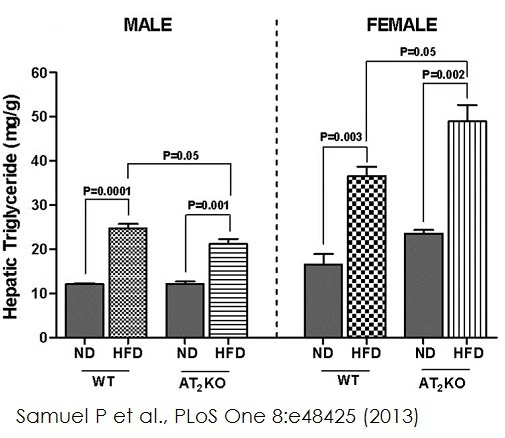
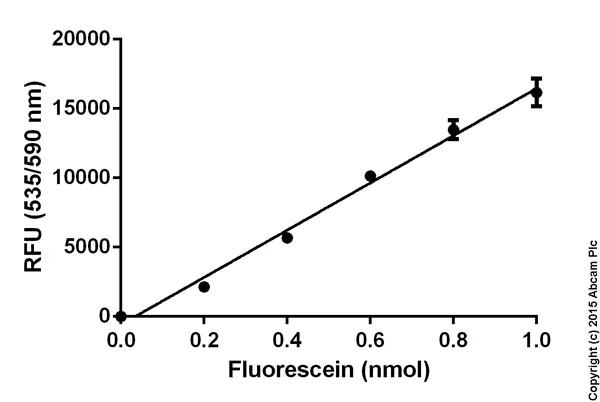
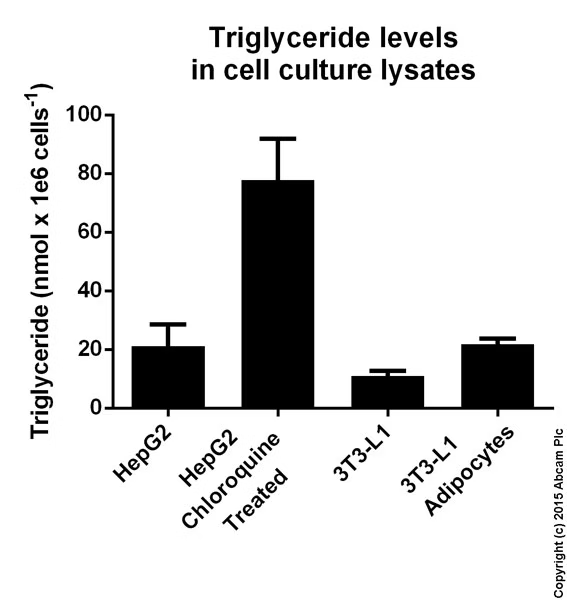
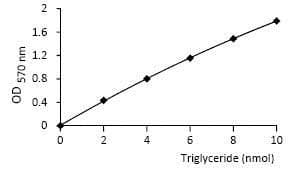
Triglyceride Assay Kit ab65336 is a quantitative, addition-only assay with a 20 min and a 60 min incubation step. In the assay, triglycerides are converted to free fatty acids and glycerol, and the glycerol is then oxidized. Readout is on any colorimetric (570 nm) or fluorometric (Ex/Em 535/587 nm) plate reader.
- Cited in over 500 publications
- Complete kit including standard curve for quantitation
- Used with sample types including tissue extracts, cell lysates, serum, heparin plasma, urine (UTI) and other biological fluids
- Individual kit components also available for purchase with a minimum order of 20 units. Contact us to discuss your needs.
Product details
Triglyceride Assay Kit (ab65336) is a sensitive, easy assay to measure triglyceride concentration in mammalian samples.
Other names used to refer to this type of assay include TAG assay, TG assay, and triacylglycerol assay.
How the Triglyceride assay works
In the triglyceride assay protocol, triglycerides are converted to free fatty acids and glycerol by a lipase enzyme. Glycerol is then phosphorylated by glycerol kinase, and subsequently oxidized by glycerol phosphate oxidase to produce hydrogen peroxide. The hydrogen peroxide reacts with a probe via a peroxidase to generate color (spectrophotometry at λ= 570 nm) and fluorescence (Ex/Em = 535/587 nm).
Triglyceride assay protocol summary
- Add samples and standards to wells.
- Add assay buffer and lipase, and incubate for 20 min.
- Add triglyceride reaction mix and incubate for 60 min.
- Analyze with microplate reader.
Getting the best performance from ab65336
Please note: the general range is 0-10 nmol (colorimetric) and 0-1 nmol (fluorometric).
If your sample contains reducing substances, they are likely to interfere with the assay. In this case, we recommend using Triglyceride Assay Kit (Fluorometric, Reducing samples) ab178780.
Technical Note: Triglyceride is unlikely to be detectable in healthy urine but may be elevated in the presence of infection or disease of the urinary tract.
Related and recommended products
Triglyceride assay kit ab65336 is often used with Free Fatty Acid assay kit ab65341, and Cholesterol assay kit ab65390, to study lipid metabolism and its role in various metabolic diseases such as diabetes, obesity, liver diseases, and cardiovascular conditions.
Supplementary information
This supplementary information is collated from multiple sources and compiled automatically.
Triglycerides also known as triacylglycerols are a type of lipid molecule found mainly in adipose tissue and the bloodstream. They consist of three fatty acids bonded to a glycerol backbone leading to a total molecular mass that varies based on the fatty acid chain lengths. Triglycerides originate in different tissues like the liver and intestines. The enzyme lipase acts on triglycerides breaking them down into free fatty acids and glycerol which is essential for metabolic processes. Scientists often measure triglyceride levels in blood to assess lipid metabolism and related health conditions.
Biological function summary
Triglycerides serve as a major form of energy storage in the body. They are important substrates for energy production especially during fasting or prolonged physical activity when the body's glycogen stores are depleted. Triglycerides do not function independently but as part of lipoprotein complexes. These complexes transport lipids throughout the body in the bloodstream. Understanding the normal triglyceride range helps in assessing if levels are within a healthy limit indicating effective lipid metabolism. Average triglyceride levels may vary but maintaining a good triglyceride level is important for overall health.
Pathways
Triglycerides are involved in lipid metabolism and energy homeostasis. One important pathway includes the lipolysis pathway where triglycerides undergo breakdown via lipase into fatty acids and glycerol. This reaction is important for providing energy particularly involving proteins such as hormone-sensitive lipase (HSL) and adipose triglyceride lipase (ATGL). In another pathway triglycerides play a role in the synthesis and storage of fats influenced by proteins like peroxisome proliferator-activated receptors (PPARs) which regulate gene expression involved in fatty acid storage.
High triglyceride levels relate to cardiovascular disease and pancreatitis. Triglyceride-rich lipoproteins link to atherosclerosis making the regulation of triglycerides important for heart health. Chronic high levels may lead to acute pancreatitis by causing free fatty acid accumulation damaging pancreatic cells. Proteins such as apolipoprotein C-III affect triglyceride metabolism and may influence the risk of developing cardiovascular diseases. Effective management of triglyceride levels can help reduce these health risks.
Product protocols
Triglyceride assay protocol
Reagent Prep
Freezing the 1mM Triglyceride Standard can cause it to separate. Heat the Triglyceride Standard in a boiling water bath to re-dissolve. Reconstitute lyophilized enzyme components. Other assay components are ready-to-use.
Sample Prep
Homogenize 1 x 10⁷ cells / 100 mg of cells / tissue in 5% NP-40 solution. To solubilize triglycerides, heat to ~90°C in a water bath and then cool to room temperature twice. Spin out insoluble material with a microcentrifuge and then dilute samples in ddH2O.
Serum and other liquid samples: test directly without processing.
Notes:
- Serum typically contains 0.1 – 6 mM triglycerides.
- NP-40 works better than Triton X-100 or Tween-20 to keep lipids in solution and does not create assay background.
- Sodium azide content above 0.05% and phenol red (if the color of the sample well is affected) can interfere with the assay.
Triglyceride Assay Procedure
- Include spiked samples with a known amount of standard to adjust for any compounds that may interfere with the reaction.
- Use sample background controls to adjust for glycerol in samples which can generate high background signals.
1. Add samples, standards and controls to wells, and adjust volume with 50 µL with Assay Buffer 5. Dilute samples as required for the assay range.
2. Add Cholesterol Esterase to standard and sample wells. Mix and incubate with agitation for 20 minutes at RT to convert triglyceride to glycerol and fatty acid.
3. Prepare reaction mix containing Assay Buffer 5, OxiRed Probe and Enzyme Mix VI, and add to each well.
4. Mix and incubate at RT for 60 minutes, protected from light.
5. Measure output immediately on a microplate reader at OD 570 nm for colorimetric assay with a clear plate or Ex/Em= 535/587 nm for fluorometric assay with a black plate. The reaction is stable for at least 2 hours.
Calculations
Subtract the absorbance / fluorescence of the zero standard well from all readings, and of the sample background controls from sample readings. Plot the standard curve and use linear regression to calculate the concentration of triglyceride. Note: Triglyceride Standard molecular weight = 885.4 g/mol.
For spiked samples, subtract the sample reading from the spiked sample reading.