L-Lactate Assay Kit (Colorimetric)
$undefined
L-Lactate Assay Kit (Colorimetric) ab65331 is a quantitive, addition-only assay with one 30-min room temperature incubation
- BIOVISION® assay kit
- Cited in over 300 publications
- Individual kit components also available for purchase with a minimum order of 20 units. Contact us to discuss your needs.
Product Details - L-Lactate Assay Kit (Colorimetric) (ab65331)
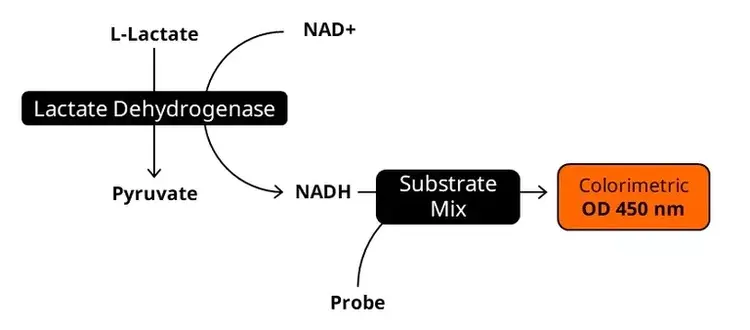
L-Lactate Assay Kit (Colorimetric) (ab65331) uses an assay protocol where lactate is oxidized by lactate dehydrogenase to generate a product which interacts with a probe to produce a color (λmax = 450 nm).
The kit detects L(+)-Lactate in biological samples such as serum or plasma, cells, tissues, cell culture and fermentation media.
Lactate assay protocol summary
- Add samples and standards to wells.
- Add reaction mix and incubate for 30 min at room temp.
- Analyze with microplate reader.
Lactate assay methods
There are two lactate assay methods established in biological research:
- The most commonly used method, where lactate dehydrogenase processes lactate in the presence of NAD+ to produce pyruvate and NADH. NADH then reduces a probe to form a colorimetric or fluorometric readout.
- The alternative method, where lactate oxidase processes lactate to produce pyruvate and hydrogen peroxide. This is followed by oxidation of a substrate by a peroxidase using the hydrogen peroxide to produce a colorimetric or fluorometric readout.
Functional Studies - L-Lactate Assay Kit (Colorimetric) (ab65331)

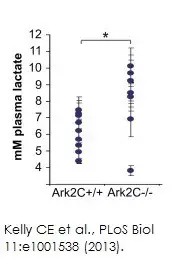
Plasma lactate concentrations were determined using L-Lactate assay kit (ab65331) in Ark2C+/+ and Ark2C−/− (Arkadia-like gene) mice.
Image from Kelly CE et al., PLoS Biol 11(4), fig2d. oi: 10.1371/journal.pbio.1001538. Reproduced under the Creative Commons license http://creativecommons.org/licenses/by/4.0/
Functional Studies - L-Lactate Assay Kit (Colorimetric) (ab65331)

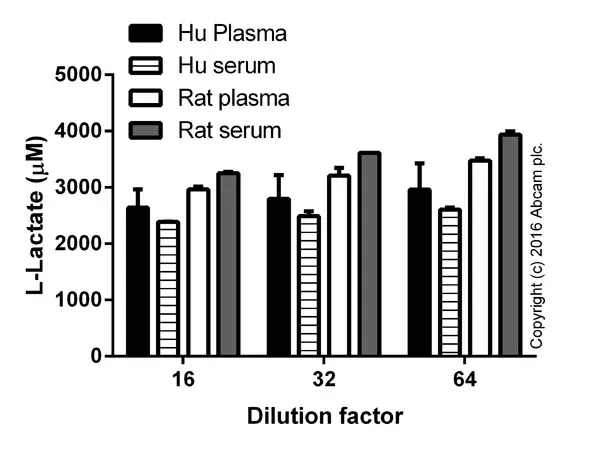
Linearity of dilution: concentration of L-Lactate in differently diluted (X-axis) biological samples, demonstrating a linearity of 89%-111% (concentrations corrected for by factor of dilution; duplicates; +/- SD).
Functional Studies - L-Lactate Assay Kit (Colorimetric) (ab65331)

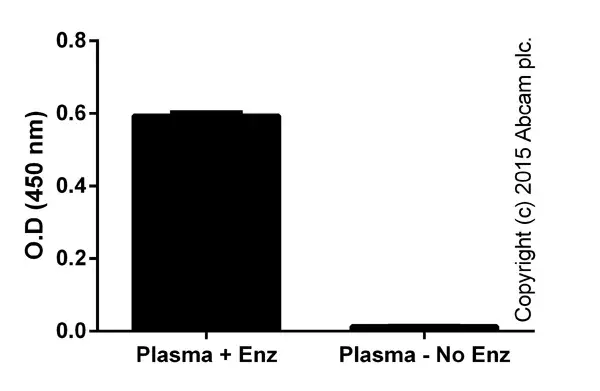
Relative signal (RFU) in unfiltered human plasma (dilution 1:8), comparing L-lactate signals with background reading (no enzyme) after 10 minutes of incubation (duplicates +/- SD).
Functional Studies - L-Lactate Assay Kit (Colorimetric) (ab65331)

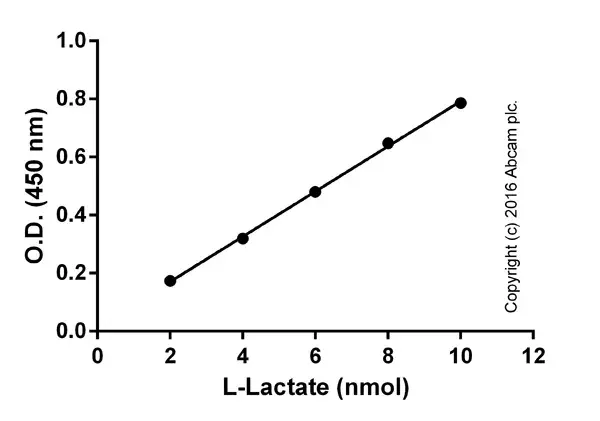
Standard curve with background signal subtracted (duplicates; +/- SD).
Functional Studies - L-Lactate Assay Kit (Colorimetric) (ab65331)

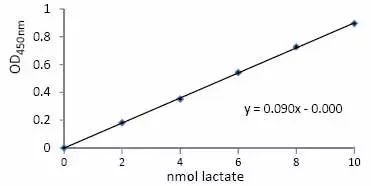
Lactate Standard Curve. The assay is performed following the kit (ab65331) protocol.
Biochemical assay - L-Lactate Assay Kit (Colorimetric) (AB65331)

Diagram showing the principles of the L-Lactate assay method.
Enzyme activity assay - L-Lactate Assay Kit (Colorimetric) (AB65331)

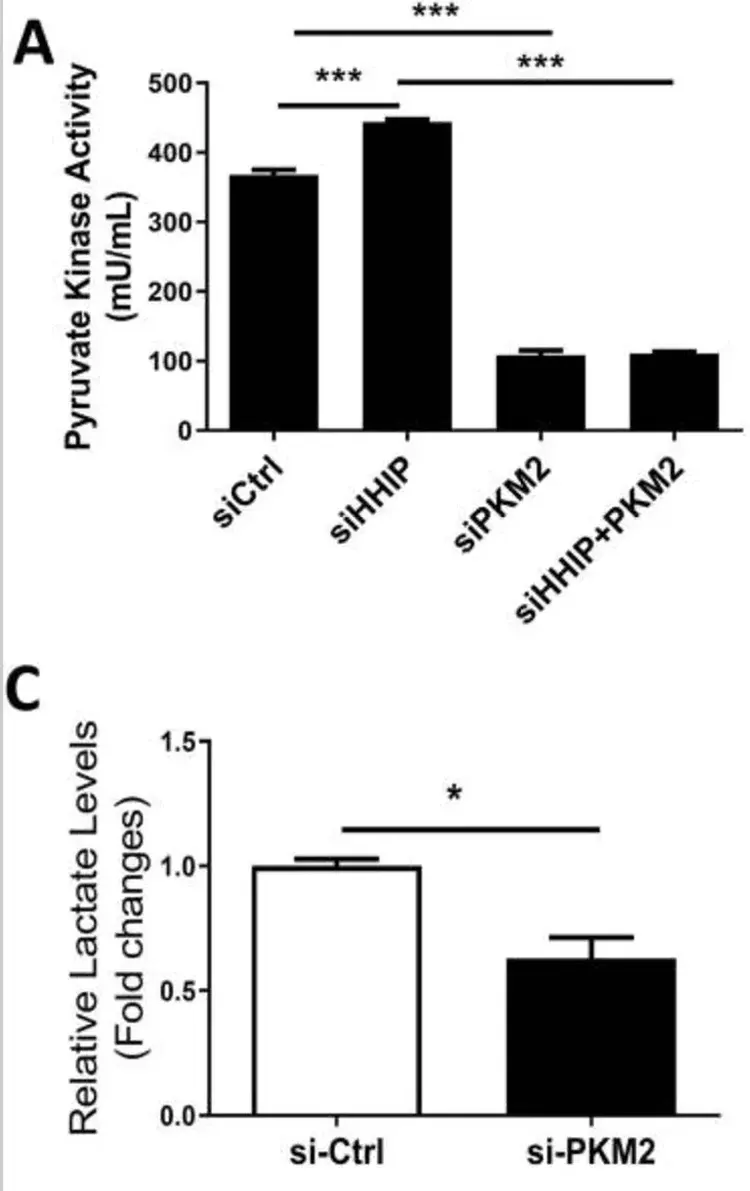
Pyruvate Kinase Assay Kit ab83432 used with cell culture lysates, and Lactate Assay Kit ab65331 used with cell culture medium.
Li et al. used Pyruvate Kinase Assay Kit ab83432 and Lactate Assay Kit ab65331 with cultured human primary airway smooth muscle cells (ASMCs) derived from healthy donors (#CC-2576, N = 4, passage 2) and Chronic obstructive pulmonary disease (COPD) patients.
PKM2 activity is essential for metabolic reprogramming towards aerobic glycolysis in COPD-derived ASMCs. (A) Pyruvate kinase activity was measured in normal ASMCs with si-RNA mediated HHIP and/or PKM2 knockdown with normalization to protein concentration. (C) Lactate levels in the culture medium were measured in COPD-derived ASMCs transfected with si-Ctrl or si-PKM2.
Pyruvate Kinase Assay Kit (#ab83432) was purchased from Abcam.
Measurement of secreted lactate levels in cell culture media : Cells were seeded into a 96-well plate at the density of 3 × 10³ cells/well. The culture medium was then collected 24 h after the seeding of cells. The lactate levels in the medium were measured by the Lactate Colorimetric Assay Kit II (#K627-100, BioVision, Milpitas, CA) [Biovision is an Abcam company, K627 is now sold as Abcam ab65331], and lactate levels were then normalized to DNA content measured in each well at the time of collection.
Biochemical assay - L-Lactate Assay Kit (Colorimetric) (AB65331)

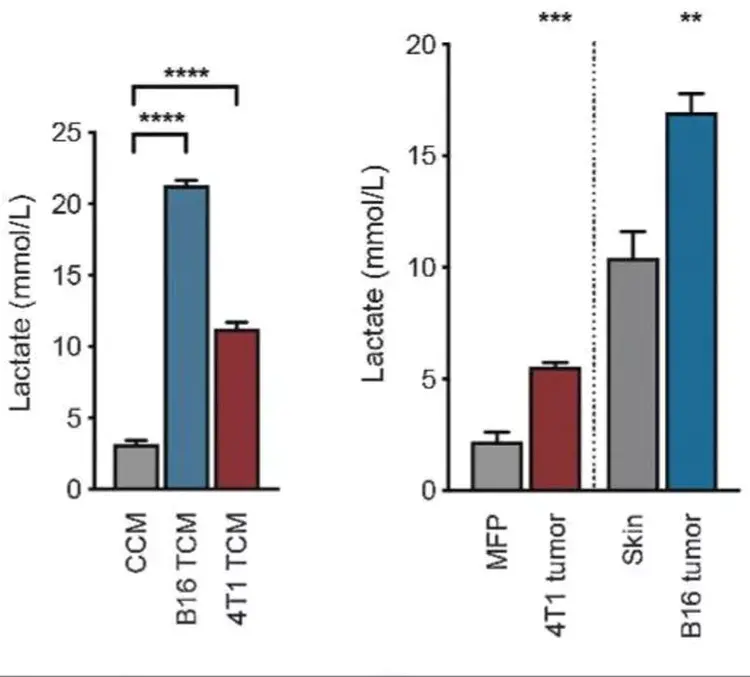
Riedel et al used Lactate assay kit ab65331 with tissue culture media of mouse cells and mouse skin tissue extracts and showed that tumor-derived lactic acid drains to lymph nodes where it modulates the function of lymph node stromal cells.
Tumor-derived lactate is responsible for the observed changes in FRC activation and mitochondria. L-lactate concentration in CCM, B16.F10 TCM, and 4T1 tissue culture media, as measured by an enzymatic assay. n = 3 experiments with 1 to 5 replicates. L-lactate quantification in tissues collected from either Balb/c sham-treated mice (MFP) and orthotopic 4T1 tumors (4T1 tumor), or C57BL/6 sham-treated (skin) and B16.F10 melanoma tumors (B16 tumor). Measured by an enzymatic assay. n = 4 to 6 independent experiments. Representative of three independent experiments. Data are means with SEM. Significance (*, P < 0.05; **, P < 0.01; ***, P < 0.001; and ****, P < 0.0001) was determined by unpaired two-tailed t test or one-way ANOVA with Tukey post hoc (B). B16, B16.F10; max., maximum; min, minute; LA, lactic acid.
L-Lactate was measured in conditioned medium and tissue samples using the L-Lactate Assay kit (abcam, #ab65331) according to the manufacturer's instructions. All samples were deproteinized with the Deproteinizing Sample Preparation Kit–trichloroacetic acid (TCIA; abcam, #ab204708) before assaying.
Tissue samples were weighed into Precellys tubes prefilled with ceramic beads. The exact 6x volume (1 mg tissue/6 μL buffer) of Lactate Assay Buffer was added on ice and samples were lysed using a Precellys 24 homogeniser (Bertin Instruments).
Biochemical assay - L-Lactate Assay Kit (Colorimetric) (AB65331)

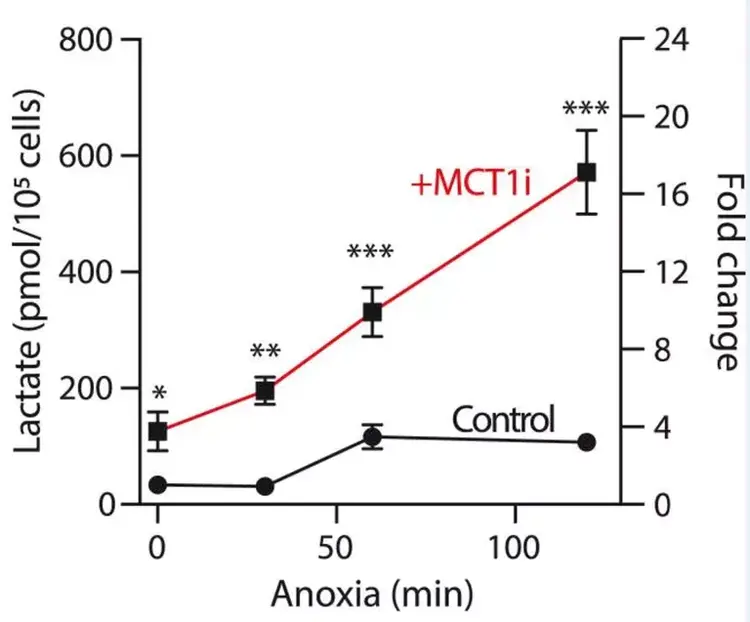
Gruszczyk et al used Lactate assay kit ab65331 to investigate the impact of anoxia in mouse primary cardiomyocyte cultures.
Cardiomyocytes were incubated for different time periods of anoxia or 120 min normoxia at 37 °C with various concentration of AR-C141990. Control buffer with 0 μM MCT1 inhibitor is shown in black, MCT1 inhibitor-containing buffer in red. The supernatant and cell pellets were then isolated and analyzed. Cell lactate concentration (pmol/105 cells) on the left y-axis and lactate fold changes to control on the right y-axis (n = 3–5 biological replicates, *P < 0.03, **P < 0.01, ***P < 0.0005, one-way ANOVA with multiple comparisons and Tukey's post hoc test.
Lactate was measured in cell supernatants or in cell pellets. For analysis of the intracellular lactate content, the cardiomyocytes were washed and lysed in 200 μL assay buffer/105 cells by scraping them down and repeating three freeze/thaw cycles and vigorous vortexing in between these cycles. The samples were centrifuged for 2 min at 14,000 g at 4 °C and the supernatant kept for deproteinization. Therefore, 25 μL 5 M perchloric acid were added to each tube, followed by 47 μL of 3 M potassium hydroxide to neutralize the samples. After centrifugation for 5 min at 14,000 g at 4 °C, the supernatant was used to determine lactate concentrations using the colorimetric Abcam Lactate Assay Kit (ab65331). According to the manual instructions, a standard curve was prepared via serial dilution of the kit's standard concentrate in assay buffer. 50 μL of each standard, blank or sample were pipetted into a CoStar 96- well plate. Then, a reaction master mix was prepared containing 46 μL assay buffer, 2 μL substrate mix and 2 μL enzyme mix per reaction. 50 μL of this master mix were added to each well and the reaction was incubated for 30 min at 400 rpm at room temperature. The output was measured on a microplate reader (CLARIOstar PLUS from BMG Labtech) at OD 450 nm.
| Shipped At Conditions | Blue Ice |
| Appropriate Long term Storage Conditions | Store at -20°C. |
| Clonality | Polyclonal |
| Applications | ICC/IF, IHC-P, WB |
| Species Reactivity | Human |
| Isotype | IgG |