Anti-GFP antibody(AB13970)
$undefined
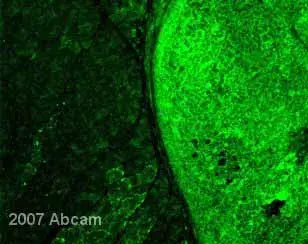
Rat Monoclonal HLA-DPB1 antibody. Carrier free. Suitable for IP, BL, Flow Cyt, WB, FuncS and reacts with Mouse samples. Immunogen corresponding to Cell preparation containing H2-Ea protein.
Anti-GFP antibody (ab13970) is a chicken polyclonal antibody detecting GFP in Western Blot, ICC/IF.
- Over 3610 publications
- Trusted since 2004
Product details - Anti-GFP antibody (AB13970)
Anti-GFP antibody (ab13970) is a chicken polyclonal antibody and is validated for use in ICC/IF and WB.
Anti-GFP antibody (ab13970) was first used in a scientific publication in 2005 and has been cited over 3610 times in peer reviewed journals. It's performance in immunofluorescence and Western Blot is trusted by the scientific community.
Abcam's high quality validation processes ensure Anti-GFP antibody (ab13970) has high sensitivity and specificity.
Anti-GFP antibody (ab13970) has 93 independent reviews from customers.
GFP antibodies are used to visualize proteins labelled with this tag in a variety of applications (for example imaging and Flow cytometry). To enable specific detection of your tagged protein, Anti-GFP antibody (ab13970) has been validated in ICC/IF and WB.
Anti-GFP antibody (ab13970) specifically detects GFP (UniProt ID: P42212; Molecular weight: 27kDa) and is sold in 100 µL selling sizes.
Green Fluorescent Protein (GFP), originally derived from the jellyfish Aequorea victoria, emits a bright green fluorescence under ultraviolet or blue light. This unique property makes GFP an invaluable tool in molecular and cell biology research. Widely used to tag proteins, GFP allows scientists to visualize and track protein expression, localization and interactions within living cells. Key applications of GFP include fluorescence microscopy (ICC, IHC, IF), flow cytometry (FC) and western blotting (WB).
Supplementary information
This supplementary information is collated from multiple sources and compiled automatically.
GFP also known as Green Fluorescent Protein acts as a bioluminescent marker derived from the jellyfish Aequorea victoria. GFP is popular in molecular biology for its fluorescence properties making it useful for visualizing proteins. This protein has a molecular weight of approximately 27 kDa. Researchers and scientists often express GFP in various organisms as a luminescent tag helping them observe protein expression localization and interaction within cells. GFP tagging involves the fusion of GFP to a protein of interest enabling the study of the protein's function and dynamics without affecting the host cell.
Biological function summary
GFP serves as a marker due to its ability to emit green fluorescence without requiring additional substrates or cofactors. GFP does not function within complexes like other proteins but acts as a standalone tool to monitor physiological processes. Scientists utilize techniques such as Western blot ELISA and microscopy along with GFP to track and quantify proteins inside living cells. Anti-GFP antibodies can detect GFP fusion proteins in various applications providing valuable insights into protein behavior and allowing robust assays involving GFP.
Pathways
GFP itself does not participate actively in traditional biochemical or signaling pathways. Instead it enables visual tracking within pathways. Researchers utilize GFP to study pathways like MAPK/ERK and PI3K/AKT where they track proteins related to these pathways using GFP tagging. For instance fusing GFP with proteins like ERK1/2 allows tracking phosphorylation events and signal transduction in living cells leading to better understanding of cellular responses to different stimuli.
Researchers use GFP as a model to study gene expression and protein interactions under disease conditions. For example in neurological disorders GFP helps visualize neuronal pathways and protein aggregation processes. By tagging proteins such as amyloid precursor protein (APP) or tau with GFP scientists can study their role in Alzheimer's disease progression. Similarly GFP facilitates the investigation of cancer pathways allowing visualization of tumor-related proteins and helping researchers study how cancer cells grow and invade tissues supporting cancer research and therapy development.
Immunocytochemistry/ Immunofluorescence - Anti-GFP antibody (ab13970)
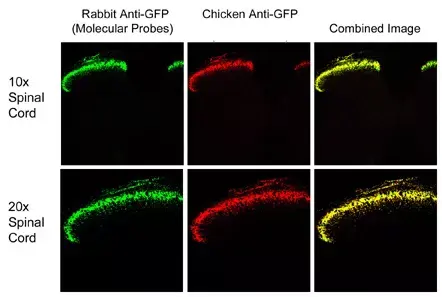
Transgenic mice expressing GFP selectively in lamina II of the spinal cord.
In the right panels, note the correspondance between the green (rabbit anti-GFP) and red signals (chicken anti-GFP from Abcam) indicating that these two antibody preparations recognized the same gene product. The secondary antibody used with ab13970 was an FITC-labeled goat anti-chicken
Immunocytochemistry/ Immunofluorescence - Anti-GFP antibody (ab13970)
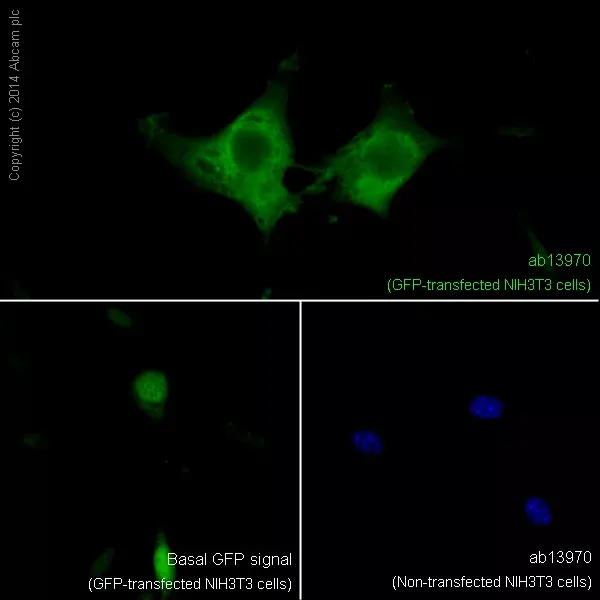
ab13970 staining GFP in GFP-transfected NIH/3T3 (Mouse embryo fibroblast cell line) cells.
The cells were fixed with 4% formaldehyde (10 minutes) and then blocked in 1% BSA / 0.3M glycine in 0.1%PBS-Tween for 1 hour. The cells were then incubated with ab13970 at 1/2000 dilution overnight at +4°C followed by incubation with Goat Anti-Chicken IgY H&L (Alexa Fluor® 488) preadsorbed (ab150173), for 1 hour, at 1 μg/ml.
Under identical experimental conditions, when compared to the basal level of GFP expression in transfected NIH/3T3 cells, the cells upon which ab13970 was applied gave a stronger signal in the 488 channel, indicating that ab13970 is binding to GFP and therefore eliciting signal amplification.
ab13970 was also applied to non-GFP-transfected NIH/3T3 cells, which produced no positive staining, indicating specificity for GFP.
Nuclear DNA was labeled with 1.43 μM DAPI (blue).
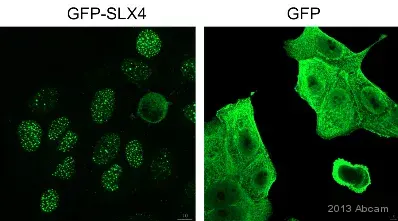
Immunocytochemistry/ Immunofluorescence - Anti-GFP antibody (AB13970)

ab13970 staining GFP in U-2 OS (Human bone osteosarcoma epithelial cell line) cells by ICC/IF.
Cells were paraformaldehyde fixed permeabilized with 0.5% triton and blocked with 2% antibody dilution buffer for 2 hours. Cells were incubated with the primary antibody (1/1000 dilution) for 1 hour at 25°C. An undiluted Alexa Fluor® 488 conjugated Goat anti-chicken polyclonal was used as the secondary antibody
Immunocytochemistry/ Immunofluorescence - Anti-GFP antibody (AB13970)

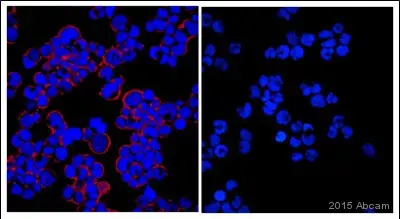
Immunocytochemical/ Immunoflurescence analysis of cytospined HEK-293 cells (Human epithelial cell line from embryonic kidney) transfected with GFP labeling GFP with ab13970 at 1/200 dilution incubated for 16 hours at 4°C with 1% BSA in PBS. Secondary used was a donkey anti-chicken polyclonal DyLight® 594 at 1/500.
GFP is shown in red (DyLight® 594).
Nuclei are counterstained in blue (DAPI).
The left panel shows HEK-293 cells transfected with GFP and the right panel shows non-transfected HEK-293 cells.
Immunocytochemistry/ Immunofluorescence - Anti-GFP antibody (AB13970)

ab13970 staining GFP + tumor in mouse muscle cells by ICC/IF.
Cells were formaldehyde fixed and blocked with 3% BSA for 1 hour at 24°C prior to incubation with the primary antibody (1/500 dilution) for 1 hour at 24°C. An Alexa Fluor® 488 conjugated goat anti-chicken was used as the secondary.
This image is courtesy of a customer review
Western blot - Anti-GFP antibody (AB13970)

All lanes:
Western blot - Anti-GFP antibody (ab13970) at 1/1000 dilution
Lane 1:
Whole cell lysate prepared from HeLa (Human epithelial cell line from cervix adenocarcinoma) cells. at 25 µg
Lane 2:
Whole cell lysate prepared from HeLa cells. at 25 µg
Secondary
All lanes:
IRDye 800CW conjugated goat anti-chicken polyclonal at 1/15000 dilution
Predicted band size: 27 kDa
Image courtesy of an anonymous Abreview.
Western blot - Anti-GFP antibody (AB13970)

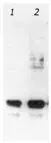
Western blot of transgenic mouse spinal cords showing that the rabbit anti-GFP (lane 1) and the chicken anti-GFP (Abcam; lane 2) recognize a band at the same molecular weight.
Lane 1:
Rabbit anti-GFP
Lane 2:
Western blot - Anti-GFP antibody (ab13970)
All lanes:
Transgenic mouse spinal cords
Predicted band size: 27 kDa
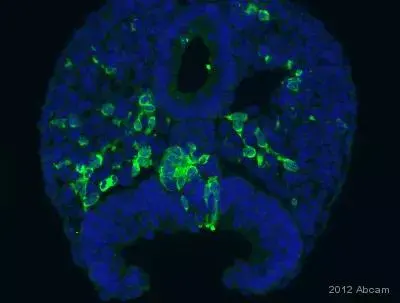
Immunohistochemistry (Frozen sections) - Anti-GFP antibody (AB13970)

ab13970 staining GFP in E10.5 mouse embryo sections by Immunohistochemistry (IHC-Fr - frozen sections). Tissue was fixed with paraformaldehyde, permeabilized with PBS/0.5% Triton-X100 and blocked with protein block for 30 minutes at 25°C. Samples were incubated with primary antibody (1/500) for 3 hours at 25°C. FITC-conjugated donkey anti-chicken IgY H&L (ab63507) (1/500) was used as the secondary antibody.
This image is courtesy of a customer review
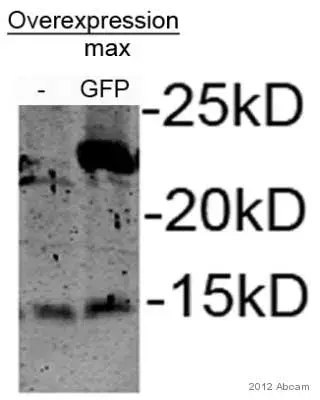
Western blot - Anti-GFP antibody (AB13970)

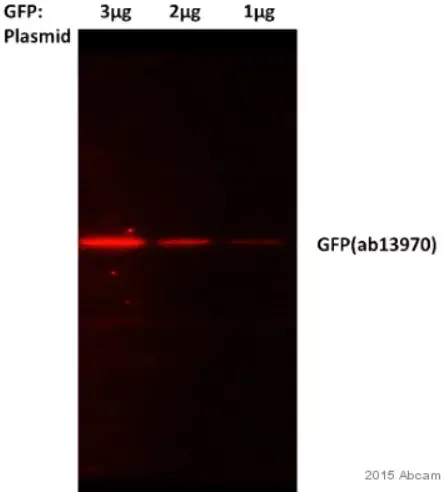
Gel Running Conditions : Reduced Denaturing (15% PAGE)
Detection method : Fluorescent Secondary Antibodies
All lanes:
Western blot - Anti-GFP antibody (ab13970) at 1/2000 dilution
Lane 1:
3 µg of GFP plasmid overexpressed in mouse cardiomyocytes whole cell lysate at 25 µg
Lane 2:
2 µg of GFP plasmid overexpressed in mouse cardiomyocytes whole cell lysate at 25 µg
Lane 3:
1 µg of GFP plasmid overexpressed in mouse cardiomyocytes whole cell lysate at 25 µg
Secondary
All lanes:
Western blot - Goat Anti-Chicken IgY H&L (Alexa Fluor® 594) preadsorbed (ab150176) at 1/5000 dilution
Predicted band size: 27 kDa
Observed band size: 25 kDa
Exposure time: 30s
This image is courtesy of an anonymous Abreview
| Shipped At Conditions | Blue Ice |
| Appropriate Long term Storage Conditions | -20°C |
| Clonality | Polyclonal |
| Applications | WB |
| Species Reactivity | Human |
| Isotype | IgG |
| Appropriate short-term storage conditions | +4°C |
| Storage information | Avoid freeze / thaw cycle |
| Form | Liquid |
| Storage Buffer | pH: 7; Preservative: 0.01% Thimerosal (merthiolate); Constituents: PBS, 50% Glycerol (glycerin, glycerine), 0.16% Sodium phosphate |
| Appropriate Short-Term Storage Duration | 1–2 weeks |
| Aliquoting Information | Upon delivery aliquot |
| Purity | IgY fraction |
| Purification Notes | Sterile filtered |