DCFDA / H2DCFDA - Cellular ROS Assay Kit(AB113851)
$undefined
DCFDA Assay Kit ab113851 includes DCFDA reagent, buffer, TBHP positive control, and a full protocol, for a fast way to set up a DCFDA assay on live cells. DCFDA taken up by cells is oxidized by reactive oxygen species with fluorescent readout (Ex/Em 485/535 nm) by microscopy, flow cytometer or plate reader.
DCFDA / H2DCFDA - Cellular ROS Assay Kit ab113851 is a complete assay kit for running a DCFDA assay to measure reactive oxygen species (ROS) in cell cultures.
- Designed to accelerate set up of a DCFDA assay
- Includes DCFDA, assay buffer, TBHP positive control, and full assay protocol
- Cited in over 700 publications
- In CiteAb's list of Top 100 most cited Assay Kits for 2024
Product Detail - DCFDA / H2DCFDA - Cellular ROS Assay Kit (AB113851)
DCFDA - Cellular ROS Assay Kit / Reactive Oxygen Species Assay Kit (ab113851) uses the cell permeant reagent 2’,7’ –dichlorofluorescin diacetate (DCFDA, also known as H2DCFDA, DCFH-DA, and DCFH) to semi quantitatively assess reactive oxygen species in live cell samples.
DCFDA / H2DCFDA / DCFH-DA / DCFH is a fluorogenic dye that measures hydroxyl, peroxyl and other reactive oxygen species (ROS) activity within the cell
How the Assay Works
The DCFDA assay protocol is based on the diffusion of DCFDA / H2DCFDA / DCFH-DA / DCFH into the cell. It is then deacetylated by cellular esterases to a non-fluorescent compound, which is later oxidized by ROS into 2’, 7’ –dichlorofluorescein (DCF). DCF is highly fluorescent and is detected by fluorescence spectroscopy with excitation / emission at 485 nm / 535 nm.
Assay Protocol Summary
DCFDA assay protocol / ROS assay protocol summary (microplate):
- collect suspension cells in tube / seed and allow attachment of adherent cells in 96-well plate
- wash in buffer
- stain with DCFDA for 30 min (suspension) / 45 min (adherent), wash with buffer
- if suspension cells, transfer to microplate
- analyze with microplate reader
DCFDA assay protocol / ROS assay protocol summary (flow cytometry):
- collect cells in tubes
- stain with DCFDA for 30 min (without washing)
- analyze with flow cytometer
DCFDA assay protocol / ROS assay protocol summary (fluorescent microscopy):
- wash adherent cells with buffer
- stain with DCFDA for 45 min
- wash in buffer
- analyze with fluorescent microscope
- maintain low light conditions to reduce photo-bleaching
Fluorescence Microscopy - DCFDA / H2DCFDA - Cellular ROS Assay Kit (ab113851)

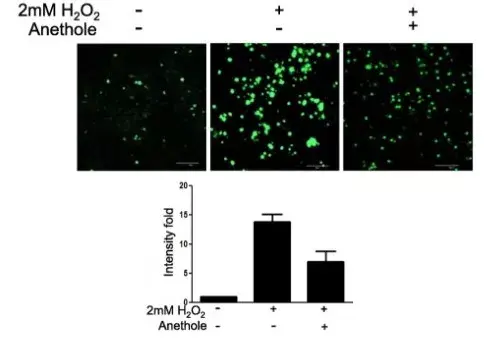
Effect of anethole on excessive ROS generation in hMSCs. hMSCs were exposed at 2 mM H2O2 for 30 min and incubated for 2 days in presence or absence of 50 μM anethole. ROS was measured by staining the cells with DCFDA cellular ROS detection assay kit according to the manufacturer's instructions. ROS generation was observed under a fluorescence microscope at 200× magnification.
Image from Rhee YH et al., BMC Cell Biol, 2018, 19: 12, Fig. 3B.; doi: 10.1186/s12860-018-0163-2 Reproduced under the Creative Commons license https://creativecommons.org/licenses/by/4.0/
Cellular Activity - DCFDA / H2DCFDA - Cellular ROS Assay Kit (ab113851)

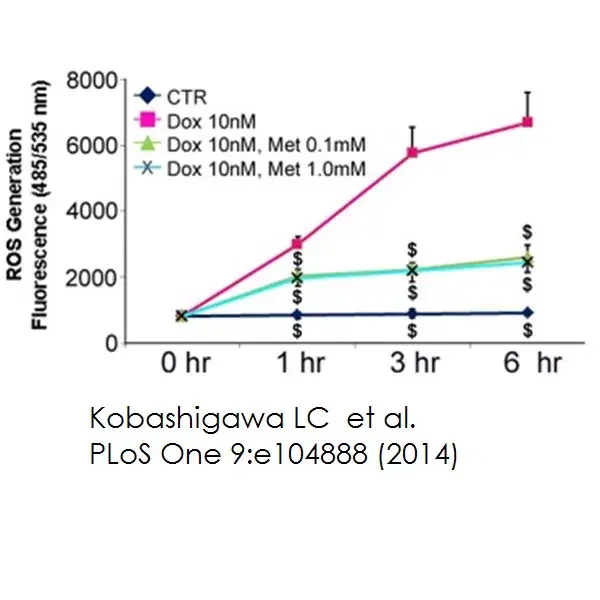
DCFDA ROS assay used to study Doxorubicin cardiotoxicity.
Kobashigawa et al. (Pubmed 25127116) used the DCFDA ROS assay ab113851 to investigate the causes of the protective effects of metformin (Met) treatment in Doxorubicin (Dox) induced cardiotoxicity.
They identified that in metformin treated H9c2 rat immortalized cardiomyoblasts, Met treatment reduced ROS levels induced by Dox (A). Values represent mean ± S.D. (n = 4).
In combination with other assays, they developed the hypothesis that Dox induces increased ROS expression, leading to increased calcium levels and cell death, and that Met reduces this effect by increasing AMPK expression.
Kobashigawa et al. (Pubmed 28056084)
Fluorescence Microscopy - DCFDA / H2DCFDA - Cellular ROS Assay Kit (ab113851)

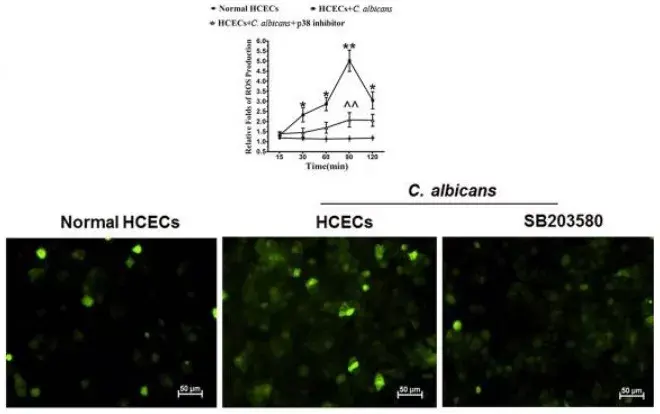
p38 MAPK pathway involved in oxidative injury to HCECs challenged with C. albicans.
p38 MAPK pathway involved in oxidative injury to HCECs challenged with C. albicans. Increased ROS generation in HCECs challenged with C. albicans and inhibition by the p38 activation inhibitor SB203580.
Image from Hua X et al., Sci Rep, 2017, 7: 10421, Fig. 4A.; doi: 10.1038/s41598-017-09636-w Reproduced under the Creative Commons license http://creativecommons.org/licenses/by/4.0/
Functional Studies - DCFDA / H2DCFDA - Cellular ROS Assay Kit (ab113851)

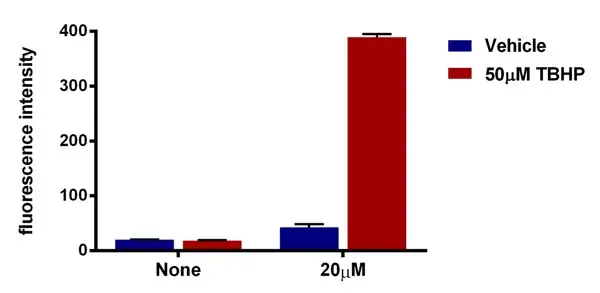
Jurkat cells were labeled with DCFDA (20 μM) or unlabeled (none) and then cultured an additional 3 hours with or without 50 μM tert-butyl hydrogen peroxide (TBHP) according to the protocol. Cells were then analyzed on a fluorescent plate reader. Mean +/- standard deviation is plotted for 4 replicates from each condition. TBHP mimics ROS activity to oxidize DCFDA to fluorescent DCF.
Functional Studies - DCFDA / H2DCFDA - Cellular ROS Assay Kit (ab113851)

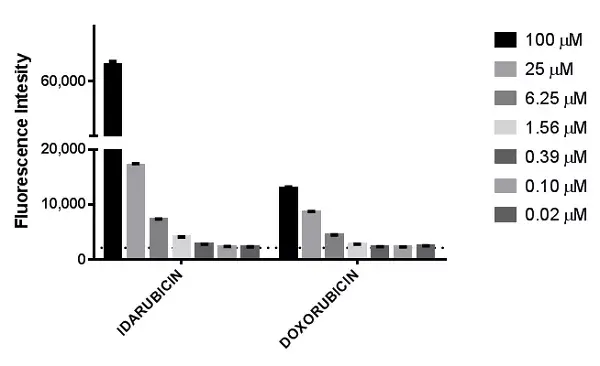
Acute Effect of anthracyclines on ROS production in HL60 cells.
Labeled HL60 cells were treated with idarubicin or doxorubicin for 4 hours at multiple doses according to the protocol. At the end of the treatment cells were read end point in a fluorescent plate reader (Perking Elmer-Wallac 1420 Victor 2 Multilabel plate reader). Mean +/- standard deviation is plotted for 3 replicates from each condition. The dotted line represents the mean of 24 replicates of HL60 cells treated with 0.5% DMSO.
Functional Studies - DCFDA / H2DCFDA - Cellular ROS Assay Kit (ab113851)

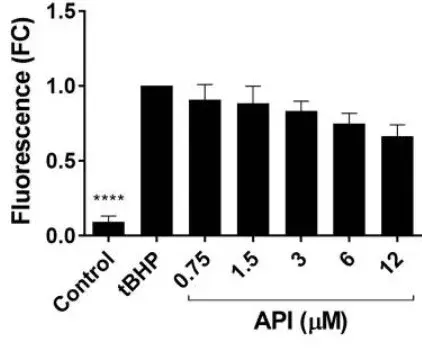
Reactive oxygen species (ROS) measured using the DCFDA assay in human primary articular chondrocytes. Cells were treated with 100 μM tert-butyl-hydroperoxide (tBHP) alone (4 h) ± pre-treatment with apigenin.
Image from Davidson et al., Sci Rep, 2018. Fig. 2B.; doi: 10.1038/s41598-018-35455-8 Reproduced under the Creative Commons license http://creativecommons.org/licenses/by/4.0/
Flow Cytometry - DCFDA / H2DCFDA - Cellular ROS Assay Kit (AB113851)

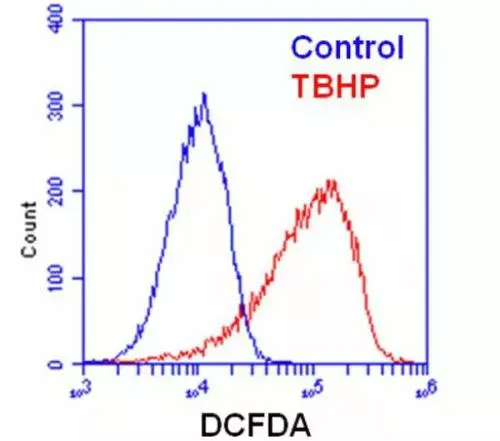
ab113851 (DCFDA) labeled and unlabeled Jurkat cells were treated with 50 μM tert-butyl Hydrogen Peroxide (tbHP), then analyzed by flow cytomet
Cellular Activity - DCFDA / H2DCFDA - Cellular ROS Assay Kit (AB113851)

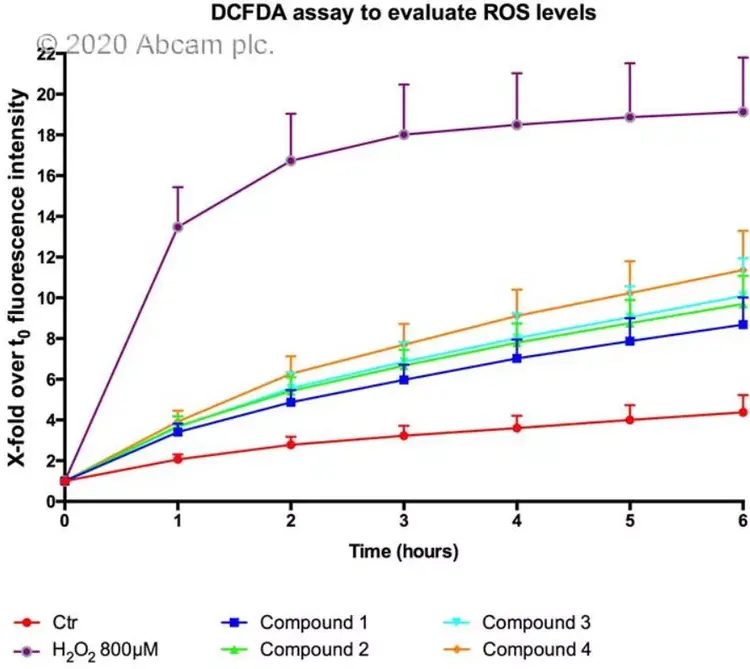
ROS levels analysis in human immortalized cardiomyocytes cells with ab113851 under different treatment conditions.
Data are mean ± SEM of three different experiments. H2O2 800μM was used as Positive Control. The values of fluorescence intensity at each time point are indicated as the ratio of the value at specific t-time point on the value at time point zero (first measurement) (t-time point/t0). Briefly, cells were plated (seeding density 2.5 x 10⁴ cells/cm2) in FBS-supplemented medium w/o phenol red onto a 96 black well plate. After 24 hours the cells were washed one time with 1X buffer (provided in the kit), then the cells were incubated with DFCDA 10 μM for 30 min at 37° C protected from light. Following incubation the wells were washed with PBS and the cells were exposed to treatments of interest in FBS-supplemented medium w/o phenol red. ROS production was determined immediately by measuring the formation of fluorescent dichloro fluorescein (DCF), using a PerkinElmer VICTOR3, at an Ex-485 and Em-535 nm. Measurements were done every 30 min for six hours. The value of fluorescence intensity at each time point is reported. The value reported was obtained by the ratio of fluorescence at specific time point on fluorescence at time 0, which was measured immediately after DCFDA incubation.
| Shipped At Conditions | Blue Ice |
| Appropriate Long term Storage Conditions | Store at -20°C. |
| CAS Number | 2044-85-1 |