End-to-end custom gRNAs and off-target control: From early CRISPR research to therapeutic development

CRISPR technologies continue to evolve rapidly, but translating research into reproducible, clinical-ready results takes careful design, validation and the right partners. In a recent webinar, Ashley Jacobi, Director of Applications & Market Development at Integrated DNA Technologies (IDT), shared how researchers can address precision, efficiency and scalability across their gene editing workflows.
We highlight key insights across smarter gRNA design, purification strategies and high-confidence off-target assessment.
Q1: What are the common challenges researchers face in their CRISPR-based custom gene editing workflows?
Designing a CRISPR-based gene therapy comes with several challenges, especially balancing editing efficiency with precision. Guide RNAs (gRNAs) must accurately target the desired gene while minimizing unintended edits. Performance depends on several factors, including the gRNA sequence and the accessibility of the target DNA within the cell. Off-target editing remains another key concern, as Cas9 can tolerate small mismatches. Researchers also face challenges with delivery methods, RNA stability and contamination, all of which can impact results and slow development.
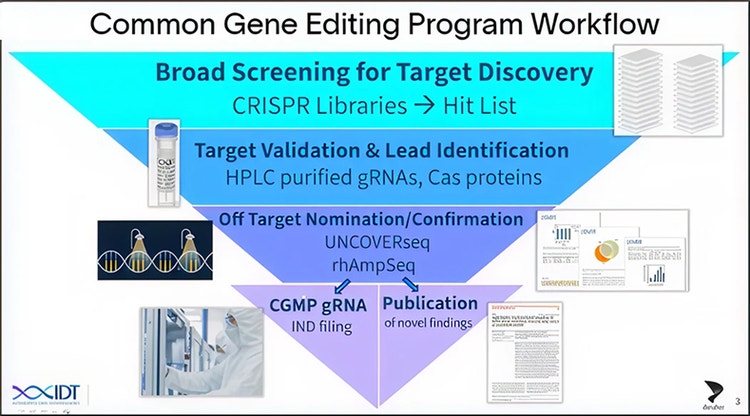
To address these issues, researchers need reliable tools for gRNA design, testing and validation across each stage of development, from target discovery to large-scale manufacturing. Partnering with experienced providers can help reduce risk and avoid costly setbacks later in development.
Q2: How can researchers improve precision during target discovery and gRNA design for CRISPR applications?
Precision starts with selecting the right targets and designing gRNAs that can edit them efficiently and accurately. High-throughput CRISPR screening helps researchers study gene function and identify promising targets, while also supporting the design of optimized gRNAs.
To achieve consistent results, researchers need workflows that combine design, testing and quality control. IDT’s ALT-R™ system brings these elements together, offering tools to improve editing efficiency while reducing off-target risk.
- The ability to design multiple gRNAs per gene to increase the likelihood of a successful edit
- Chemical modifications to improve stability and reduce immune responses
- Flexible formats to support a wide range of cell types, including difficult-to-transfect cells
For validation, our proprietary NGS technology rhAmpSeq™ uses targeted sequencing to measure editing outcomes with high accuracy. By reducing background noise and focusing on true edits, rhAmpSeq™ helps researchers clearly distinguish between artifacts, imprecise self-repairs and precise insertions.

We see a way to reduce off-target editing up to 100-fold
IDT | Alt-R HifFi Cas9 nuclease
Q3: What is the importance of high-fidelity purification and how are gRNAs analyzed to ensure high-quality performance downstream?
gRNA purity is critical for moving gene editing programs from early research to clinical development. As applications progress to more advanced studies, higher quality standards are required to ensure consistent, reliable results.
High-quality purification methods and accurate purity assessment are both important factors in HPLC-purified gRNAs. IDT has optimized HPLC purification methods specific to gRNAs up to 175 nt to achieve higher-purity gRNAs. Additionally, IDT has optimized a high-fidelity, ultra-high-performance liquid chromatography (UHPLC) method to assess the purity of RUO gRNAs accurately. This higher level of purity in HPLC-purified gRNAs translates into improved performance. For example, in primary human T cells, high-purity gRNAs show higher editing efficiency than screening-grade gRNAs, especially at lower doses.
By using HPLC-purified guides, researchers can achieve the same editing outcomes with lower doses, thereby reducing cellular toxicity and the risk of unwanted immune responses.
Q4: What is the most effective strategy for off-target assessment during CRISPR editing?
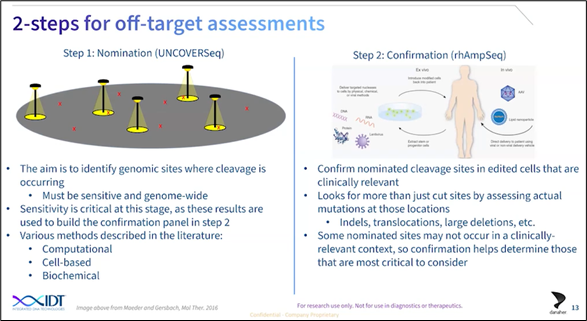
A reliable off-target assessment strategy combines two key steps: identifying potential off-target sites and confirming which ones are truly relevant.
The first step is nomination. Several techniques exist and researchers often combine multiple orthogonal approaches for identifying potential off-target sites:
- In silico tools that scan the genome for similar sequences
- In vitro methods that detect cutting preferences
- In cellulo approaches that reflect real cellular context
Computational tools scan the genome to find sequences similar to the target. Not all are accessible in cells, so we pair this with cell-based methods that detect actual editing sites. We use UNCOVERseq, an improved GUIDE-seq methodology, to help researchers better estimate off-target risks without overestimating.
The second step is confirmation. Targeted sequencing methods, such as rhAmpSeq™, are used to measure editing at the nominated sites with high sensitivity. The primer design minimizes background noise and eliminates misleading artifacts, enabling detection of rare but meaningful off‑target events.
Together, these two steps help researchers focus on meaningful off-target risks, avoid unnecessary optimization and increase confidence in the safety of their gene editing workflows.
Check out the full webinar to see how a coordinated, end‑to‑end approach to gRNA design, purity and off‑target analysis can help de‑risk CRISPR programs at every stage.